


Summary
- The Amazon’s ghost dog was extensively recorded by camera traps.
- The new study gathered 594 independent records.
- Evidence suggests the species may be more common than previously believed.
- Protected areas play a critical role in its survival.
One of the most mysterious animals of the Amazon has once again been recorded by camera traps, providing scientists with new information about a species that remains largely unknown.
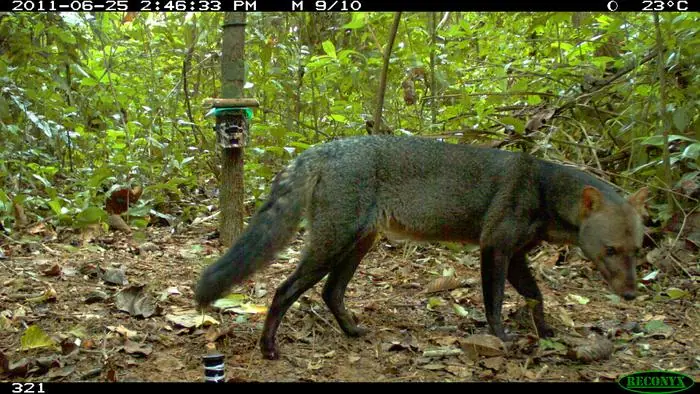
The Amazon’s “ghost dog” was the focus of a long-term study in Bolivia and Peru, with researchers gathering hundreds of records of the species. For decades, the animal was considered almost mythical because sightings were extremely rare.
The new study is particularly important because it concerns one of the least-studied canids in the world. Despite its reputation as a rare and elusive animal, the new data suggest it may be more widespread than previously believed.
An animal that avoids humans
The “ghost dog” lives in the dense tropical forests of the Amazon and is known for its secretive behavior. The very limited number of direct observations is due both to the remote habitats where it lives and to its highly developed senses.
The animal has a relatively large head, small rounded ears, short legs, and a dense coat ranging from dark gray to reddish brown. One of its most distinctive features is its partially webbed paws, which help it move efficiently through wetland environments.
The largest study ever conducted on the species
The study was based on nearly 25 years of monitoring using camera traps. Scientists carried out dozens of field expeditions in lowland forest regions of Bolivia and Peru, collecting a total of 594 independent records.
This represents the largest dataset ever assembled for the species. The findings suggest that its population may be larger than previous estimates, although it remains a rare animal.
Researchers estimate that some regions may support around 15 individuals per 100 square kilometers, a figure significantly higher than previously thought.
The role of protected areas
The research also showed that the species is recorded more frequently in protected areas and territories managed by Indigenous communities.
The finding reinforces the importance of conserving Amazon forests, which continue to face pressure from deforestation and other human activities. According to scientists, preserving these ecosystems is essential for the species’ long-term survival.
What we think
The story of the Amazon’s ghost dog highlights how much remains unknown even about large mammals on our planet. Despite modern technology and extensive scientific efforts, it took nearly 25 years of monitoring to gain a clearer understanding of the species. At the same time, the discovery underlines the importance of protected areas and Amazon forest conservation.
Frequently Asked Questions
What is the Amazon ghost dog?
It is a rare canid that lives in the Amazon rainforest and remains one of the least-studied species in the region.
How many records did the study collect?
Scientists gathered 594 independent records through camera traps.
In which countries was the study conducted?
The research was carried out mainly in Bolivia and Peru.
Why is it considered so rare?
It lives in remote Amazon habitats, avoids humans, and is extremely difficult to observe in the wild.