Summary
Curiosity recorded wispy clouds drifting through the Martian sky after sunset in a black-and-white sequence published by NASA on November 20, 2026.
The images were taken on October 31, 2026, during sol 5061 — the mission’s 5,061st Martian day. The rover was inside Gale Crater, which it has been exploring since 2012.
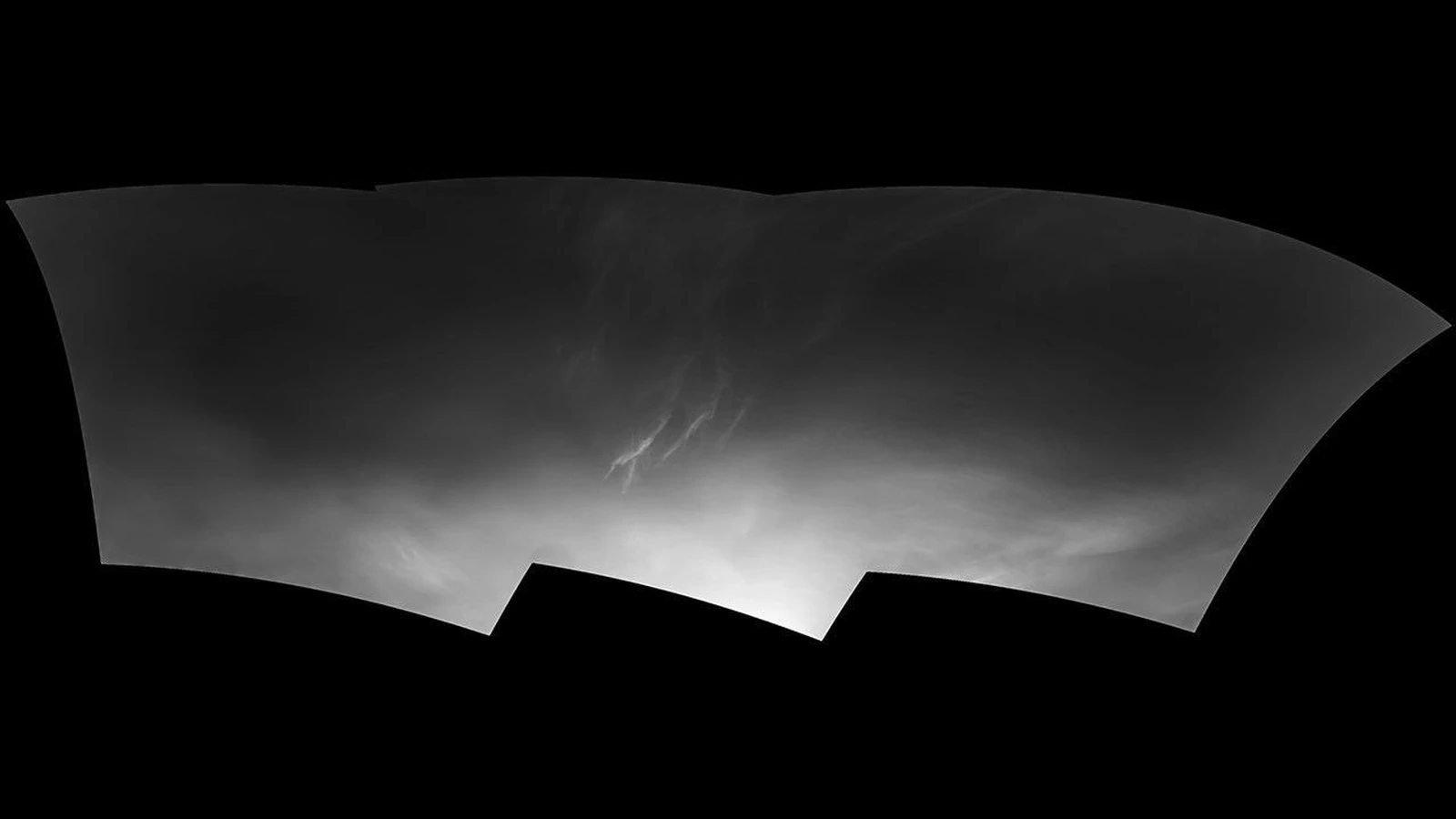
Clouds that remain visible after sunset
NASA calls these formations “twilight clouds.” They appear only briefly during each Martian autumn over Gale Crater. Even after sunlight has faded at ground level, higher clouds can still catch the Sun’s rays.
Mars has a far thinner atmosphere than Earth, but it still supports clouds and complex lighting conditions. The shifting colors of the Martian sky at sunset are linked to sunlight scattering through fine atmospheric dust. This latest sequence instead records cloud movement in monochrome.
How Curiosity recorded the sequence
Curiosity used its navigation cameras, or Navcams, which capture black-and-white images. NASA offers the sequence as a 2.59 MB animated GIF under image ID PIA26805. The still image shows the clouds’ delicate bright shapes; the animation reveals how they drift over time.
This is not Curiosity’s first twilight-cloud observation. The rover has photographed these clouds during earlier Martian years. In a 2025 release, NASA identified higher carbon-dioxide-ice clouds and lower water-ice clouds, but the 2026 PIA26805 release does not identify the composition of these particular clouds.
The rover’s photography also extends well beyond the sky. In August it captured distant wind-sculpted cliffs on Mars with Mastcam. The photographic difference is striking: the earlier panorama drew its story from surface detail, while this observation is about a scene changing over time.
What we think
A single frame can already show us how unfamiliar the sky of another planet can look. But put the frames in sequence and you gain something a still cannot convey: motion. It is the same difference photographers see when they turn an ordinary cloud study into a timelapse here on Earth.
What stands out is that Navcams, designed first and foremost to help the rover navigate, can also tell such a strong visual story. There is no need for vivid colors or a dramatic landscape in the foreground. Those fine glowing streaks against a nearly black sky carry the image.
We would have liked the complete animation to be more prominent alongside the still. Movement is central to this story, and seeing it changes how you read the scene.
Frequently asked questions
When were these clouds recorded?
On October 31, 2026, during Curiosity sol 5061. NASA added PIA26805 to Photojournal on November 20, 2026.
Why are the clouds visible after sunset?
Higher clouds can remain illuminated by sunlight after the surface has entered twilight.
Do scientists know what these particular clouds are made of?
The PIA26805 release does not specify their composition. Earlier Curiosity observations have identified both water-ice and carbon-dioxide-ice clouds.