Summary
- NASA selected a photograph by Apostolos Kyriazis as its Astronomy Picture of the Day on November 20, 2026.
- Light-painted dots and dashes spell V-G-R in Morse code.
- The image celebrates Voyager 1 reaching a distance of one light-day.
- Kyriazis recently spoke in depth about his relationship with astrophotography.
NASA selected a photograph by Greek astrophotographer Apostolos Kyriazis for its November 20, 2026 Astronomy Picture of the Day, showing a sequence of luminous dots and dashes spelling out a message for Voyager 1.
Titled “V-G-R”, the image was made at the Emirates Astronomical Observatory in the United Arab Emirates, linking long-exposure photography to a historic milestone in the spacecraft’s journey.
What do the streaks of light in the sky mean?
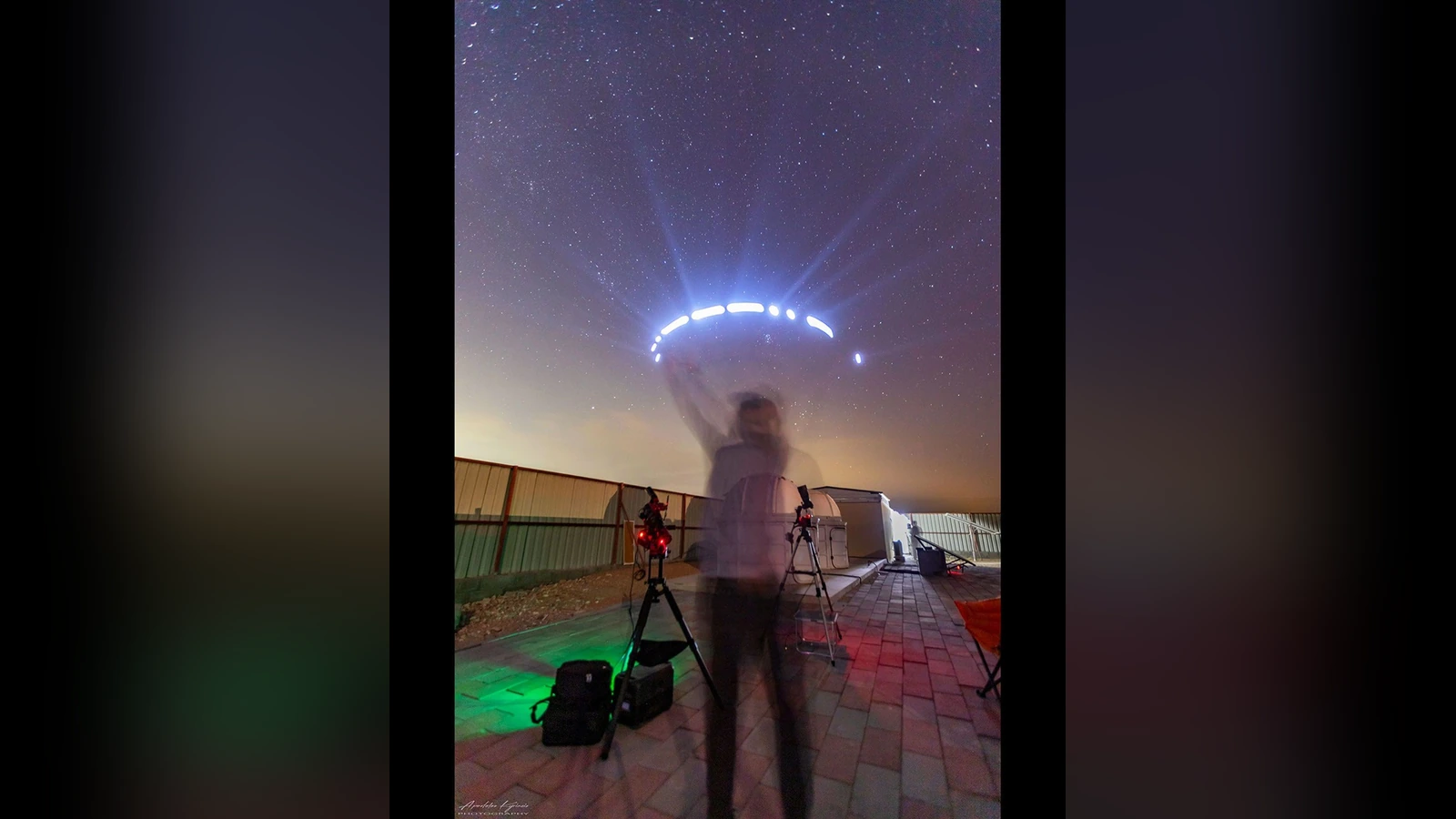
The arc of light is neither a meteor trail nor a satellite track. On November 17, as part of NASA’s “Shine Bright for Voyager’s Light-Day” initiative, participants traced Morse code across the night sky. A flashlight was switched on and off as a long exposure recorded its movement.
The dots and dashes read “V-G-R”, a call sign used for Voyager 1. The human figure, tripods and observatory dome give the composition a sense of scale, set against a star-filled sky.
Voyager 1 reaches a distance of one light-day
The photograph marks a milestone reached on November 18, 2026, at 10:16:07 UTC: Voyager 1 had reached a distance of one light-day from Earth. In practical terms, a light or radio signal takes roughly 24 hours to cover the distance to the spacecraft.
Launched in 1977, Voyager 1 continues to travel through interstellar space, around 26 billion kilometres away according to NASA’s figures for that date. Kyriazis’s photograph is a visual salute to the spacecraft, not evidence that the flashlight sent a message to its onboard systems.
The Voyager vidicon cameras, which photographed the outer planets and produced images including the iconic “Pale Blue Dot”, have been switched off for decades. The spacecraft continue collecting scientific data with other instruments.
Apostolos Kyriazis and the night sky
Apostolos Kyriazis is an architect, academic and astrophotographer based in Abu Dhabi. In an interview with PTTL, he discussed the patience behind night photography, the preparation each outing requires and the importance of honesty in creating images. Read our full interview with Apostolos Kyriazis about astrophotography and architecture.
In October, he was also among the recognized photographers in Astronomy Magazine’s 2026 astrophotography competition, earning runner-up honours in the Nightscapes category for an image of a total lunar eclipse above dunes south of Abu Dhabi. NASA’s latest selection features a different work.
What we think
What makes this photograph memorable goes beyond its selection by NASA. It takes a straightforward technique —switching a flashlight on and off during a long exposure— and turns it into a way of talking about a distance that is almost impossible to picture.
Keeping a person in the frame matters too. Voyager 1 is already beyond the heliosphere, but the photograph keeps us on Earth, at an observatory beneath the night sky we all share. For photographers, it is a reminder that a strong concept and a well-told story can give a simple technique real impact.