Summary
- Apostolos Kyriazis discusses the relationship between architecture, photography and astrophotography.
- He describes a prize-winning total lunar eclipse photograph and his desert panoramas.
- He explains his shooting techniques, views on editing and experience of light pollution.
- He also shares personal moments and advice for new photographers.
Apostolos Kyriazis moves between architecture and the night sky, making photographs from the Arabian desert to the mountains of Greece.
Following his recognition in Astronomy Magazine’s 2026 astrophotography competition, he talks to PTTL about making panoramas, the demands of a total lunar eclipse and why our relationship with darkness matters.
The interview
Apostolos, let’s start by getting to know you better. You’re an architect and academic based in Abu Dhabi. How did photography enter your life, and when did it become such an important part of it?
My first encounter with photography was with an Agfamatic Pocket Camera! My father, Dimitris, taught me the basics. He was a very active amateur photographer. He still has two old Minoltas, and we used to develop film together in our home darkroom. I imagine our family trips also played a part. Around the same time, when I was in high school, I got into astronomy through Carl Sagan’s magical documentary series Cosmos and acquired an old Russian reflecting telescope for my first observations. Since then I’ve been a founding member of two amateur astronomy societies in Greece, in Volos and Thessaloniki.
Photography has always accompanied my architecture. When I returned to academia in 2015, I began using it for my lectures as well as for astrophotography. Since then, I’ve gone deeper into architectural photography as a professional and research activity, while astrophotography remains a hobby. I’ve published two books of my own featuring architectural photography, contributed material to five other books, presented several papers at academic conferences and taken part in many group exhibitions. More recently, I began teaching an Architectural Photography course in my school’s architecture programme. I’ve also had the honour of inviting many well-known photographers, including Greeks, to give talks.
My interest in astronomy developed alongside all the equipment that comes with it. I’m a founding member of another society, the UAE Astronomy Group, with our own observatory 100 kilometres south of the city. I’ve received several distinctions for my astrophotographs, but none of that compares with a night spent lost among the dunes.
How has your architectural education influenced the way you see and compose a photograph? Are there shared principles between designing a space and making a photographic image?
That’s the central subject of my Architectural Photography course! As architects, we’re trained not only in aesthetics but above all in composition, leading lines, perspective, colour theory, form and even social questions through the design of public spaces and cities. That gives us a slight advantage, especially in architectural photography: how we read space, light, shapes, proportions, solid and empty areas, symmetries and so on.
Unfortunately, I’ve also begun to see the reverse: architects designing buildings to create ‘Instagrammable’ views. That’s a huge mistake, a trade-off of substance for an image’s popularity.
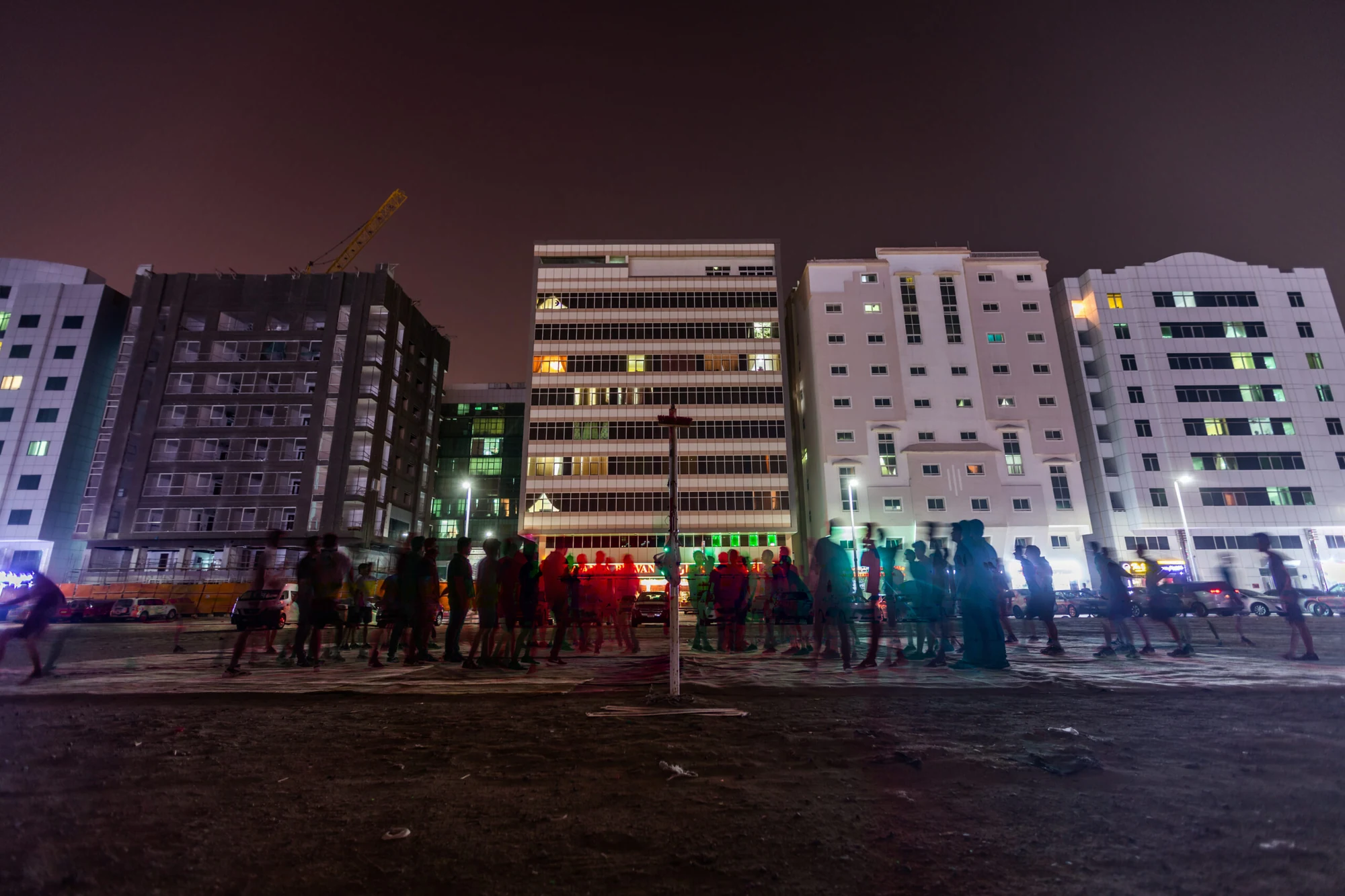
Personally, I prefer minimal editing. I want an ethical approach, showing a building’s context, including neighbouring buildings, in the panoramic images I enjoy taking, rather than isolating and idealising it. I also like photographing public space with slightly longer exposures, filling it with human figures while concentrating on movement, flow and behaviour. I’ve researched this subject and produced a book on the public spaces of the city where I live.
As for principles shared by architecture and photography, I’d name two. First, people. Second, light. Two giants of architecture, Louis Kahn and Jean Nouvel, have described light as a fundamental building block of architecture. Its relationship with photography is existential.
Kyriazis A., Chaveneau C., Dubucs H. (2021), Abu Dhabi public spaces: Urban encounters, social diversity and (in)formality. Abu Dhabi: Motivate. ISBN 978-1-86063-525-0. Book information.
What drew you to astrophotography? Do you remember a particular night or photograph that made you pursue the night sky more seriously?
As I mentioned, I entered the world of astronomy towards the end of middle school and the beginning of high school through Carl Sagan’s magical Cosmos series, then got an old Russian reflecting telescope for my first observations. I would go up to the roof of our apartment building in Volos, or to the Pelion ski resort with other amateur astronomers. In my second year of high school, I came second for Greece in a Europe-wide ESO competition. The first prize winner travelled to the major telescopes in Chile’s Atacama Desert. I won a T-shirt and a documentary about the second most famous supernova in our sky. I was even more excited about that.
When I moved to the Emirates, I remember my first night in the desert with two good friends and colleagues from Syria and Egypt. As they played violin and guitar to songs by Umm Kulthum, I took my first photograph of the Milky Way with a small APS-C Canon 100D.
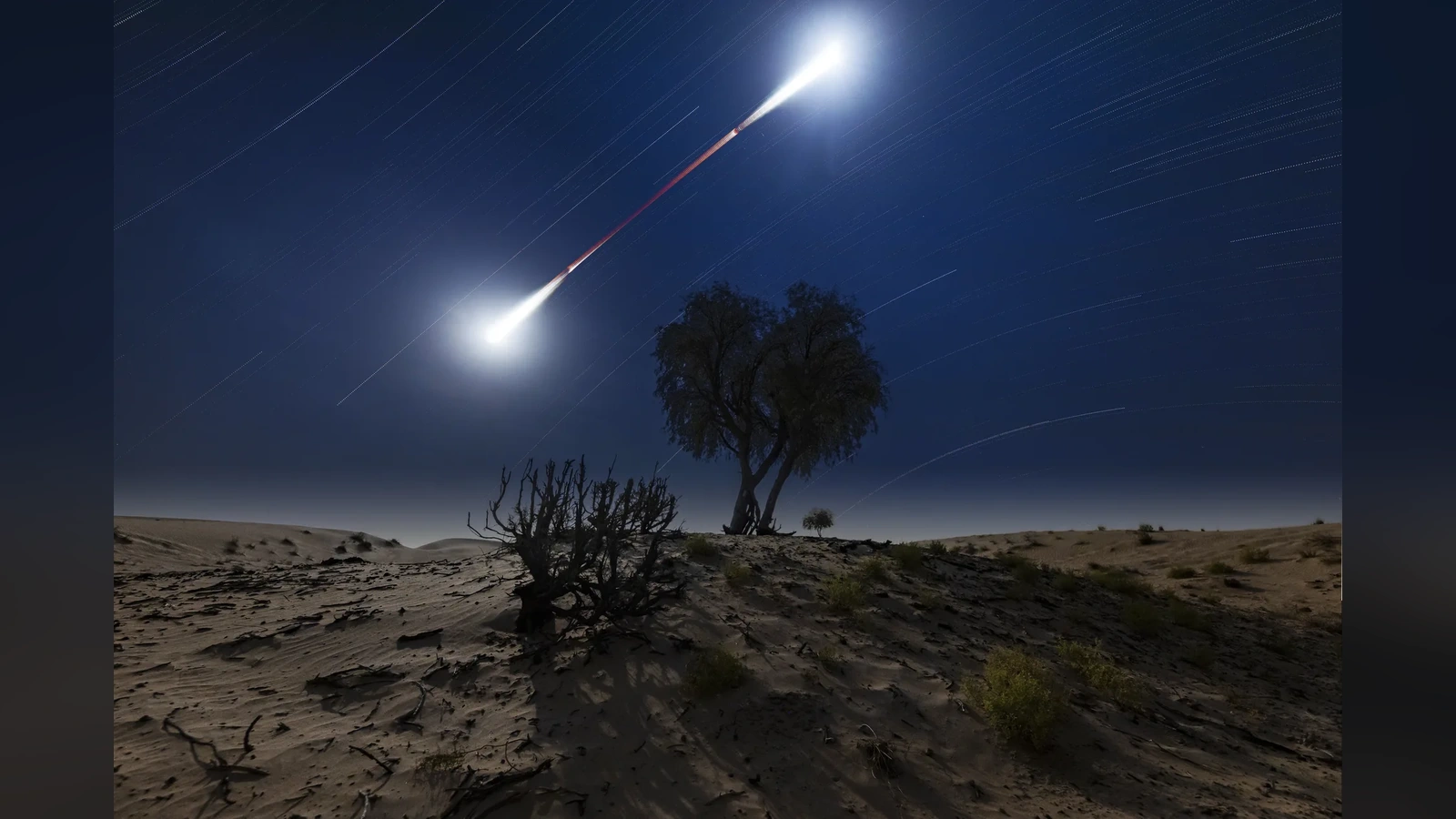
In Astronomy Magazine’s 2026 astrophotography competition, you were a runner-up in the Nightscapes category with an image of a total lunar eclipse over dunes south of Abu Dhabi. What’s the story behind that photograph?
In astrophotography, the organisations, institutions and companies that run competitions are fairly specific, and the competition is enormous. When I saw Astronomy Magazine’s announcement, I was surprised, mainly because it was the magazine I’d bought every month in high school and used to learn how to find my way around the sky. With that emotional connection, I had to enter.
I submitted three images. I received a reply about this particular one, and I was genuinely happy because it was different.
How did you prepare to photograph that eclipse? How important were location, framing and timing, given that an astronomical event leaves little room for a second attempt?
Astronomers hate the Moon because its bright light hides the other stars and ruins photographs of nebulae. But I was determined to photograph it on those days, because I knew the eclipse was coming.
I don’t personally use apps that overlay celestial targets on the landscape in front of you. I know my sky very well. I knew where the full Moon would rise, at what time and how it would travel across the sky. I knew I had roughly an hour before the eclipse’s first phase began, so I could experiment. I went to a favourite spot in the desert, walked 300 metres across the dunes to the tree you can see in the photograph — one I’d photographed before and therefore knew — and left two cameras recording throughout the night. I chose to photograph the tree from a low angle, partly to capture the Moon’s entire movement and partly to include the texture of the sand in the foreground.
I checked the first frame, adjusted the exposure and framing, and before heading back to the car I simply made sure the remote was locked and working.
What were the biggest technical challenges of photographing the eclipse, and what equipment did you use? Can you walk us through the processing that led to the final image?
The enormous brightness difference between the full Moon and the eclipsed Moon almost ruined the whole session. I didn’t have an automatic exposure controller available, only a simple remote. In the end, I photographed the entire eclipse: around 400 exposures of three seconds each, with 30-second gaps between them — hence the little dots in the star trails — at f/7.1 and ISO 800.
I used a Canon EOS Ra, modified for full-spectrum capture, and a Sigma Art 14mm EF f/1.8, with the necessary EF/RF adapter and a Hot Mirror filter to counteract the full-spectrum modification.
For the final image, I used 388 frames, after processing them in Lightroom, with the excellent free program StarStaX. At the height of the eclipse, the foreground — the tree and desert — is completely invisible: darkness. But the software had already read the brighter frames. In the end I edited the image only minimally, adding the foreground from the initial test frame, as the tree’s shadow confirms.
You also won Silver and Bronze distinctions at the 2026 Epson International Pano Awards. Which images were recognised, where did you make them and what makes each special to you?
I enter these awards every year, and I regard them as excellent in quality and highly competitive. They suit me, too, because they’re dedicated to panoramic photography.
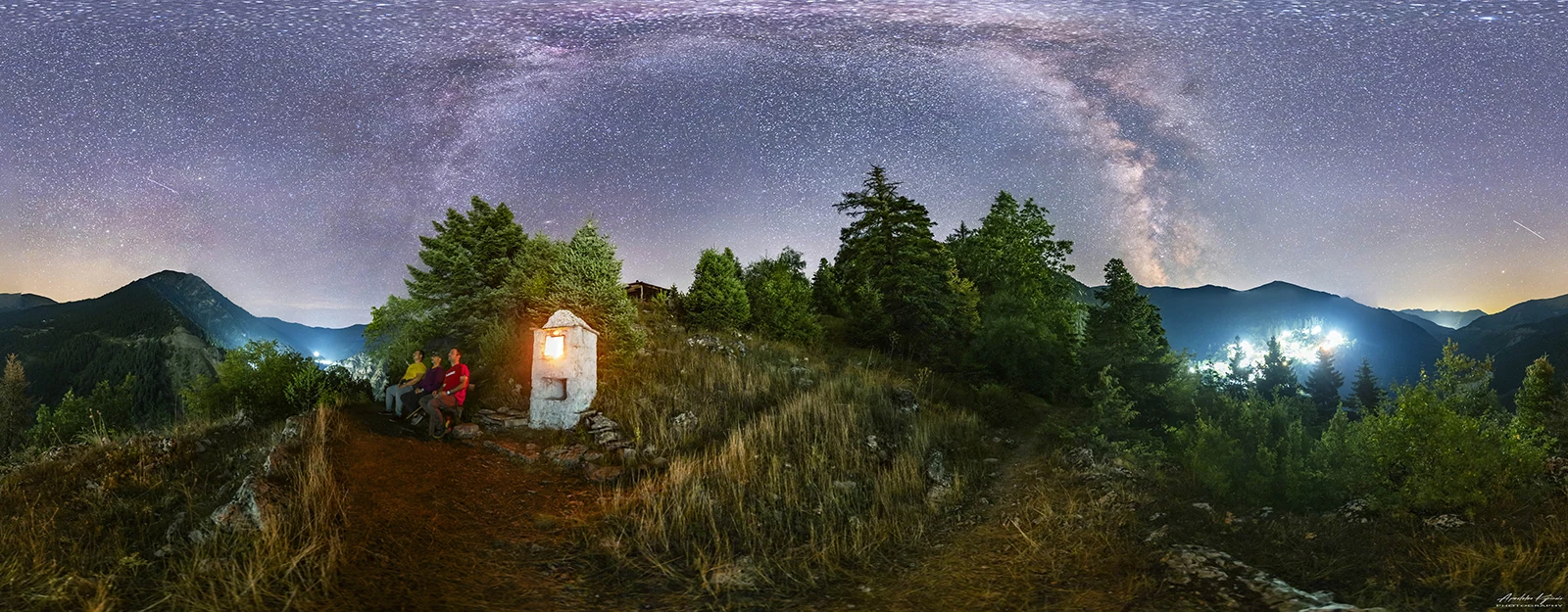
This year, I entered seven images and earned four distinctions: one Silver and three Bronze. Three were nightscape astrophotographs: two taken in the Rub Al Khali desert south of Abu Dhabi and one in the Pindus mountains, in my village of Tyfloseli, Trikala. The fourth was an architectural photograph of the new National Museum of the UAE in Abu Dhabi, designed by Norman Foster.
The three astrophotographs are particularly special to me because each was connected with a wonderful, unique night. For one, I walked two kilometres through the dunes at sunset to find a group of seven trees I’d noticed in a satellite photograph, truly in the middle of nowhere.
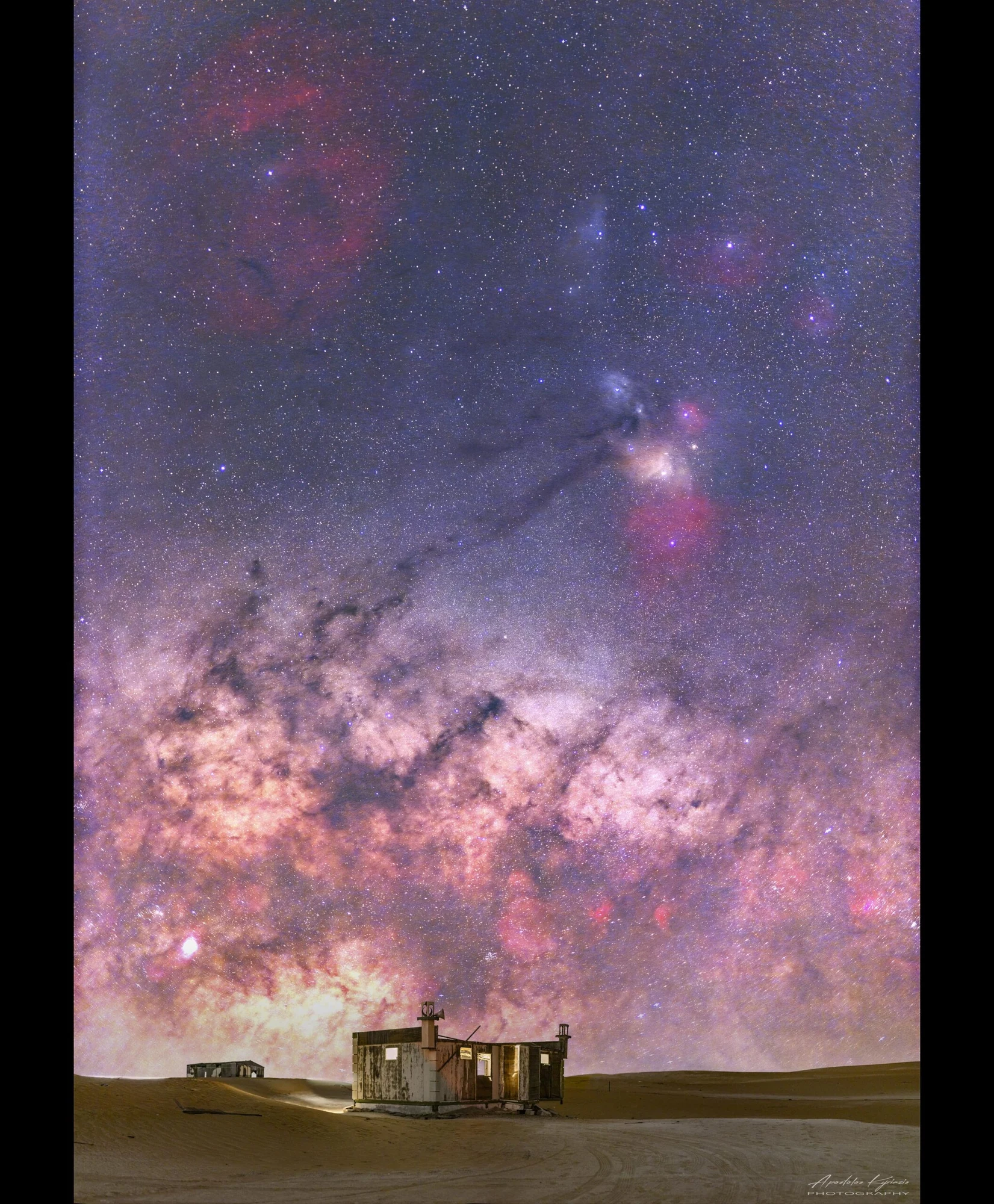
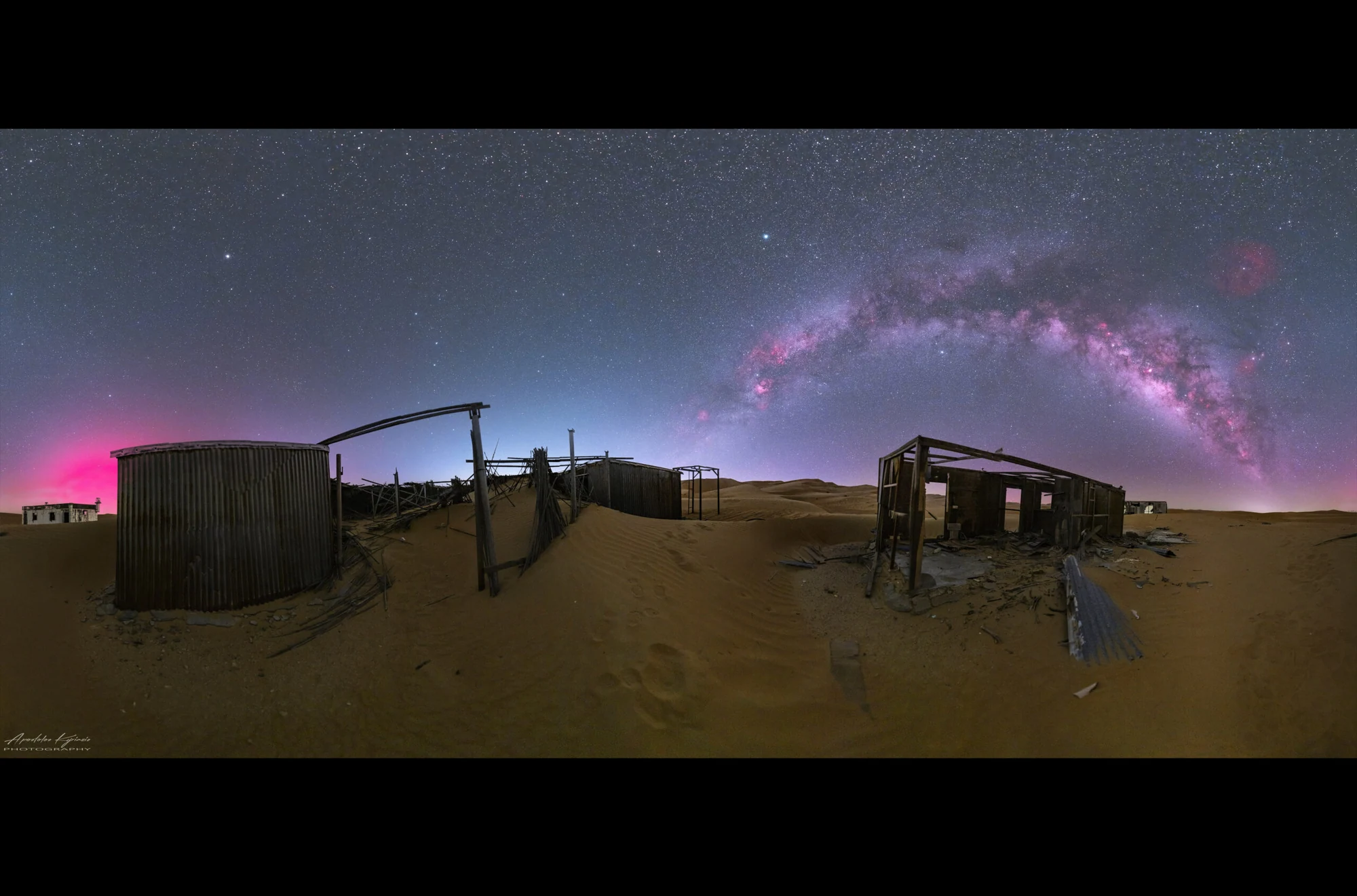
One of the photographs you sent us shows the Milky Way and red nebulae above the desert. How did you create it, and what techniques helped you capture so much detail in the sky?
It’s a 360-degree panorama made using blending. I had the Canon Ra and Sigma Art 14mm EF f/1.8 on a Sirui tripod, and I walked 100 metres from the car in search of a beautiful dune, without footprints or tyre tracks, with interesting geometry. When I found the right spot, I set up the tripod, mounted the camera vertically with an L-shaped tripod bracket and photographed two horizontal rows of eight frames each, simply rotating the tripod head, to cover the entire circle. I started with the upper row to focus on the stars, theoretically at infinity: 80% sky and 20% ground. Then I shot the lower row.
After that I walked back to the car, where I had my telescope, and mounted the same camera and lens on a tripod with a special equatorial tracking motor, the iOptron SkyGuider Pro. It turns the camera against the Earth’s rotation, allowing long exposures of celestial targets. I aligned it with the pole star — which takes me one or two minutes — and then, with the camera still in portrait orientation, made another eight frames of the sky alone.
The sky requires different settings. These nebulae are invisible to the naked eye and need quite long exposures to reveal themselves. I used the full-spectrum Canon Ra and Sigma Art 14mm EF f/1.8, with 180-second exposures at f/2 and ISO 6400, plus an IDAS NBZ-II DRE filter for ionised hydrogen and oxygen.
Once I’d captured all the frames, I converted them to TIFF in Lightroom, stitched them with PTGui and processed the result in Photoshop.
From left to right in the image you can see the Andromeda Galaxy, Perseus, the Pleiades at the top, Orion with his red cloak, blue Sirius below and finally the enormous Gum 1 nebula in the southern constellation Vela. Jupiter stands in the centre beneath our galaxy, while a diagonal beam of light is the famous zodiacal light.
Your award-winning work ranges from astrophotography and natural landscapes to black-and-white architectural photography. What draws you to these different genres, and what connects them in your personal style?
They might be connected, or they might not. The competition had separate categories, after all. But both genres are part of who I am.
In architectural photography, I emphasise contrast in black and white to bring out buildings’ forms, dynamic lines and structures in the clouds. Like nebulae…
I believe the two genres meet through human scale and human vanity. The sky teaches you humility and patience. It shows you how small you are. Architecture shows you how to express that down here on Earth.
Panoramic photography often demands careful planning and substantial post-processing. How do you approach a panorama, from choosing the location and equipment to stitching the frames together?
It’s true that technology has developed enormously. I used to print photographs in the standard 10 × 15 cm format and arrange them as collages. Today, with the software available, you make sure adjacent frames have good overlap — about one fifth of the image width — similar settings and… imagination.
I look at the space around me and imagine myself turning with the camera, as if dancing. I work with the geometry of the space. A key building or a tree will sit at the centre.
Then I make sure the tripod and camera are level, vertically or horizontally. If they’re tilted, I’ll lose a substantial part of the image during stitching.
Living in the United Arab Emirates gives you access to extraordinary desert landscapes. What does this environment offer you photographically, and what challenges do you face when shooting there at night?
This is the Rub Al Khali — the Empty Quarter — the world’s largest continuous sand desert. The Liwa area in particular has the world’s second-highest dunes after Namibia. Large parts of Star Wars and Dune were filmed here.
However monotonous it may look, it’s the exact opposite. It’s constantly changing, moving. I search for isolated trees, alive or sun-scorched, and for beautiful untouched curves.
The dangers? Heat. You don’t go near it in summer. Nighttime is only just bearable, when temperatures rarely fall below 40°C and cameras suffer from considerable thermal noise. ‘Winter’ is magical.
Wildlife is another factor. It’s hidden, but it’s there, and apart from the camels it’s nocturnal: fennec foxes, gazelles, white hares, little mice, as well as vipers, lizards, camel spiders and, of course, yellow, almost invisible scorpions. So far I’ve encountered everything except the vipers.
You’ve also photographed the night sky in Greece. Which Greek locations do you find especially rewarding for astrophotography, and how do their conditions compare with those of the Arabian desert?
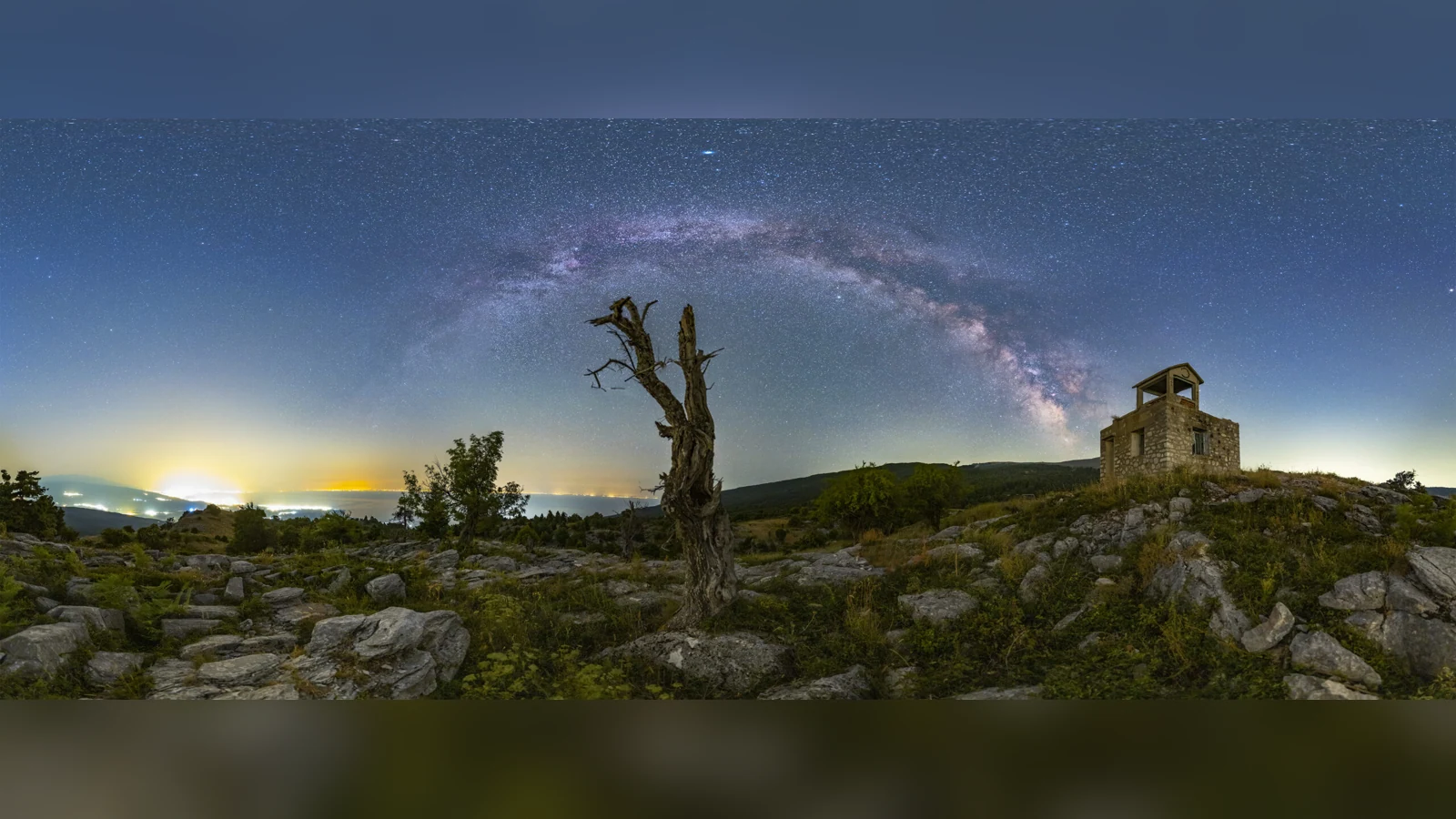
The Greek mountains are wonderful. Magical. So is the coastline. The Greek landscape is unique because of its scale.
I come to Greece every summer and photograph Pelion, Aspropotamos in the Pindus mountains and Kissavos. I love the Thessalian plain. It offers many subjects worth photographing. I also spent a few days on Lemnos this year. Its landscape enchanted us.
There are two main differences from the UAE. First, the roads. In Greece, forest roads provide almost endless access to wonderful landscapes. In the UAE, you don’t have that freedom, not even in its mountains.
Second, the atmosphere — the air. In the UAE, it is full of sand, dust and humidity. When the wind blows in the desert, you simply head home. And because of the lack of topographic barriers, the lights of major cities travel far. In Greece the air is clearer, cleaner and there’s less light pollution.
However, the UAE is farther south, near the Tropic of Cancer, allowing me to see constellations that are invisible from Greece.
What photography equipment do you use today for astrophotography and panoramas? Are there particular cameras, lenses, trackers or other tools that matter most to your work?
I’ve already mentioned them: a Canon Ra modified for full-spectrum capture; the wonderful Sigma Art EF series — 14mm f/1.8, 50mm f/1.4 and 135mm f/1.8; an EF/RF adapter with a filter slot; Hot Mirror filters for normal imaging and H-alpha and OIII filters for nebulae; a Sirui tripod and head for panning in ordinary panoramas; and an iOptron equatorial tracking motor for longer nebula exposures.
When travelling, I use an even smaller tracker, the MSM Nomad, which I recommend. And, of course, a remote control.
How crucial is processing in astrophotography? Where do you personally draw the line between revealing genuine captured detail and excessive manipulation that changes an image?
A difficult question. Processing is everything.
The issue is partly subjective — many people overdo particular colours or details — and partly objective. Personally, I’d rather lose out on some of that and gain a flawless image without noise.
And, of course, I favour an ethical and transparent approach from photographers. Very often, people show images combining skies and landscapes from different places, days and orientations.
AI has also changed the field. There are profiles circulating obviously fake pictures of the sky that attract huge numbers of approving followers simply because people don’t know what they’re looking at. That has consequences for the credibility of an image and for the truth.
Light pollution is an increasing problem for night-sky photographers. How has it affected your outings, and what needs to change in how we illuminate cities and public spaces?
Light pollution has affected me considerably, because I have to drive farther and farther to find something so basic.
More than once, an otherwise excellent night has been spoiled by a very bright horizon, or by groups of tourists who bring floodlights into the desert to have a barbecue as if they were at home!
Light pollution affects our telescopes — we need more exposure time for the same target — and the local wildlife. In cities it also affects people, their biological rhythms and, by extension, their physical and mental health. There’s a substantial body of research into first-generation LED lights and the damage they caused to wildlife. I believe education is the key to ending the demonisation of the night.
You’ve entered international photography competitions for many years. What do awards mean to you, and how important is entering competitions to a photographer’s development?
Without wanting to sound arrogant, it feels good. It’s a small reward, but far less important than others: the moment you’re out in the field, being with friends on a mountain, or the adventure you’ve had and can later recount.
For me, having work shown in an exhibition or a book is much more important, because of the interaction with people and the feelings it creates in viewers.
As an academic, you work with young people every day. Do you use photography in your teaching, and can a photographic way of seeing help young architects understand space and their environment?
Yes, I use my own photographs in my lectures extensively — almost relentlessly! I use them to describe landscapes, buildings and public spaces, and also the memories they contain. My ‘photographic memory’ lets me recall the precise location and conditions of any photograph I’ve made.
Photography and cinema have helped architects enormously in their work, as well as the social environment around us. Photography can teach us a great deal about light, darkness, chance, time, human relationships, materials and their textures. So it can contribute greatly to an architect’s way of seeing.
I’m proud that my Architectural Photography course in the university’s BA Architecture programme received glowing comments from RIBA, the Royal Institute of British Architects, the body that has accredited our programme. It was described as a course that gives character to the whole school. It’s the graduating students’ favourite subject!
Modern digital cameras, smart telescopes and editing software have made astrophotography more accessible. How do you see this development, and what still separates a truly good photograph from one that is merely technically impressive?
Knowledge of the landscape, sky, moment and night. If you can’t communicate that magic, either through the photograph or your words, you’re only technically competent.
I know people who use automated telescopes remotely over the internet, from thousands of kilometres away, to produce perfect nebula images. Yet when they look at the actual sky, they can’t tell east from west.
Patience matters. Astrophotography takes a lot of time, many sleepless nights and many kilometres. But it rewards you. And, of course, luck. I’m not very lucky, especially with meteor showers.
What would you advise someone starting astrophotography today on a limited budget? What equipment would they need, and which mistakes should they avoid?
An ordinary, standard camera body with a really good fast lens and a tripod is enough to get started. No rushing, no extra gear.
Learn the basics. Photograph and understand the sky. Understand what you’re seeing and how it changes with the seasons. Learn to love the Earth and think of it as one enormous spaceship.
Looking back on your photography, is there a particular image that means a great deal to you personally, regardless of whether it has won an award? What makes it special?
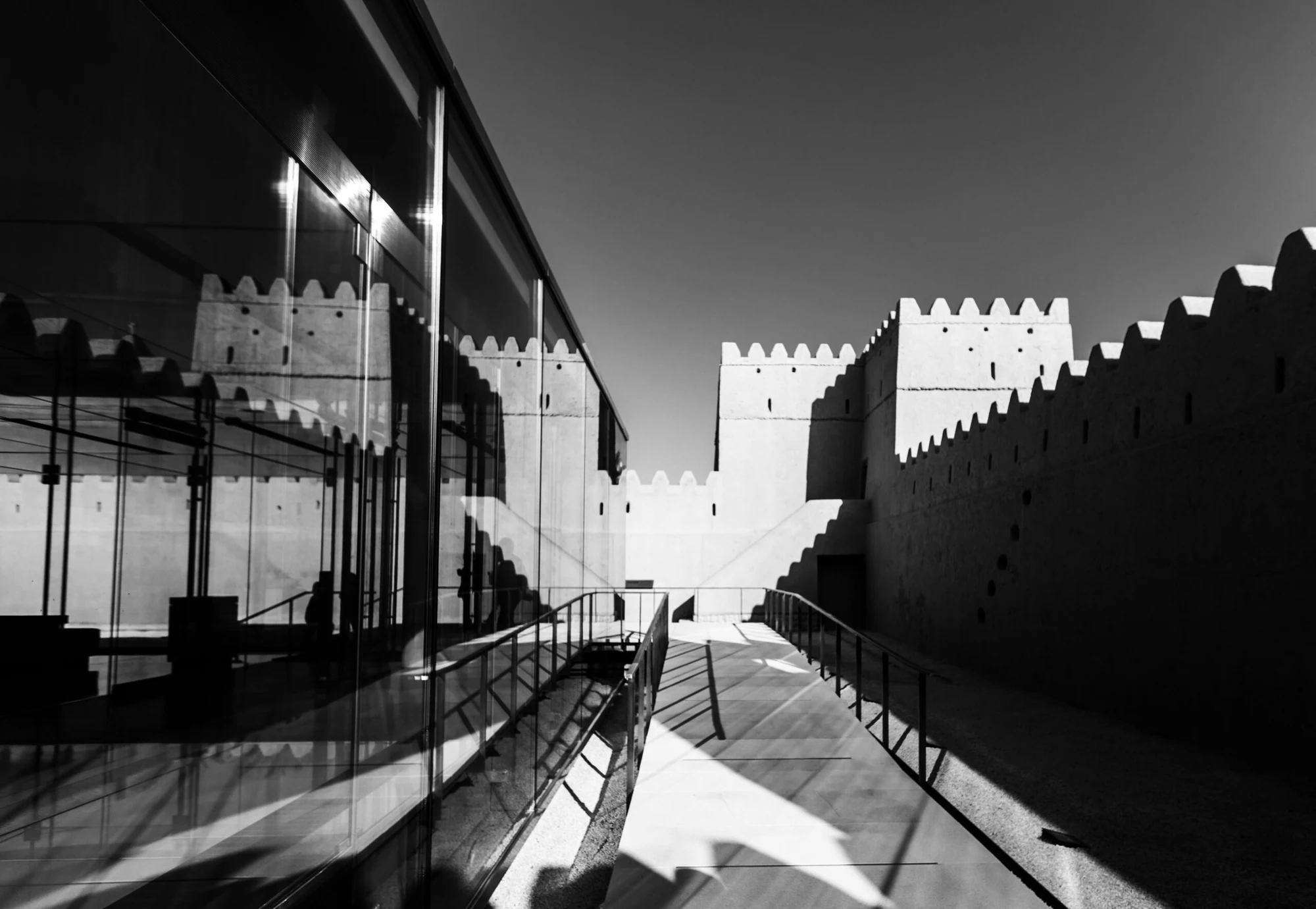
Good question. Of the award-winning images, I’d choose a black-and-white photograph of the Arabian fort Qasr Al Muwaiji, in Al Ain in the UAE.
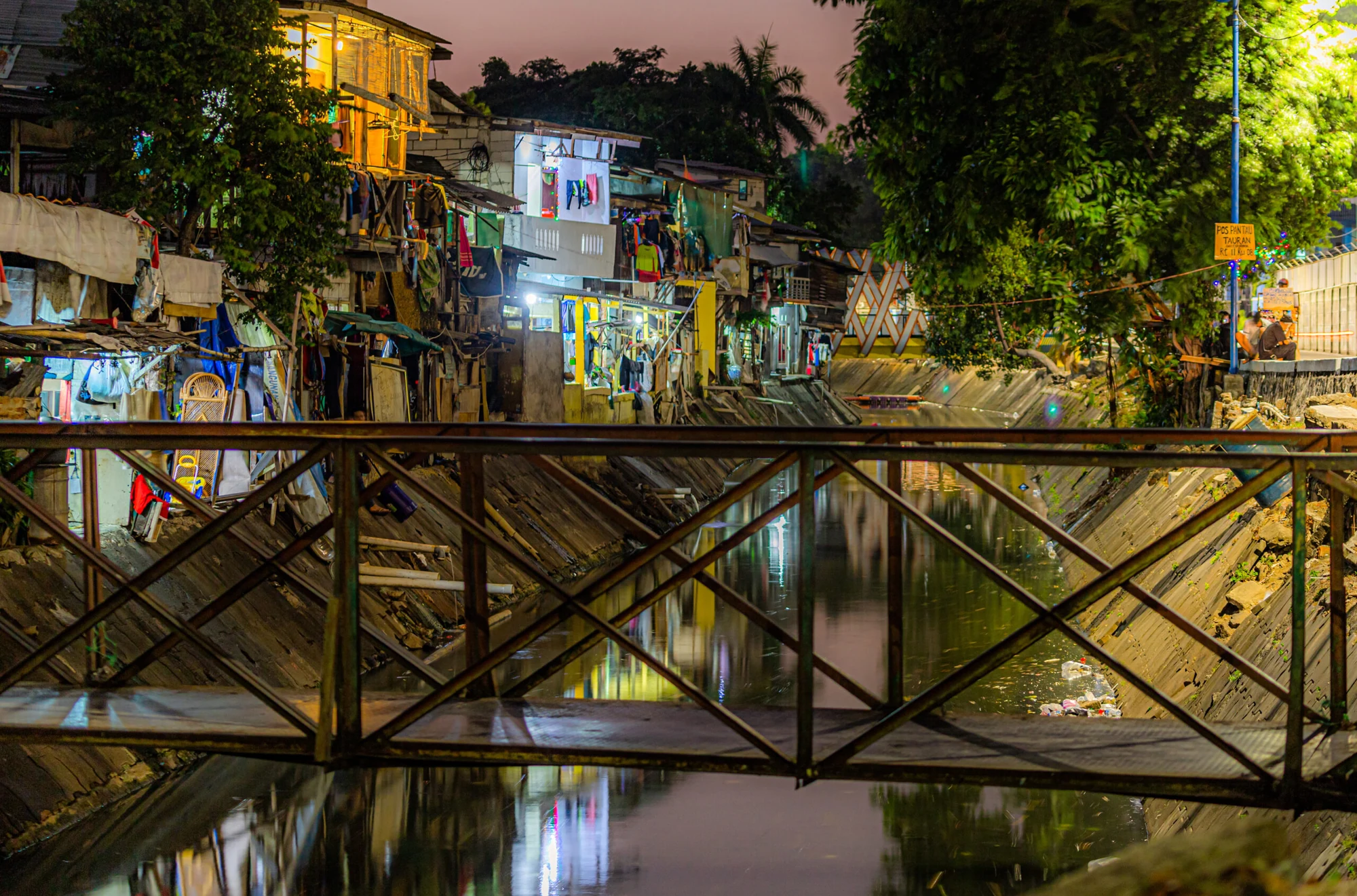
Among ordinary photographs, there are many. Most are portraits of people I love. I’ll mention two. The first is from Sri Lanka, featuring two wonderful people who came over and whom I photographed on the railway tracks. I would also include photographs I’ve made in favelas and informal settlements I’ve visited, such as the kampungs of Jakarta.
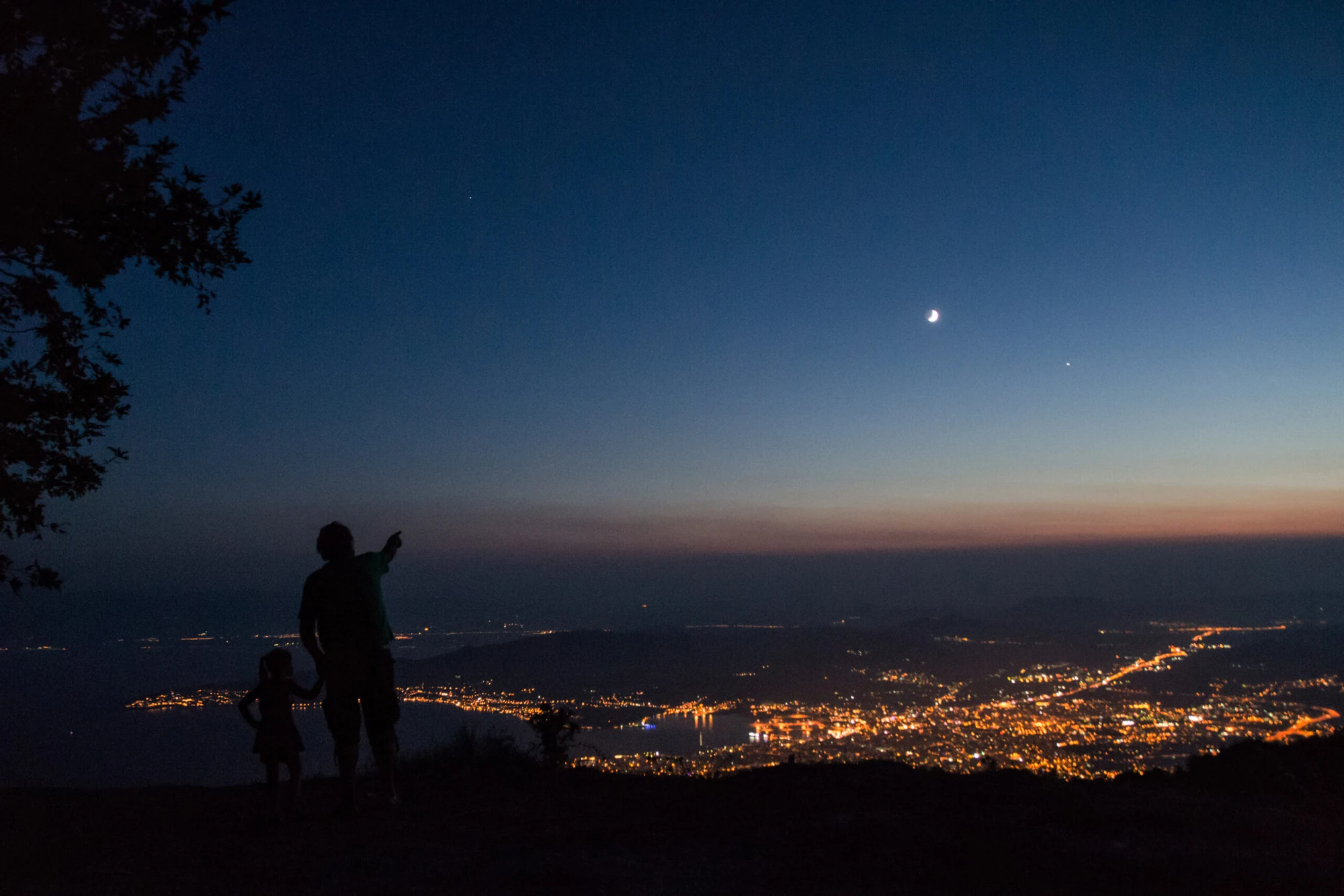
The second shows my father holding his granddaughter in his arms and pointing out Jupiter and Venus above Volos, just as he once did for me. I took it without a tripod, very quickly, to catch the moment.
After this year’s international awards, what are your next photography goals? Is there a place, astronomical event or personal project you dream of photographing?
I already have several projects under way, and they’re very demanding. One is an upcoming large monograph on the architecture of Abu Dhabi, with extensive architectural photography documenting the city. I’ll announce more soon.
I’d like to be there for the total solar eclipse in Egypt in the summer. It’s a once-in-a-lifetime experience, one I was fortunate enough to have in Bucharest in 1999, with my father’s simple Minolta. I was trembling. Out of a roll of 36 frames, I managed to make one photograph!
The journey is the purpose. Photography follows.
Biography — Apostolos Kyriazis
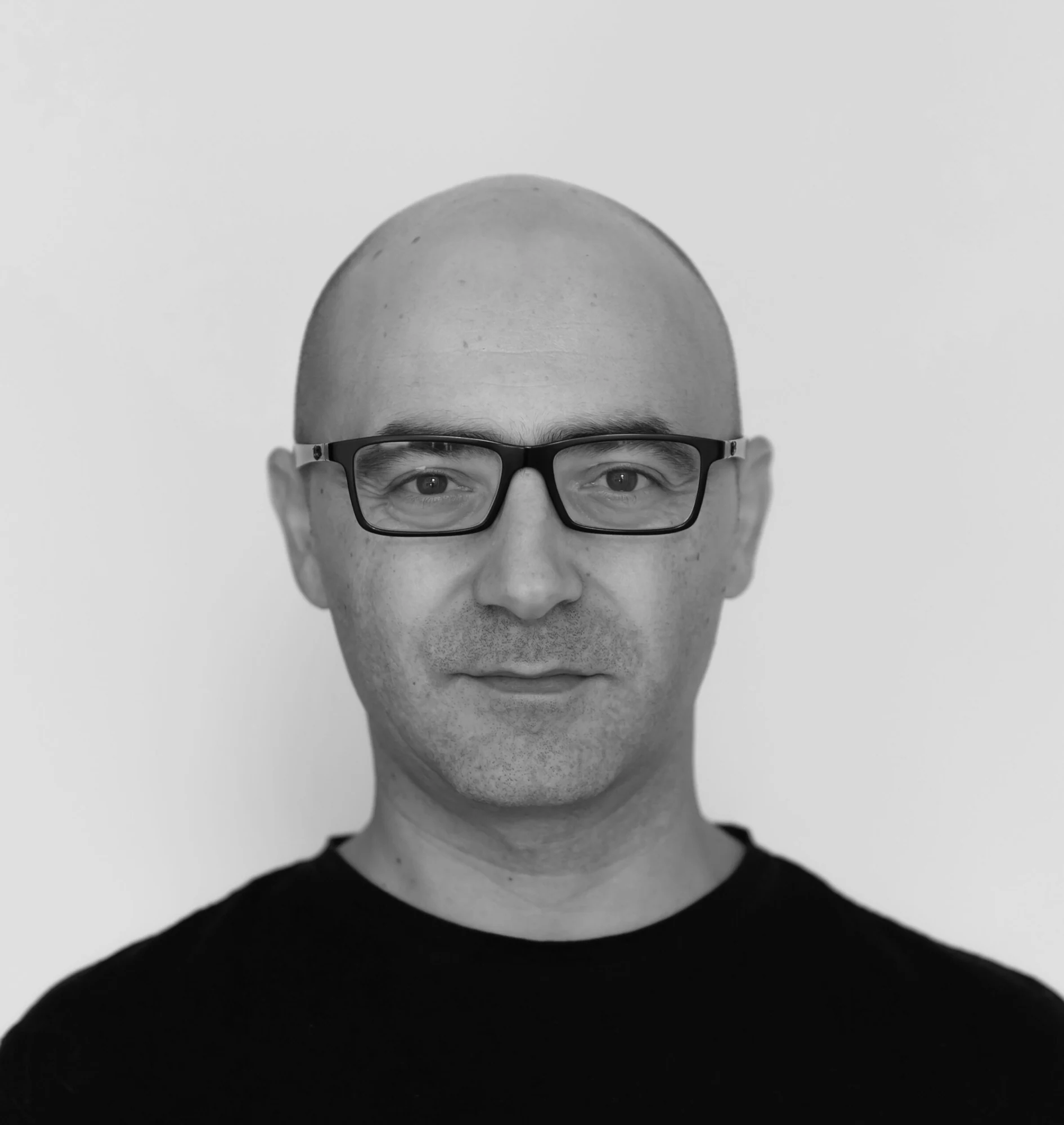
Apostolos Kyriazis was born in Thessaloniki and is from Volos. He studied architecture at Aristotle University of Thessaloniki, urban planning and regional planning at the University of Thessaly, and completed a doctorate in architecture at Aristotle University. Since 2014–2015 he has lived in Abu Dhabi, where he works as an architect and Associate Professor of Architecture at Abu Dhabi University.
Website: apostoloskyriazis.com
LinkedIn: Profile
https://www.facebook.com/apostolos.kyriazis.1
https://www.instagram.com/akyriaz
What we think
It is refreshing to hear a photographer with so much technical knowledge insist that understanding a place matters most. For Kyriazis, knowing where the Moon will rise or walking kilometres to find a tree in the desert is not just preparation: it is part of the photograph itself.
His position on editing also stays with us. Combining hundreds of frames takes real technical work, but being transparent about how an image was made matters, especially when a fabricated night sky can so easily look plausible. For newcomers, his recommendation to start with a basic camera, a fast lens and a tripod may be the most practical lesson of the conversation.