Summary
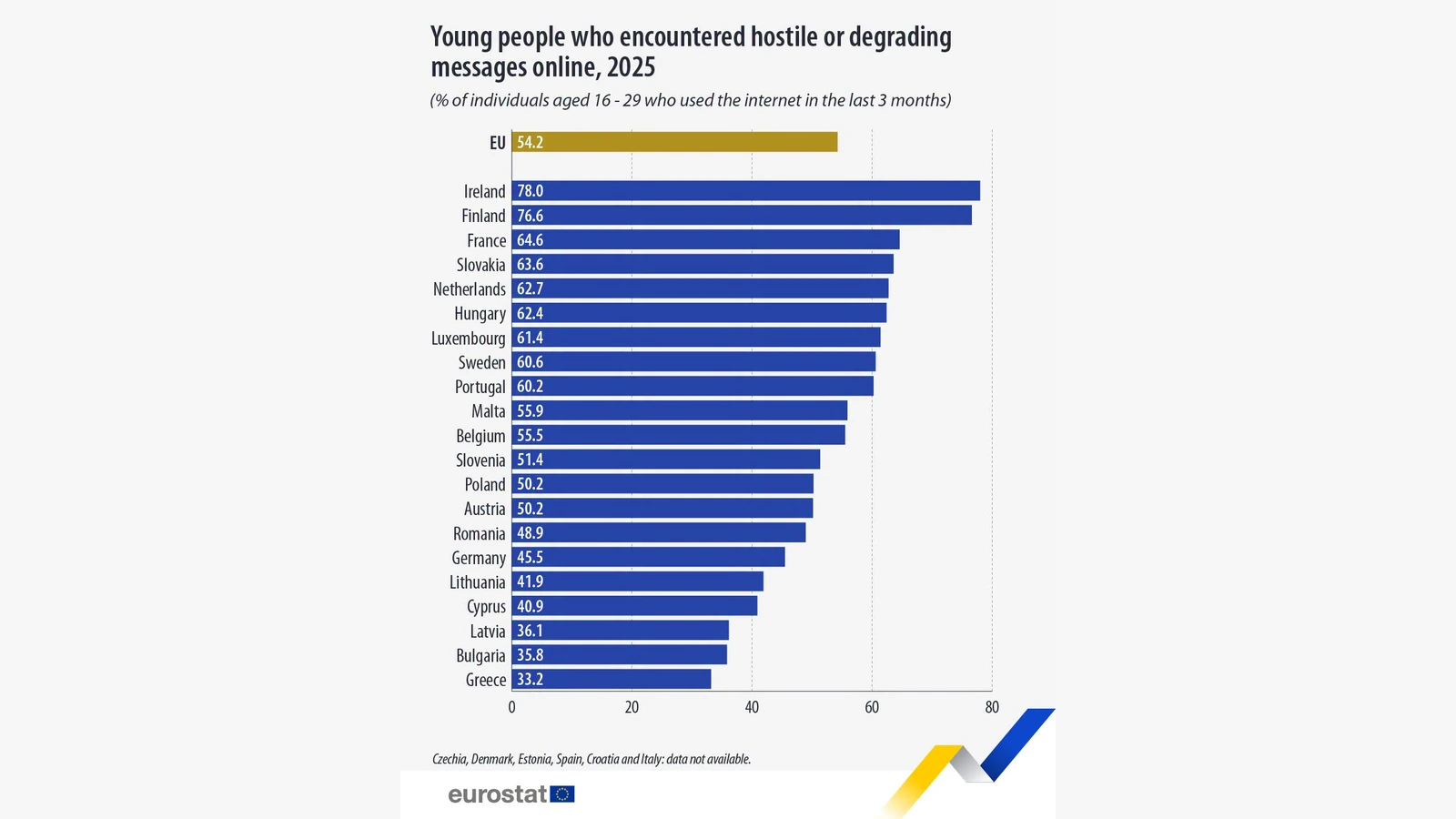
- In 2025, 54.2% of EU internet users aged 16–29 encountered hostile or degrading messages online.
- Greece had the lowest reported share at 33.2%, while Ireland reached 78%.
- The indicator measures exposure rather than personal harassment alone.
- Data for six countries are unavailable in this chart.
One in three young people in Greece encountered hostile or degrading messages online in 2025, compared with 54.2% across the European Union, according to Eurostat.
Greece recorded 33.2% among internet users aged 16–29, the lowest share among countries with available data. Exposure reached 78% in Ireland and 76.6% in Finland.
The figures measure exposure to this type of content, not necessarily personal harassment: posts may target other individuals or entire groups.
Greece records the lowest share; Ireland and Finland top the chart
Greece’s 33.2% is 21 percentage points below the EU figure. Ireland (78%), Finland (76.6%) and France (64.6%) recorded the highest shares. After Greece, the lowest shares were in Bulgaria (35.8%) and Latvia (36.1%).
The EU aggregate stands at 54.2%. The chart does not provide data for Czechia, Denmark, Estonia, Spain, Croatia or Italy, so the ranking covers only the 21 countries shown.
What the 54.2% figure actually measures
The indicator covers people aged 16–29 who had used the internet in the three months preceding the survey. Respondents reported whether they had encountered online messages they considered hostile or degrading towards individuals or groups of people.
Such content can include comments, posts, photographs, memes and videos. A user may see a hostile message without being its target. The figures therefore should not be interpreted as the share of young people personally subjected to cyberbullying.
The differences between countries describe self-reported exposure. On their own, they do not establish how much hate exists in a country or whether a particular platform, algorithm or social behaviour accounts for the gap.
Photographs, videos and comments: Why creators should pay attention
For people publishing photographs and videos, the issue goes beyond the text under a post. A photograph can be reshared with an abusive caption, turned into a meme or used to provoke hostile comments targeting the people depicted.
Safety for younger users is already part of a wider European debate, including a proposal for age-based access restrictions on social media. Yet restricting access and addressing hostile content are separate issues: the latter also concerns adult users, creators and their audiences.
What we think
Greece’s 33.2% is substantially below the EU figure of 54.2%. But it is hardly a small number: even here, roughly one in three young internet users has encountered hostile or degrading content.
Anyone working with images knows how quickly a photograph or video can be stripped of its original context and given a different meaning through a comment or a reshared post. Images are not inherently responsible for targeting people, but they can become a fast vehicle for spreading hostility.
We would like to see better moderation of comments and reports of targeted abuse, alongside more effective tools for creators who manage online communities. The answer cannot simply be to close comments or leave the platforms.
Frequently asked questions
Does Greece’s 33.2% mean that this many young people were victims of cyberbullying?
No. It represents young people who encountered hostile or degrading content, even where it was directed at someone else. It does not measure only personal attacks.
Does the chart include every EU country?
No. The chart provides no data for six countries in 2025: Czechia, Denmark, Estonia, Spain, Croatia and Italy.