

Summary
- The Economist reports an increase in mountain rescues involving people aged 17 to 25.
- Incidents involving young people in the Scottish Highlands have nearly quadrupled since 2022.
- Almost 400 incidents were recorded in England and Wales in 2025, compared with 166 in 2019.
- Experts link part of the increase to influencer culture and the pursuit of dramatic photographs.
- Social media posts often hide the preparation, equipment and experience required for a safe climb.
- Incidents in Scotland have nearly quadrupled
- Rescues have more than doubled in England and Wales
- A similar pattern in the United States and continental Europe
- The Instagram effect and the role of influencers
- The preparation that does not appear in the photograph
- Rescue in a feels-like temperature of -15°C
- When the search for the perfect frame increases danger
- What we think
- Frequently asked questions
According to The Economist, the pursuit of dramatic social media photographs is being linked to an increase in mountain rescues involving young and often unprepared hikers.
As The Economist reports, mountain rescue services in several countries are recording more incidents involving people aged 17 to 25 who attempt demanding climbs or hikes without suitable equipment or the necessary experience.
The trend matters because it shows how the idealised image of adventure on social media can conceal the real demands of the mountains, including checking the weather, choosing suitable clothing, carrying water and food and understanding the route.
Incidents in Scotland have nearly quadrupled
According to figures presented by The Economist, mountaineering incidents involving people aged 17 to 25 in the Scottish Highlands have nearly quadrupled since 2022.
In 2018, this age group accounted for 15% of the people rescued in the region. By 2025, the proportion had risen to 25%.
This change differs from the pattern seen in the early 2010s, when middle-aged hikers were the group most likely to require assistance from mountain rescue teams.
Rescues have more than doubled in England and Wales
The increase is not limited to Scotland. According to figures published by The Times of London and cited in the report, almost 400 mountain rescue incidents in England and Wales during 2025 involved people aged 18 to 24.
In 2019, 166 similar incidents were recorded, meaning that the number more than doubled over six years.
The figures do not prove that every rescue was directly connected to photography or content creation. They do, however, show a clear increase in the presence of younger and often less experienced people in demanding mountain environments.
A similar pattern in the United States and continental Europe
Similar trends have also been reported outside Britain. In the United States, people aged 18 to 25 represent a growing share of those requiring assistance during mountain trips.
France, Italy and Switzerland have also recorded increases in emergency calls involving younger hikers.
The geographical spread of the trend supports the view that this is not simply a local change, but part of a broader shift in the way young people approach nature and outdoor adventure.
The Instagram effect and the role of influencers
Nick Phillips, a volunteer and communications director at Mountain Rescue England and Wales, told The Times that social media, particularly the influencer community on TikTok and Instagram, has contributed significantly to the increase in incidents.
Posts from summits, steep trails and remote landscapes usually show only the final result. The photograph presents a smiling creator standing in front of an impressive view, but it does not reveal the preparation, physical effort and risks that came before it.
Ludovic Richard, from a mountain-safety observatory in France, told The Economist that the so-called “Instagram effect” has led some young hikers to take dangerous risks to photograph themselves in scenic locations.
In many cases, these people have limited experience, inadequate equipment and little understanding of how quickly conditions can change in the mountains.
The preparation that does not appear in the photograph
Catriona Thomas, an influencer from north Wales, explained that young people usually see only the final image produced by content creators, in which everything appears easy and effortless.
Behind the photograph, however, there may have been a detailed weather check, the selection of suitable hiking boots, careful preparation of clothing and equipment and calculations concerning water, food and available time.
These practical steps are rarely shown in a short video or a single photograph. As a result, some viewers underestimate the difficulty of a route and assume that they can repeat it without similar preparation.
Rescue in a feels-like temperature of -15°C
The Economist cites the case of two hikers in their 20s who had to be rescued in December from Britain’s second-highest mountain as a striking example.
The feels-like temperature in the area had fallen to -15°C. The two young hikers were wearing trainers and tracksuit bottoms rather than hiking boots and thermal clothing suitable for the conditions.
The incident demonstrates the considerable gap that can exist between the appearance of a route on a screen and the actual temperatures, wind exposure and demands of the mountain environment.
When the search for the perfect frame increases danger
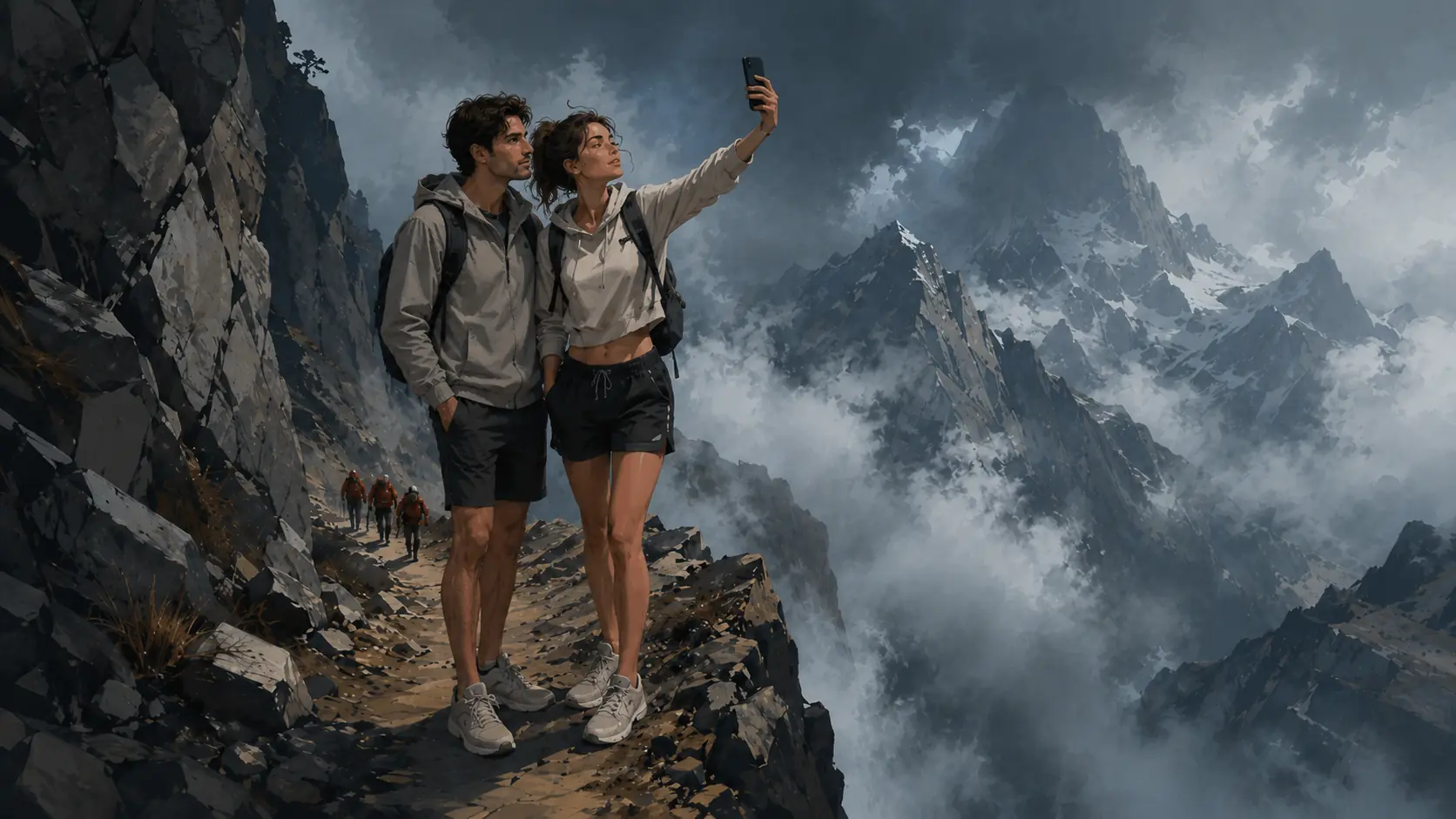
The risk does not come only from inadequate preparation. The effort to capture the perfect image can lead someone close to the edge of a cliff, onto unstable ground or into a location from which returning safely is difficult.
Attention shifts towards the screen, the composition and the position of the body, reducing awareness of the surroundings and immediate hazards.
At Grand Canyon National Park in the United States, photography has been described as the deadliest recreational activity, accounting for many of the fatal falls recorded at the famous natural landmark.
What we think
Social media can encourage more young people to discover nature and landscape photography, which is positive when accompanied by proper information. The problem begins when the final image is separated from the preparation, experience and respect required by mountain conditions. Photographers and content creators can make a meaningful contribution by showing not only the dramatic frame, but also the equipment, planning and safety measures required to create it.
Frequently asked questions
What does The Economist report about mountain rescues involving young people?
The Economist reports that mountain rescue incidents involving people aged roughly 17 to 25 are increasing, with a particularly notable change in Britain and similar trends in other European countries and the United States.
Are Instagram and TikTok solely responsible?
No. The figures show an increase in incidents, while experts and rescue workers believe social media contributes to the trend. This does not mean that every rescue operation is caused by photography.
What is the Instagram effect?
The term describes the influence of idealised social media images, which may encourage some people to visit difficult or dangerous locations without fully understanding the preparation required.
What is usually missing from influencers’ mountain photographs?
The images often do not show the weather checks, route planning, suitable clothing, hiking boots, water, food, safety equipment and experience required for the trip.
How can photography increase the danger?
The search for a better angle can lead a photographer close to cliffs, steep areas or unstable ground, while focusing on a screen reduces awareness of the surrounding environment.