

Summary
- Capture the Dark 2026 received 2,288 entries from more than 30 countries.
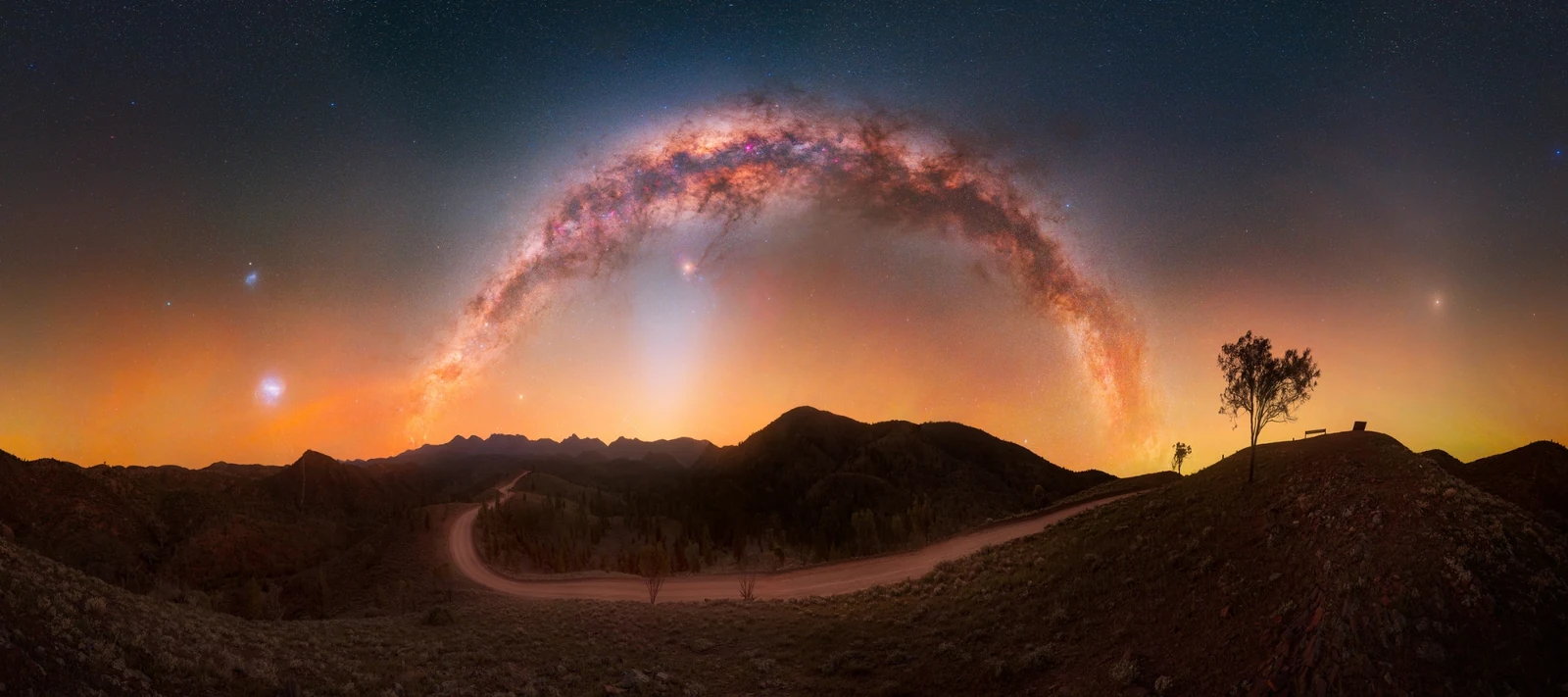
- Paul Wilson won the Nightscapes category with the tracked panorama “Razorback”.
- The winners used everything from smartphones and DSLRs to astro-modified and specialized astronomy cameras.
- DarkSky connects the competition with responsible astrophotography and the protection of dark skies.
- The special Star Trek 60 category was part of the franchise’s 60th anniversary celebration.
- The first-place winners of Capture the Dark 2026
- All second- and third-place winners
- The People’s Choice Award and special Star Trek 60 category
- What photographers can learn from the winning images
- Light pollution remains central to the competition
- A competition open to different types of creators
- Frequently asked questions
- What we think
Capture the Dark 2026 showcased the year’s standout images of the nighttime world from 2,288 entries submitted by photographers in more than 30 countries.
DarkSky International announced the winners of the sixth Capture the Dark competition on August 13, 2026, celebrating nighttime photography, astrophotography and the protection of dark skies. This year’s edition received a record 2,288 submissions from more than 30 countries, with winners across nine main categories, the People’s Choice Award and the special Star Trek 60 category.
For photographers, the significance of the results goes beyond visually impressive images. The winning photographs span almost the entire spectrum of contemporary nighttime photography, from single exposures and smartphone captures to tracked panoramas, stacking, astro-modified cameras and complex blends using H-alpha data. DarkSky also links the competition directly to responsible photography and the need to reduce light pollution.
The first-place winners of Capture the Dark 2026
In Nightscapes, Paul Wilson took first place with “Razorback”, a tracked panorama captured from Razorback Lookout near Quorn in South Australia. The frame brings together the Milky Way, the Large and Small Magellanic Clouds and Zodiacal Light in one expansive nighttime landscape. Wilson used a Canon R5 and Sigma Art 28mm lens at f/2.5, 30 seconds and ISO 3200.
Kat Lawman won International Dark Sky Places with “Window to Orion”, a self-portrait at Arches National Park in Utah that frames Orion through Turret Arch. The final photograph is a blend created with Sony A7 III and A7 IV bodies and a Sony 20mm f/1.8 lens, with additional H-alpha frames revealing hydrogen structures around Orion and Barnard’s Loop.
Ross Steensland won Quality Lighting and Design with “Little Mt Hoffman” from California. The stacked photograph was captured with an astro-modified Sony A7 III and Sigma 24mm f/1.4, showing how carefully controlled artificial lighting can coexist with a clearly visible star-filled sky.
The Impact of Light Pollution produced one of the competition’s most distinctive winners. Kouyu Wang’s “Artifical Comet” records a newly launched group of Starlink satellites, with stacked exposures revealing their orbital movement across the sky. The photograph was made in Inner Mongolia using a Nikon D750 and Sigma 14mm Art.
Tom Rae won Creatures of the Night with “The Chasm”, photographing glow worms and the fragile ecosystem of a cave in Waitomo, New Zealand, after rappelling more than 100 metres underground. He used Nikon Z8 and Z7IIA cameras in extremely humid and very low-light conditions.
In Deep Sky Observations, Julien De Winter, Landon Boehm and Brian Diaz won with “The Dementors of Cepheus (LBN 528 & LBN 532), Wardens of a Dead Star (SNR G110.3+11.3)”. The stacked ASI 6200 MC image from Texas records a rich region of Cepheus containing dark and reflection nebulae, a planetary nebula and the remnant of an ancient supernova.
In Mobile Nighttime Photography, Enrique Barquet demonstrated that nighttime photography is not limited to large cameras. “Aurora Over Mount Shuksan”, captured during the May 10–11, 2024 geomagnetic storm in Washington, is listed as a single exposure at f/1.4, 5 seconds and ISO 1600.
Norah Swann won Young Astrophotographers with “River of Light”, a stacked image of synchronous fireflies above a creek in North Carolina, captured using a Nikon D3500 and Nikkor 35mm f/1.8 DX. The photograph directly connects natural darkness with the survival of nocturnal wildlife.
Dennis Lehtonen took first place in Nighttime Adventures with “Aurora over the Prince Christian Sound” from Greenland. The single exposure was captured with a Sony A7 IV and Sony FE 14mm f/1.8 GM at 2.5 seconds and ISO 2000, with the aurora reflected in almost perfectly still water.
All second- and third-place winners
In Nightscapes, Yifei Pei finished second with “Wind-Carved Earth, Star-Written Night” from Qinghai, China, while Marcin Zajac placed third with “Forest of Stars” from Namibia. Pei’s image relied on an elaborate blend and hundreds of stacked frames, while Zajac created a tracked panorama with a Nikon D810 and Sigma 40mm f/1.4.
International Dark Sky Places saw Max Inwood place second with “Alpine Archway” from Aoraki Mackenzie in New Zealand and Florian Riou third with “Allos” from Col d’Allos in France.
In Quality Lighting and Design, F. Xavier Cuvelier finished second with “Colmars-les-Alpes: A ‘Starry Village’”, while Dario Giannobile placed third with “Visions from Sicily Gangi, Etna with Gas Rings, Venus and the Sickle Moon”. The two European photographs were made in France and Sicily respectively.
In The Impact of Light Pollution, Mikel Iraeta took second place with “A dialogue between space and human light” from Nugget Point, New Zealand, while “Night Sky over Yuanyang Terraced Fields” by 文俊 韦 from Yunnan, China, finished third.
In Creatures of the Night, Gerri Whitley placed second with “Chicago Lights”, while Nanthakumar K Nallvan was third with “Scorpion & Scorpious” from Malaysia.
In Deep Sky Observations, Paul Montague took second place with “Echoes of a Merger” from South Australia, while Andrew Warner finished third with “The Auriga Neblua Complex” from Texas. The photographers used specialized ZWO 294MM Pro and ZWO ASI2600MM Pro astronomy cameras respectively.
In Mobile Nighttime Photography, Katrina Brown finished second with “Milky Way in White Pocket of Vermillion Cliffs National Monument”, captured on a Pixel 9 Pro XL, while Nikita Veerabahu Pillai placed third with a panorama of the Milky Way and Magellanic Clouds above Taranaki Maunga in New Zealand.
In Young Astrophotographers, Kunzhe Chen placed second with a tracked panorama from the Atacama Desert, while Avis Kennedy-Stirling finished third with “Midsummer Night Cat and Fireflies”, captured on an iPhone 16 Pro Max at ISO 10000.
In Nighttime Adventures, Dustin Bischke was second with “Watching the Galaxy Rise” from Alberta, Canada, while Chris Owen placed third with “The Cabin” from Otago, New Zealand.
The People’s Choice Award and special Star Trek 60 category
The People’s Choice Award went to Ethan Keller for “The Great Bear and the Rainbow Bridge La Grande Ourse et le pont arc-en-ciel”. The single exposure from Alberta, Canada, combines the aurora with Ursa Major and Canes Venatici and was captured using a Canon 80D and Tamron 15-30mm f/2.8.
The special Star Trek 60 category gave this year’s competition another distinctive element. It was introduced as part of DarkSky International’s partnership with the Star Trek 60th anniversary celebration and invited photographers to incorporate the iconic Vulcan salute into images beneath the night sky.
Monika Deviat took first place with “In View” from Banff National Park in Canada, using an astro-modified Nikon Z6 II and Nikkor 20mm f/1.8. Rositsa Dimitrova finished second with “Waiting for 2063” from Tyulenovo, Bulgaria, and Ken Lee placed third with “Live Long and Prosper (In That Order)” from Joshua Tree National Park.
What photographers can learn from the winning images
One of the most interesting conclusions is that there is no single technical formula for success. The winners include simple single exposures lasting only a few seconds, smartphones, older-generation DSLRs, modern mirrorless cameras, astro-modified bodies and specialized cooled astronomy cameras.
At the other end of the spectrum are advanced stacking techniques, tracked panoramas, blends of sky and foreground and H-alpha captures. This shows that extensive processing is not automatically excluded from modern international competitions, but transparency becomes especially important.
DarkSky’s Principles for Responsible Astrophotography call for photographers to limit additional artificial light, represent editing honestly, clearly label composite imagery, keep skies geographically consistent with their foregrounds and respect the locations where they work.
For photographers looking to develop their nighttime work, the lesson from the results is fairly clear: technical quality remains important, but a strong image also needs an idea, a meaningful relationship with its location and a clear visual narrative.
Light pollution remains central to the competition
Capture the Dark is not simply a contest for attractive astrophotography. DarkSky uses photography as a communication tool to address the gradual loss of natural darkness and says light pollution is increasing globally at a rate approaching 10% per year.
That figure is consistent with scientific observations suggesting that the decline in naked-eye star visibility can be explained by an increase in sky brightness of roughly 7% to 10% per year.
The issue has direct practical consequences for astrophotography. As skyglow increases, the number of locations where photographers can cleanly record the Milky Way and faint celestial objects without substantial processing becomes increasingly limited.
pttl has previously covered the winners of Capture the Dark 2025 as well as the Milky Way Photographer of the Year 2026, where light pollution again emerges as one of the defining challenges facing contemporary night-sky photography.
A competition open to different types of creators
Capture the Dark is free to enter and open to all ages. For 2026, submissions ran from May 1 through June 30, with DarkSky asking entrants to follow its Principles for Responsible Astrophotography.
Separate categories for young photographers and mobile photography are also significant. Norah Swann’s first-place image made with a Nikon D3500 and Avis Kennedy-Stirling’s third-place photograph made with an iPhone 16 Pro Max show that access to expensive or highly specialized equipment is not a requirement across every part of the competition.
Frequently asked questions
How many entries did Capture the Dark 2026 receive?
DarkSky International reported 2,288 submissions from more than 30 countries, a record for the competition.
Who won the Nightscapes category?
Paul Wilson took first place with “Razorback”, a tracked panorama captured near Quorn in South Australia.
Was there a category for smartphone photography?
Yes. Enrique Barquet won Mobile Nighttime Photography with “Aurora Over Mount Shuksan”, while the second-place photograph was captured on a Pixel 9 Pro XL.
Are stacking and composite images allowed?
The winning gallery includes stacked, blended and composite photographs. DarkSky places particular emphasis on transparency around editing, clear labeling of composites and honest representation of the night sky.
What was the Star Trek 60 category?
It was a special category connected to DarkSky International’s official partnership with the Star Trek 60th anniversary celebration, inviting photographers to create nighttime images incorporating the iconic Vulcan salute.
What we think
Capture the Dark 2026 is particularly interesting because it does not present astrophotography as an equipment competition. Smartphones, DSLRs, mirrorless cameras, astro-modified bodies and specialist astronomy systems can all be found among the winners. What connects the strongest images is intent, technical consistency and storytelling. More importantly, the competition treats darkness not merely as a photographic backdrop but as a natural resource worth protecting.