Summary
- Voyager 1 will reach about 25.9 billion kilometers from Earth on November 18.
- NASA invites the public to salute it with light signals on November 17.
- Participants can photograph or film their contributions.
- A JPL discussion follows on November 19.
Could a small beam of light from Earth become part of a worldwide salute to the most distant human-made object? NASA is inviting everyone to try it on November 17 as Voyager 1 approaches a remarkable milestone.
On November 18, 2026, at approximately 12:16 p.m. in Greece, Voyager 1 is expected to reach a distance of roughly 25.9 billion kilometers from Earth: one light-day. That is how far light travels in 24 hours, a distance no other human-made object has reached.
A flash of light from around the world
“Shine Bright for Voyager’s Light-Day” takes place on Tuesday, November 17, after local sunset. Using a flashlight, phone, bike light or portable lamp, participants are invited to point toward the sky and flash V-G-R, the Voyager mission call sign, in Morse code.
NASA has also built an automatic flasher that works in the browser of a smartphone or tablet on the official activity page. This is a symbolic tribute, not a method of contacting the spacecraft: a handheld light cannot carry a detectable message across such a vast distance.
How to flash VGR in Morse code
The sequence is straightforward. V is three short flashes and one long (···–). G is two long flashes and one short (––·). R is one short, one long and one short (·–·). Leave a small pause between signals and at least a second between letters, repeating for around a minute.
NASA encourages participants to photograph or film their light signal and share the results on social platforms, tagging @NASA. Photographers could use the occasion to create a night scene involving people and light, without needing to capture Voyager itself.
What one light-day really means
The milestone is a measure of distance, not the duration of the spacecraft’s journey. At that range, a radio transmission from Earth takes 24 hours to reach Voyager 1, and a reply takes another 24 hours to arrive. Even a simple exchange therefore takes roughly two days.
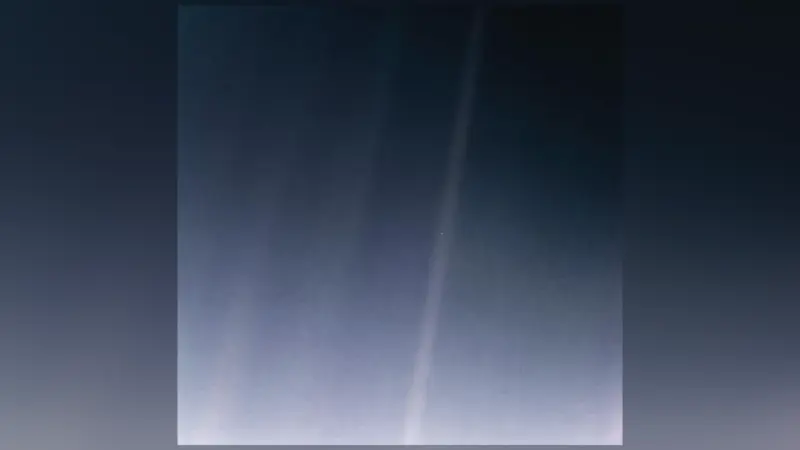
Voyager 1 launched on September 5, 1977, and entered interstellar space in 2012. The mission produced some of space exploration’s most memorable images, including the 1990 “Pale Blue Dot.” The photographic legacy of the Voyager spacecraft remains significant even though their cameras have been inactive for decades.
A NASA event follows on November 19
On November 19 at 7 p.m. Greek time, the Jet Propulsion Laboratory will host a discussion with mission team members about the status of both probes, the science they continue to gather and the engineering challenges of keeping them operating. The program will also preview a NASA+ Voyager documentary planned for 2027, the 50th anniversary year of their launches.
The discussion will be available through NASA’s live-streaming page. Anyone pairing the light-day activity with a night-sky shoot can also consult the November skywatching and photography guide for Greece.
What we think
There is something appealing about people in different countries switching on a little light to salute a spacecraft that has been travelling for almost half a century. No telescope or expensive equipment is needed, just a flashlight and a few seconds under the night sky.
For photographers, the event is also a concrete creative prompt. A portrait lit by a single beam, a group in a dark landscape or a long exposure tracing the light can tell the same story in very different visual ways.
What stands out to me is the shared gesture rather than another spectacular distance chart. Voyager 1 will never see our flashlights. But we can still make a photograph of the moment we decided to send it a greeting.
Frequently asked questions
When will Voyager 1 reach one light-day from Earth?
On November 18, 2026, at approximately 12:16 p.m. Greek time, according to NASA’s schedule.
Can we see or photograph Voyager 1 from Earth?
No. The activity is about recording the symbolic light signal on Earth, not directly observing the spacecraft.