

Summary
- Voyager 2 is gaining at least another year of scientific operation thanks to a new power-saving effort.
- The two Imaging Science Subsystem cameras have been switched off since 1989 and will not capture new photographs.
- The imaging system used a 200mm f/3 wide-angle camera and a 1500mm f/8.5 narrow-angle camera, each equipped with eight filters.
- Voyager 2 remains the only spacecraft to have photographed Uranus and Neptune from close range.
- Its images form one of the most important photographic archives in the history of space exploration.
- Two cameras that went where no others had gone
- The images that shaped our view of the outer planets
- What a 1977 camera could achieve
- Color through filters and processing on Earth
- Why Voyager 2’s cameras no longer work
- From photographs to the invisible side of space
- Why every watt now matters
- Commands from 21.4 billion kilometers away
- A photographic archive that still cannot be replaced
- Voyager 1 is next
- What we think
- Frequently asked questions
Voyager 2, the spacecraft that gave humanity some of the most important photographs of the outer Solar System, is gaining at least another year of scientific life thanks to a new NASA power-saving intervention.
Nearly 49 years after launch, NASA has completed the “Big Bang” operation on Voyager 2, switching off certain powered devices while replacing their functions with lower-power alternatives. The spacecraft is approximately 13.3 billion miles, or nearly 21.4 billion kilometers, from Earth, and the resulting savings are expected to keep its three remaining science instruments operating for at least another year.
For photographers, however, Voyager 2 has an especially interesting story: its cameras have not operated since 1989. The Imaging Science System that photographed Jupiter, Saturn, Uranus, Neptune, and their moons was switched off after the planetary encounters to save power. The latest intervention therefore does not mean that Voyager 2 will send back new photographs. Instead, it extends the life of the spacecraft whose photographic archive remains irreplaceable.
Two cameras that went where no others had gone
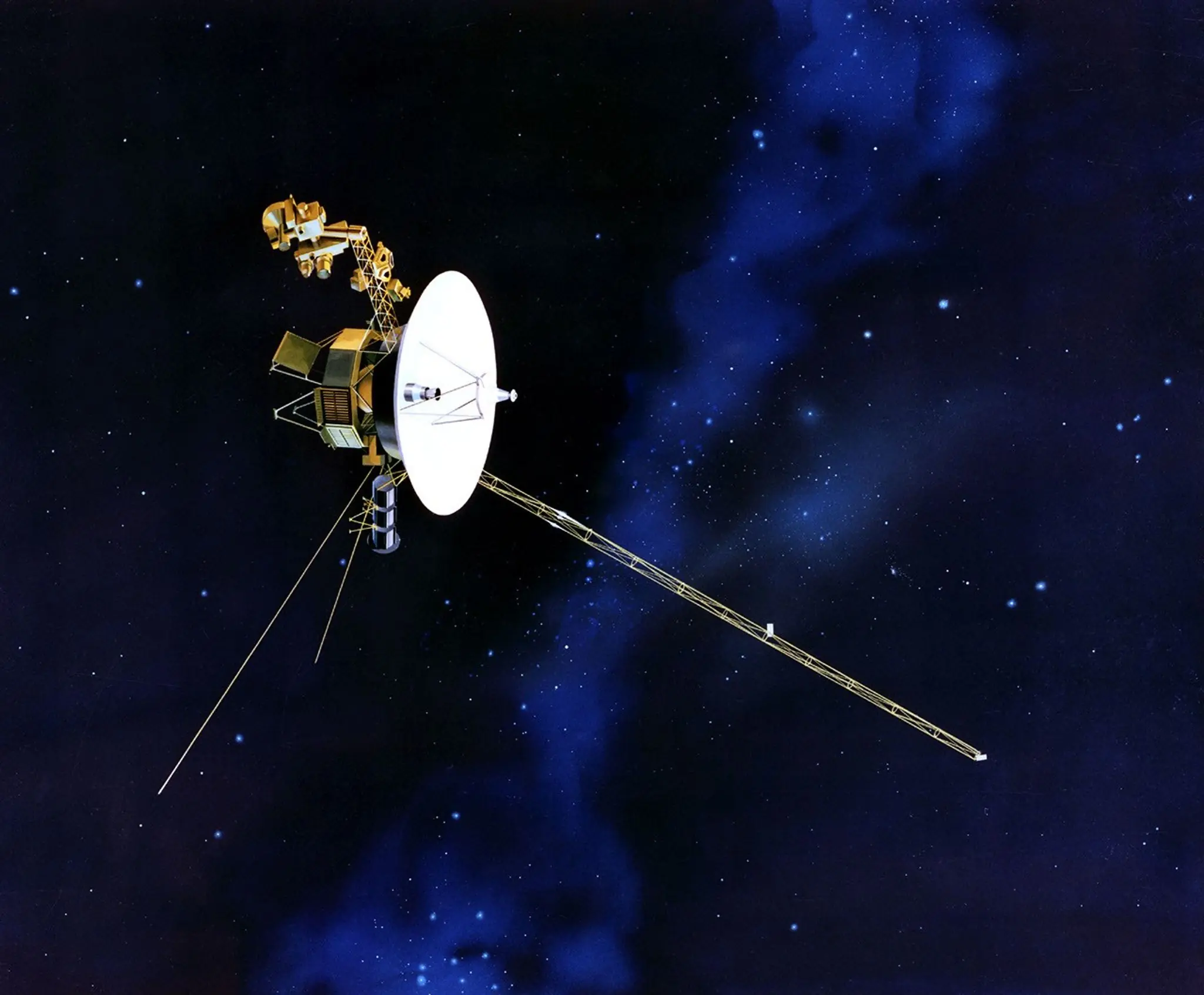
Voyager 2 carried the Imaging Science Subsystem, a two-camera television-style imaging system based on modified slow-scan vidicon technology previously used on the Mariner missions.
One was a wide-angle camera with a 200mm f/3 lens, while the other was a narrow-angle camera using a 1500mm f/8.5 lens. Each vidicon had a commandable wheel containing eight filters, allowing different spectral information to be recorded and later combined into color or false-color images.
Unlike a modern digital camera, there was no CMOS or CCD sensor in the contemporary sense. The cameras recorded images using vidicon tubes, gradually converting the scene into data that could be transmitted back to Earth.
The images that shaped our view of the outer planets
Voyager 2 flew past Jupiter in 1979, Saturn in 1981, Uranus in 1986, and Neptune in 1989. It remains the only spacecraft to have studied all four giant planets from close range and the only one ever to visit Uranus and Neptune.
That means many of the photographs it produced are more than historical records. For Uranus and Neptune, they remain the only close-range images ever captured by a spacecraft during a flyby.
At Uranus, Voyager 2 returned thousands of images and revealed details of its rings and moons that could not be observed in the same way from Earth. The mission discovered 10 new moons and two new rings there.
At Neptune, its cameras revealed a world with a complex atmosphere, clouds, and dark features including the Great Dark Spot. Voyager 2 also discovered new moons and rings and captured close views of Triton.
What a 1977 camera could achieve
The specifications of the Imaging Science System may look extremely limited when compared with a modern mirrorless camera or even a smartphone. Its photographic value, however, was never about megapixels or high burst rates.
Engineers had to build a system capable of surviving for years in space, operating at enormous distances from the Sun, and imaging targets illuminated by far less sunlight than objects near Earth.
The sensitivity and dynamic range of the Voyager cameras were therefore critical. JPL noted as far back as the 1980s that the performance of the vidicon cameras enabled detailed imaging even in the Uranian system, where solar illumination is only a small fraction of that experienced at Earth.
Color through filters and processing on Earth
Many of Voyager’s best-known images were not produced as single color exposures in the way a modern digital camera would create them.
The system recorded frames through different filters, which could then be combined to create color composites. False-color images were also produced to emphasize scientific features that might otherwise be difficult to distinguish. NASA’s archives include images of Neptune and Triton created through such combinations.
For a modern photographer, the process resembles scientific multispectral imaging and compositing more than simply pressing a shutter button.
Why Voyager 2’s cameras no longer work
After its final major planetary encounter at Neptune in 1989, there was no longer a comparable requirement to photograph planets.
NASA switched off Voyager 2’s wide-angle camera on October 10, 1989, and its narrow-angle camera on December 5 of the same year to conserve power.
This is essential context for the current news. The “Big Bang” operation does not revive the imaging system, and Voyager 2 will not suddenly begin returning new photographs from interstellar space.
The three instruments NASA is now trying to preserve are used to study the interstellar environment rather than to capture photographs.
From photographs to the invisible side of space
This transition is perhaps one of the mission’s most interesting aspects from a photography perspective.
During the 1970s and 1980s, Voyager 2 showed humanity unfamiliar worlds through images. Today, it is so far away that its primary scientific value comes from measurements of things that cannot be recorded by a conventional camera, including magnetic fields, plasma, charged particles, and waves.
Its photographic mission ended decades ago, but the data it continues to transmit represent a different kind of observation of the universe.
Why every watt now matters
The Voyager spacecraft are powered by radioisotope thermoelectric generators that convert heat from decaying plutonium into electrical energy.
Available power decreases by about four watts every year. After nearly half a century, margins are so narrow that NASA must continually look for ways to shut down nonessential functions or replace them with lower-power alternatives.
Without the latest intervention, NASA would have had to switch off another Voyager 2 science instrument before the end of 2026. The savings are expected to keep the three remaining instruments running for at least one additional year.
Commands from 21.4 billion kilometers away
Voyager 2 is approximately 21.4 billion kilometers from Earth. At that distance, even a radio signal traveling at the speed of light takes about 20 hours to reach the spacecraft.
That distance gives NASA’s current work another dimension. Engineers are modifying the operation of a computing and scientific system launched in 1977, with no possibility of physical access and with nearly a full day of communication delay in each direction.
A photographic archive that still cannot be replaced
The two Voyager spacecraft produced approximately 67,000 images in total during their planetary missions.
Among them are photographs that changed not only planetary science but also the public visual understanding of the Solar System. Images of Uranus, Neptune, Triton, planetary rings, and atmospheric formations became part of the collective visual memory of space exploration.
Voyager 2 retains a particularly unique photographic distinction at Uranus and Neptune: no other spacecraft has returned for another close encounter since.
Voyager 1 is next
NASA plans to carry out a similar power-saving intervention on Voyager 1, which is even farther from Earth.
Voyager 1’s cameras have also been switched off for decades. Its own photographic legacy includes the famous “Pale Blue Dot,” part of the final Solar System family portrait it captured in 1990.
What we think
For photographers, Voyager 2 is a reminder that the significance of a camera is not measured only by its technical specifications, but by where it can go and what it can show. Its two vidicon cameras have remained silent since 1989, yet their images are still scientifically and historically important. The latest mission extension will not bring us new photographs, but it keeps alive the same spacecraft that created one of the most significant photographic archives in the history of space exploration.
Frequently asked questions
Can Voyager 2 take photographs again?
The two Imaging Science Subsystem cameras were switched off in 1989 after the planetary encounters to save power. NASA’s current intervention is designed to preserve the remaining science instruments rather than reactivate the cameras.
What cameras did Voyager 2 use?
It carried two television-style slow-scan vidicon cameras: a 200mm f/3 wide-angle camera and a 1500mm f/8.5 narrow-angle camera. Each used a wheel containing eight filters.
Why are its photographs still so important?
Voyager 2 is the only spacecraft ever to visit Uranus and Neptune at close range. Its images therefore remain the only photographic record from a close spacecraft flyby of those two planets.
What does Voyager 2 do today if it does not take pictures?
It continues making scientific measurements of the interstellar environment using its active instruments, while NASA works to minimize power consumption and extend their operating life.
How far away is Voyager 2?
It is approximately 13.3 billion miles, or nearly 21.4 billion kilometers, from Earth.
Featured Image filename