Summary
- Fujifilm reported record revenue of ¥885 billion for the July–September 2026 quarter.
- Consumer Imaging grew by 22.5%, while Professional Imaging declined by 5.1%.
- Memory and component inflation is expected to cost Imaging ¥14 billion over the full fiscal year.
- No new price increase for Greece has been announced.
Fujifilm has posted record quarterly revenue, but sharply rising memory and component costs are bringing the prospect of more expensive cameras back into focus.
On November 9, 2026, the Japanese group reported results for July–September: revenue of ¥885 billion, up 7.6%, operating income of ¥90 billion (+8.2%), and net income of ¥67.8 billion (+2%). These are second-quarter records for the entire group, not camera sales alone.
Instax powers growth while digital-camera revenue slips
The Imaging segment posted ¥162.3 billion in revenue (+11%) and ¥50.1 billion in operating income (+29.6%). Its operating margin rose from 26.4% to 30.8%, underscoring the strength of the wider imaging business.
The split is revealing: Consumer Imaging, home to Instax, climbed 22.5% to ¥104.5 billion. Professional Imaging, which includes digital cameras, fell 5.1% to ¥57.7 billion. Fujifilm attributes the comparison to unusually strong sales of newly launched products in the corresponding quarter last year.
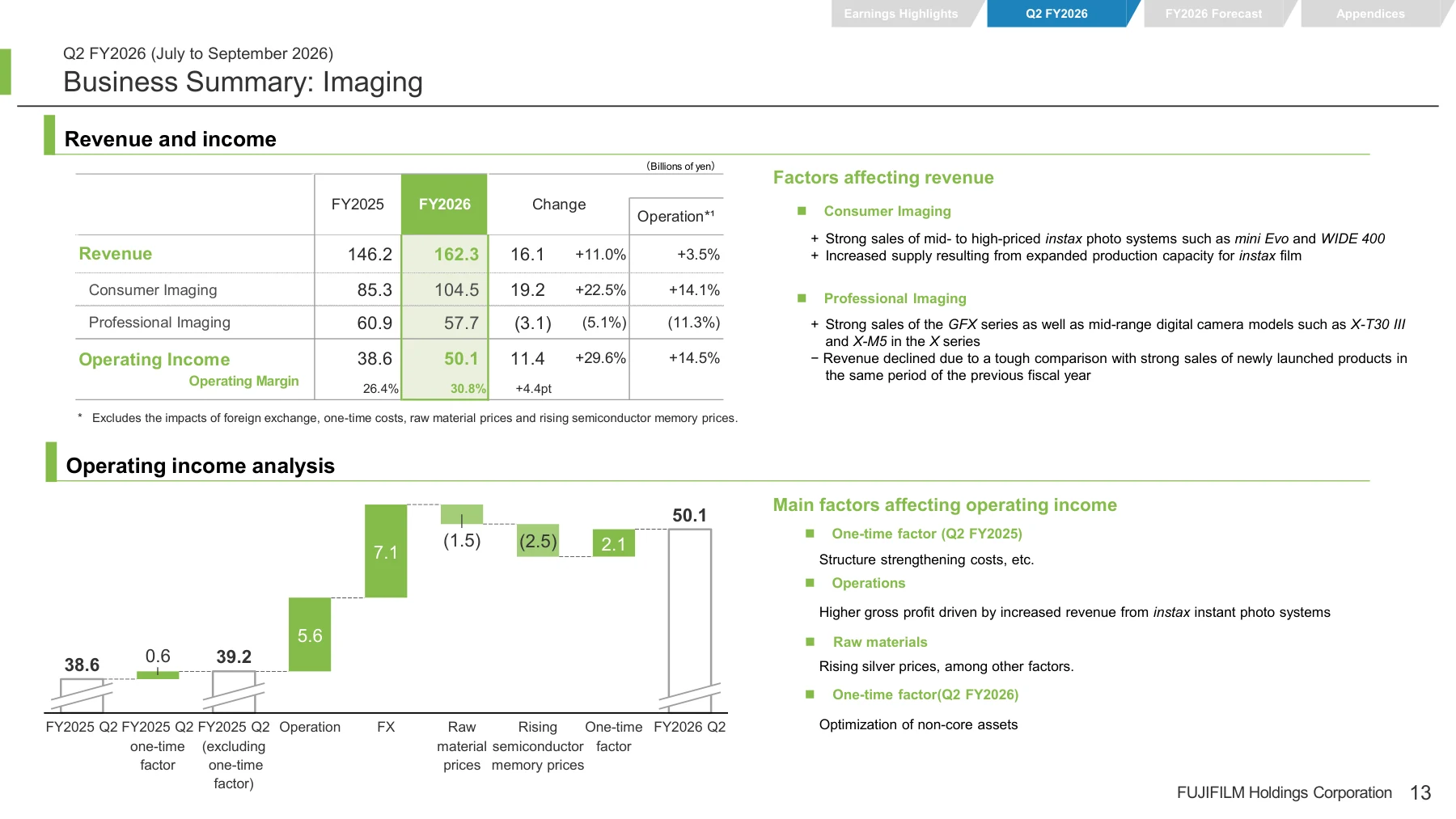
Higher-priced Instax models such as mini Evo and WIDE 400 performed well, while expanded production helped improve instant-film supply. For digital cameras, the company also points to healthy GFX demand and sales of X-series models including the X-T30 III and X-M5, despite the overall Professional Imaging decline.
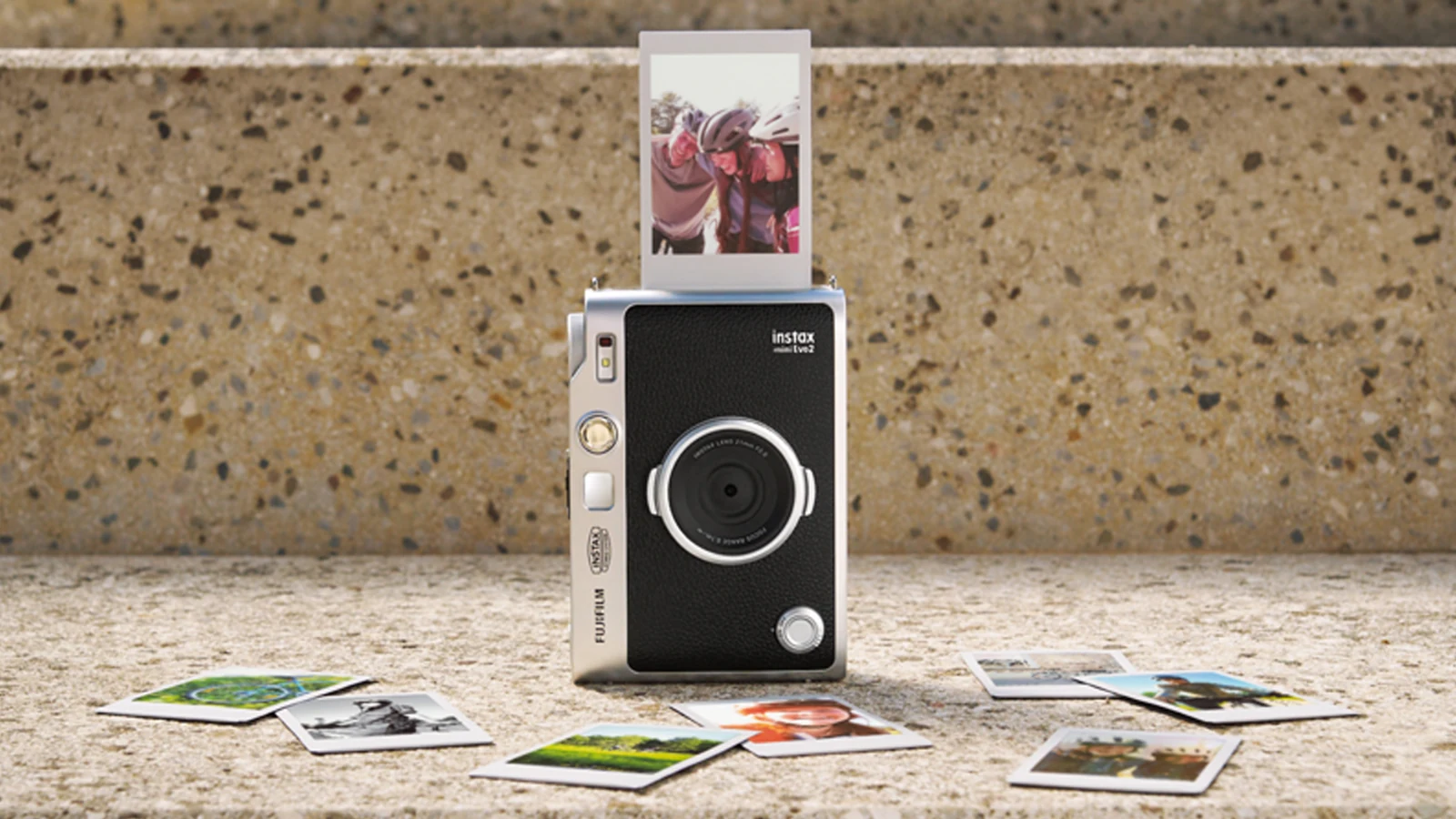
The new instax mini Evo 2, introduced in October, illustrates Fujifilm’s commitment to hybrid instant photography. However, the reported quarter ended before the model’s launch, so its sales must not be credited for these results.
More information here.
A ¥14 billion hit from memory and component costs
Slide 19 of the official presentation forecasts a ¥14 billion impact on Imaging from higher semiconductor memory and IT-component prices in the financial year ending March 2027. The cost impact amounted to ¥2.4 billion in the first quarter and ¥2.5 billion in the second quarter.
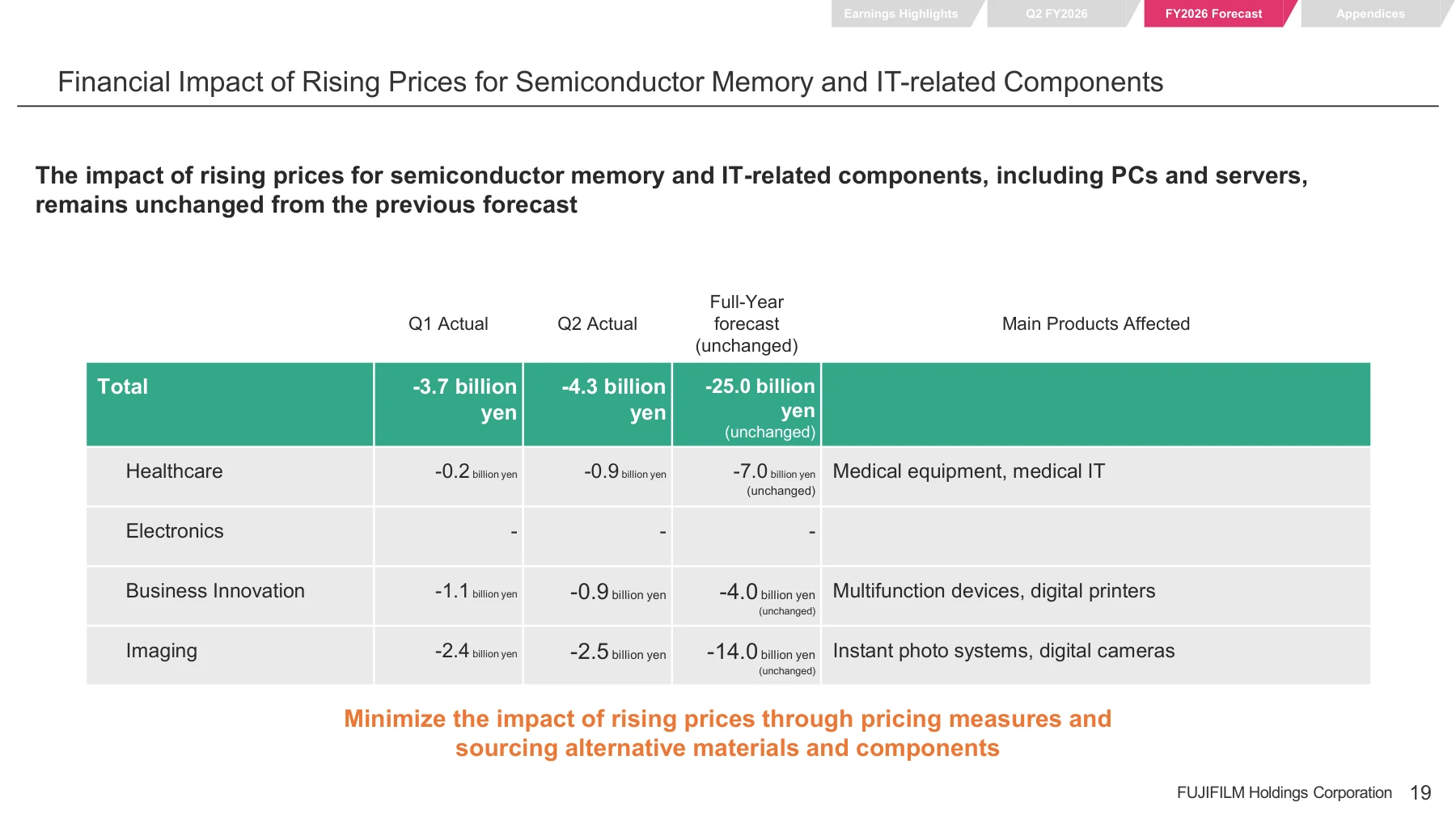
The ¥14 billion figure is an expected business cost, not an announced price increase for any particular camera. Fujifilm says it will pursue pricing measures and alternative materials and components to limit the impact. Rising silver prices are adding another cost pressure.
The pressure follows October price increases of 6%–15% for selected Fujifilm digital cameras in Japan, with larger rises for some Instax products. Those changes apply to the Japanese market and do not represent a newly announced price list for Greece.
What the results mean for the camera market
For the full fiscal year, the group raised its revenue forecast to ¥3.59 trillion while keeping its operating-income forecast at ¥365 billion. Imaging revenue is now expected to reach ¥680 billion, ¥10 billion above the previous forecast, while projected operating income remains ¥162 billion.
The picture is therefore mixed: Fujifilm is benefiting from Instax growth while facing substantial increases in the cost of components used in imaging products. The announcement does not specify another price increase for Greece or Europe.
What we think
For anyone planning a Fujifilm purchase, the implications matter more than another corporate record. Imaging is growing and becoming more profitable, yet component costs are rising enough for the company to openly discuss pricing measures.
The contrast between Instax and digital cameras is also worth watching. Instant printing clearly has momentum, while X and GFX comparisons depend heavily on the timing of new releases. A quarterly revenue decline does not mean enthusiasts and professionals have suddenly lost interest in those systems.
If the camera you need is already available at a good price, this is a reason to keep track of actual local pricing, not to panic-buy. The ¥14 billion figure is a corporate cost estimate and cannot be converted directly into a retail price increase.