Summary
- James Webb reveals stars and protostars at different stages of evolution in NGC 7129.
- The region is about 3,300 light-years from Earth.
- Its golden cavity and red jets reveal how young stars interact with hydrogen gas.
- NIRCam imaging exposes structures hidden by dust.
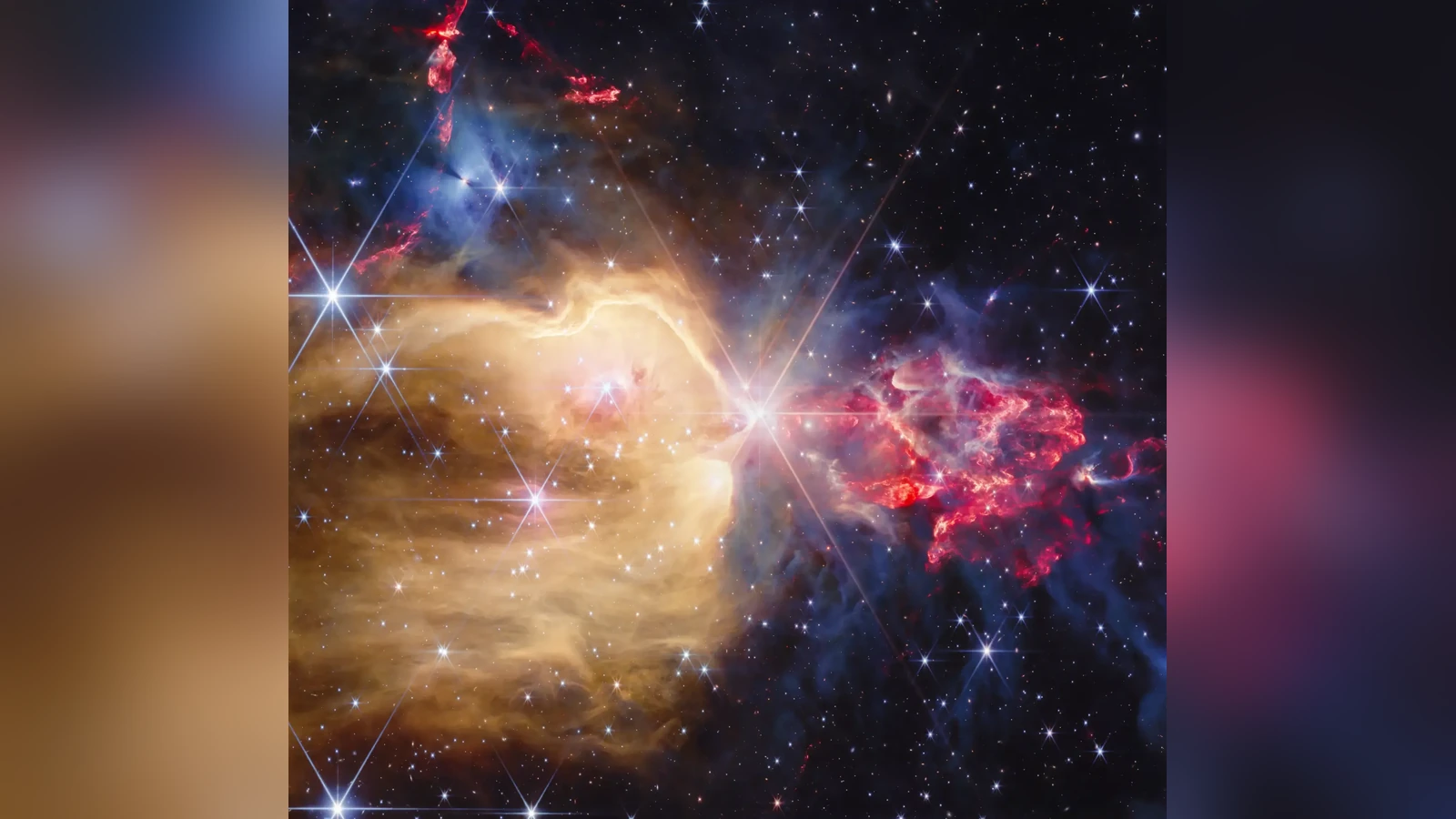
James Webb takes us into NGC 7129, where stars at different stages of development sculpt a striking nebula with radiation, stellar winds and jets of material.
Released by ESA/Webb on 6 October 2026, the Near-Infrared Camera (NIRCam) image reveals intricate details in a star-forming region around 3,300 light-years away in the constellation Cepheus.
ESA also offers two short videos, one zooming towards the nebula and another panning across the image.
https://esawebb.org/videos/weic2620b/
https://esawebb.org/videos/weic2620a/
One nebula, different stages of stellar evolution
Near the centre is LkHα 234, a luminous pre-main-sequence star with approximately five to eight times the mass of the Sun. It has accumulated most of its mass and is still contracting; eventually conditions in its core will allow hydrogen fusion. The striking eight-point pattern around it is caused by diffraction in Webb’s optical system.
To its left, a golden cavity stretches roughly 3.5 light-years. Outflows from an earlier stage of the central star’s life carved into the molecular cloud, while radiation and winds from nearby stars heat and reshape the gas. Bright curved features around some embedded stars mark places where those winds collide with surrounding material.
What the golden and red clouds reveal
The golden region traces hot atomic hydrogen. At the cavity’s bright boundary, stellar radiation breaks hydrogen molecules into atoms, creating a photodissociation region. This process gradually erodes the cloud, while gas compressed elsewhere may provide conditions for new stars to form.
On the right, irregular red structures lie within cooler molecular hydrogen. Much younger protostars are still drawing in surrounding material while also ejecting powerful outflows. These jets crash into dense gas, generating shock waves that heat it. Several overlapping outflows contribute to the tangled appearance.
More red outflows appear in the upper-left portion near a bluish nebula. ESA describes a protostar there surrounded by a disk that casts a shadow across the nebula, reminiscent of the “Bat Shadow” previously observed by Hubble.
How infrared imaging reveals stars hidden by dust
Dust absorbs and scatters much of the visible light, making many newborn stars difficult to observe with conventional optical telescopes. Webb’s infrared sensitivity helps astronomers look through dusty material and examine young objects within the same field.
This is a composite of infrared observations, rather than a picture of what the human eye would see. Visible colours assigned to the data make different conditions in the gas easier to interpret. The infrared panorama of IC 348 offers another example of Webb revealing everything from protostars to exceptionally low-mass brown dwarfs.
What we think
This is the kind of image worth spending more than a few seconds looking at. The contrast between the golden cavity and the red outflows grabs you first. Once you understand what each side represents, you begin to see stars at very different stages of life sharing the same frame.
For anyone interested in photography, the imaging process is just as compelling. These colours are not an attempt to imitate a conventional photograph. They turn information outside human vision into a composition we can examine and understand. That makes the image visually powerful without sacrificing its scientific purpose.
The most fascinating detail may be how the image shows more than stars being born: it also reveals how those young stars begin reshaping the very cloud that made them.
Frequently asked questions
Are these the real colours of NGC 7129?
Not in the sense of what human eyes would see. The image combines infrared NIRCam observations and assigns visible colours to distinguish structures and physical conditions in the gas.
Why do protostars produce jets?
While accumulating material, protostars can eject streams of gas. When these outflows strike the surrounding cloud, they create shock waves and glowing structures.