Summary
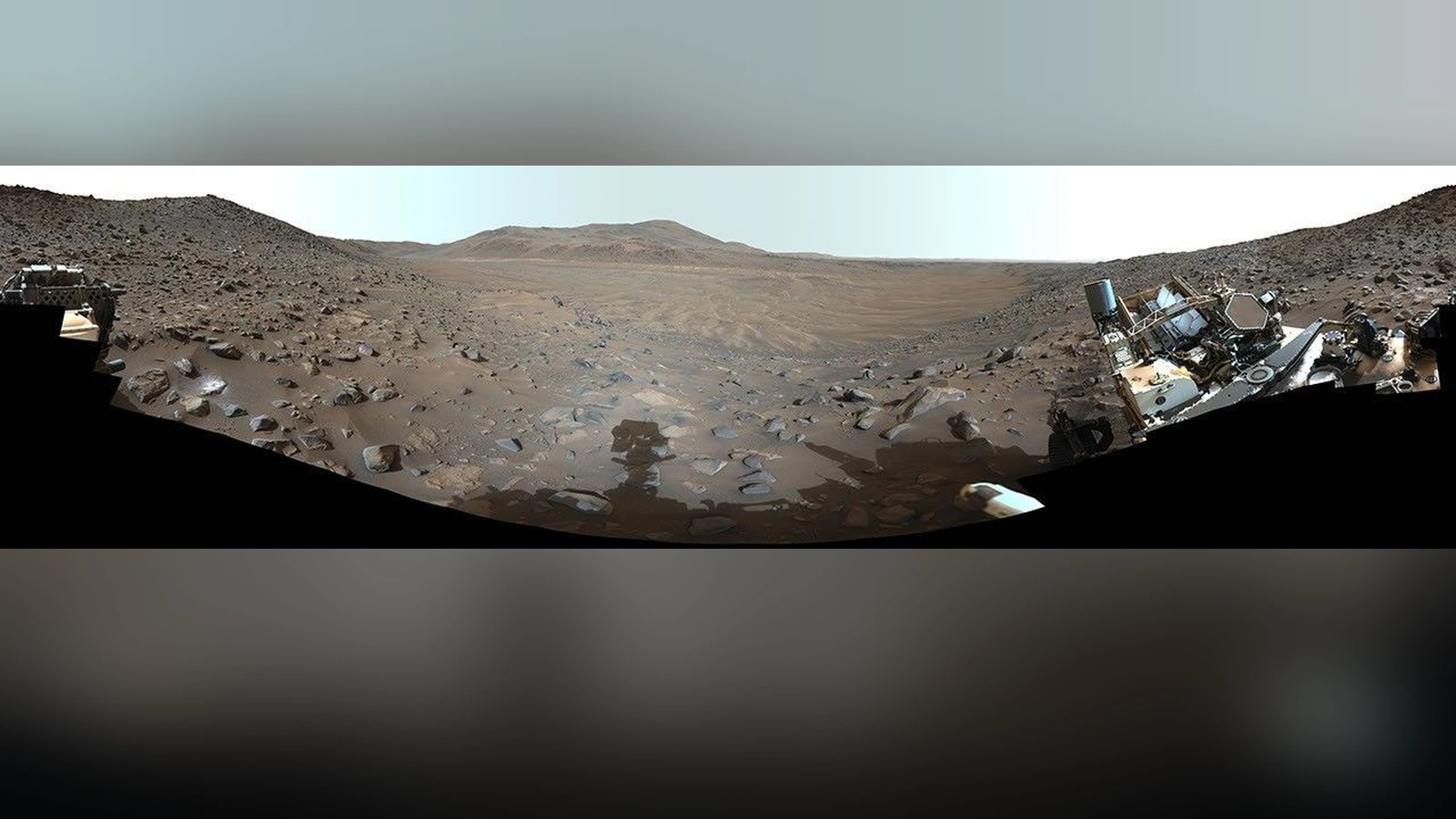
NASA has stitched 217 Perseverance photographs into a 360° panorama of Neretva Vallis, an ancient river valley on Mars.
The images were captured on May 20, 2024, the mission’s 1,155th Martian day, or sol, and the panorama was published in NASA’s Photojournal on October 26, 2026. The result is a genuine photographic mosaic of the landscape inside Jezero Crater.
How the 217-image panorama was made
The rover’s Mastcam-Z camera system captured the individual frames, which were stitched into one continuous panoramic view. Parts of the rover itself appear on both sides of the image, while rocks, dust and low hills stretch across the center. The irregular black area along the bottom marks the edge of the released mosaic; it is not dark Martian terrain.
Mastcam-Z helps document terrain and also performs less conventional observations. The same camera system captured Earth passing behind Phobos, an example of the very different photographic tasks performed by Perseverance.
A dry valley that once carried water
Neretva Vallis is now a dusty, wind-swept landscape. Billions of years ago, however, a river channel here carried fresh water into Jezero Crater. This panorama connects what the ground looks like today with its very different geological past.
Perseverance has continued exploring and traveling across Mars since these photographs were taken. In October 2026, it surpassed Opportunity’s total-distance record, showing how much ground the rover has covered since its visit to this valley.
Why the colors have been enhanced
NASA describes this release as an enhanced-color image. Its color bands were processed to increase visual contrast and make subtle differences in the terrain easier to distinguish. The resulting colors should therefore not be treated as an exact depiction of what a person would see from the same location.
NASA’s official image page also provides a high-resolution TIFF file for anyone who wants to examine the mosaic in more detail.
What we think
Anyone who has assembled a large panorama knows the importance of frame overlap and accurate stitching. Here, 217 separate photographs were collected by a robot on another planet. That alone makes this image remarkable, even without the dramatic rock formations we often associate with Martian photography.
We also like the fact that the full scene includes parts of the rover and the uneven edges of the mosaic. This is not a polished travel photograph. It retains traces of how the picture was actually captured, making the camera’s exploratory role easier to understand.
The enhanced-color label matters just as much. Processing can help reveal small variations in the ground, provided the viewer understands what has changed. It is a useful reminder for our own photography too: color can communicate information, not merely shape the mood of an image.
Frequently asked questions
Is this a single photo or a composite?
It is a composite of 217 individual photographs captured by Perseverance’s Mastcam-Z camera system on May 20, 2024.
Is the 360° panorama a video?
No. It is a still photographic mosaic covering a 360-degree view around the rover.
Are these exactly the colors a human would see on Mars?
Not exactly. This particular version uses enhanced colors to improve contrast and make differences in the ground easier to see.