Summary
- Photographer Dave Wilson challenged Whitehaven lighthouse images described as storm-time drone photographs.
- Provenance checks flagged AI signals in the disputed picture and additional portfolio images.
- Aerial Perspectives acknowledged that one image should not have been presented as genuine, while rejecting claims about the whole portfolio.
- The case underlines the value of original RAW files and transparent editing histories.
A dramatic image of Whitehaven Lighthouse battered by storm waves was presented as a risky drone photograph, until a local photographer began asking whether the scene had ever been captured that way.
Dave Wilson, a Cumbrian photographer and certified commercial drone pilot, publicly challenged images shared by Aerial Perspectives. His investigation led to an acknowledgement that at least one image should not have been presented as genuine photography.
The storm photograph that raised serious questions
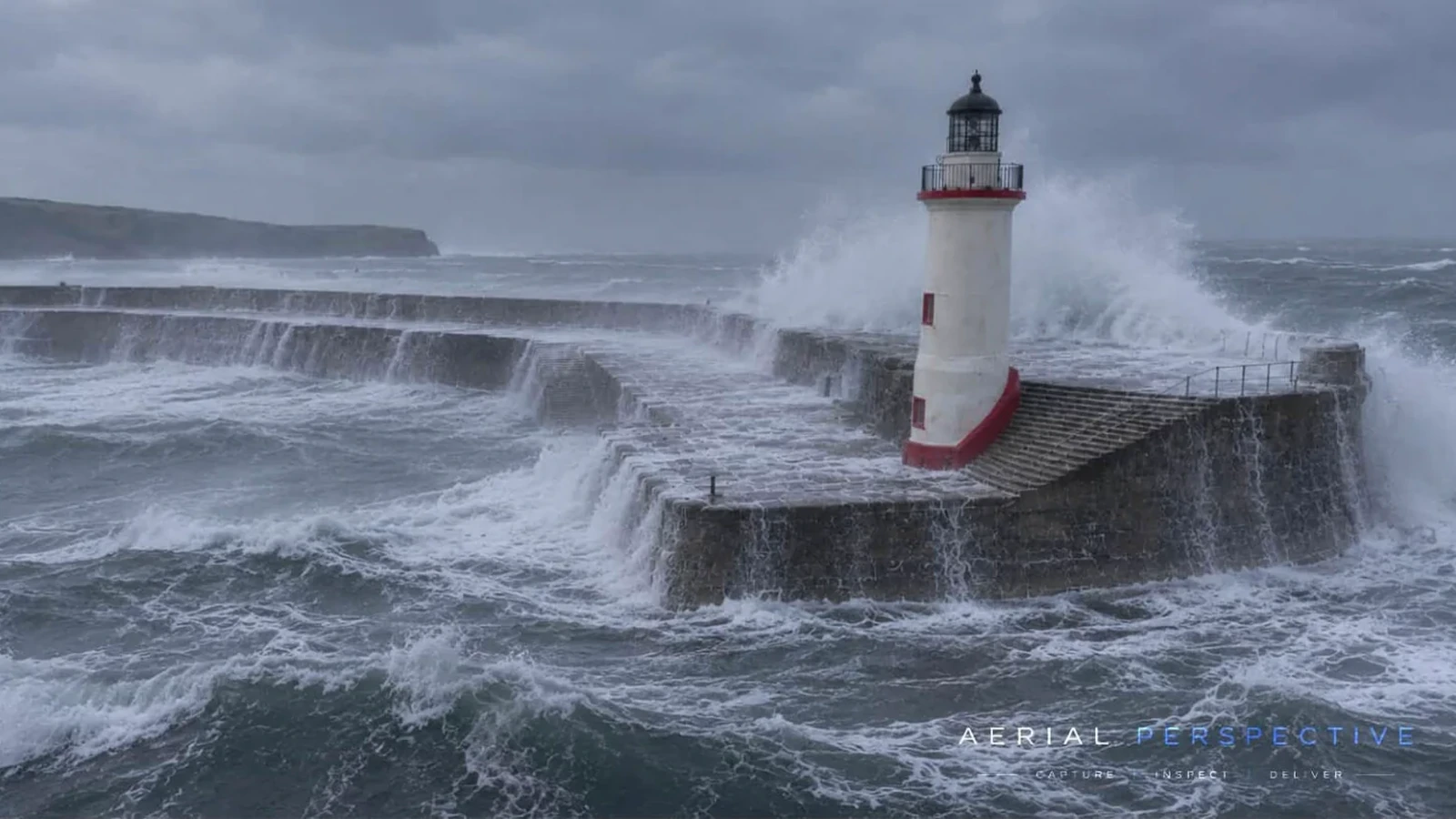
On October 25, 2026, Aerial Perspectives posted pictures of the lighthouse surrounded by huge waves on Facebook, joking that almost losing the drone had been worth it. The photos also appeared on the local myWhitehaven Facebook page, where Wilson spotted them.
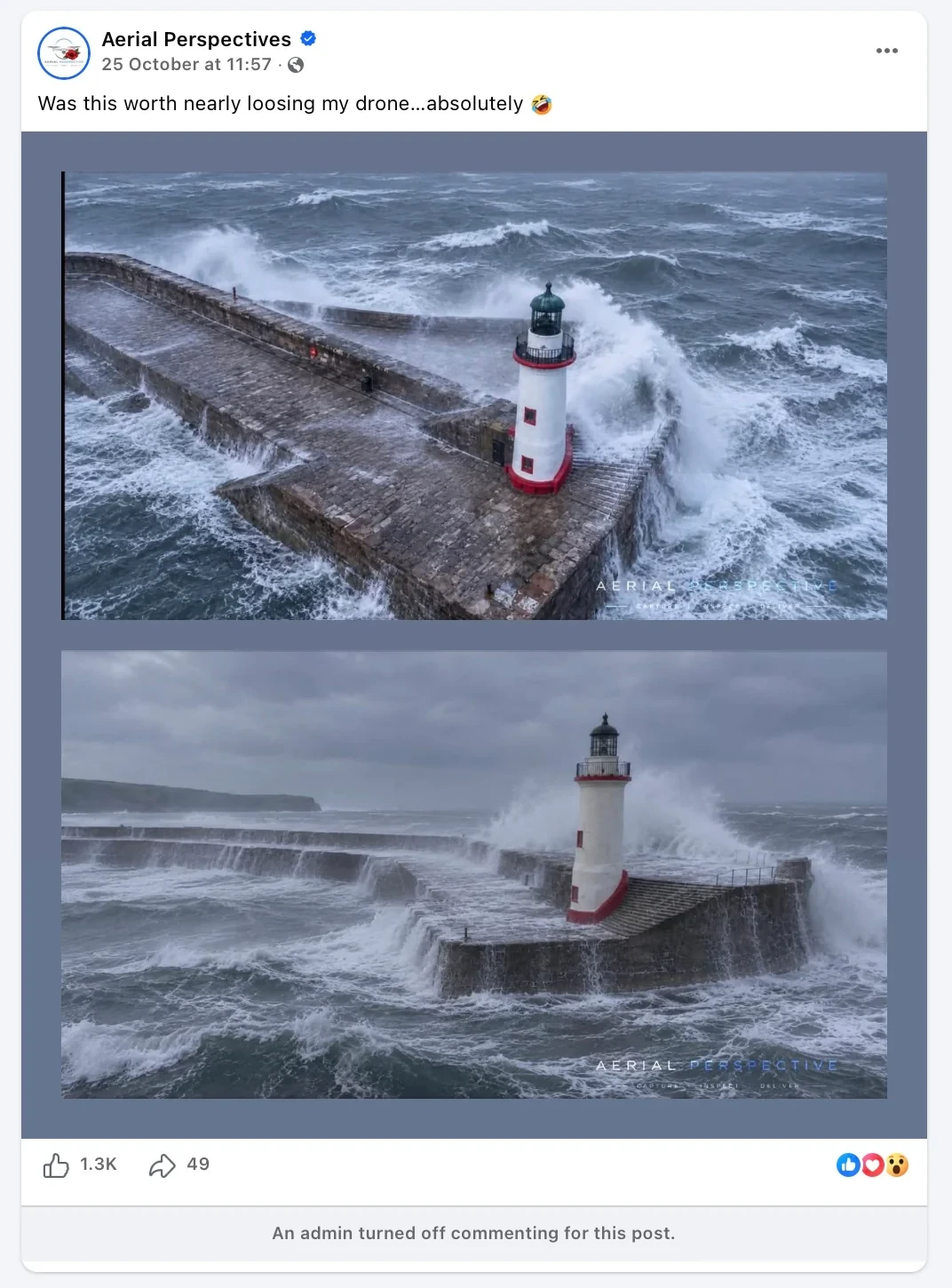
The company initially insisted that the pictures had been captured using a DJI Air 3S. Yet wind gusts of up to 77 mph (around 124 km/h) had been reported in the area. Wilson argued that attempting such a flight would be extremely dangerous and hard to reconcile with the drone’s capabilities.
DJI specifies maximum wind resistance of 12 m/s for the Air 3S, approximately 43 km/h. A reported gust in the wider area does not establish the wind speed at the precise place and moment of the alleged capture, but it explains why the claim immediately raised serious doubts. Administrators of the myWhitehaven page removed Wilson’s questioning comments.
More information here.
AI verification and the wider portfolio
Wilson went beyond the weather conditions. He checked the images using a provenance verification service and shared his findings in an October 26 video. The result shown for the disputed image displayed “Generated with OpenAI tools” and “SynthID detected,” while also reporting that trusted OpenAI Content Credentials were not detected.
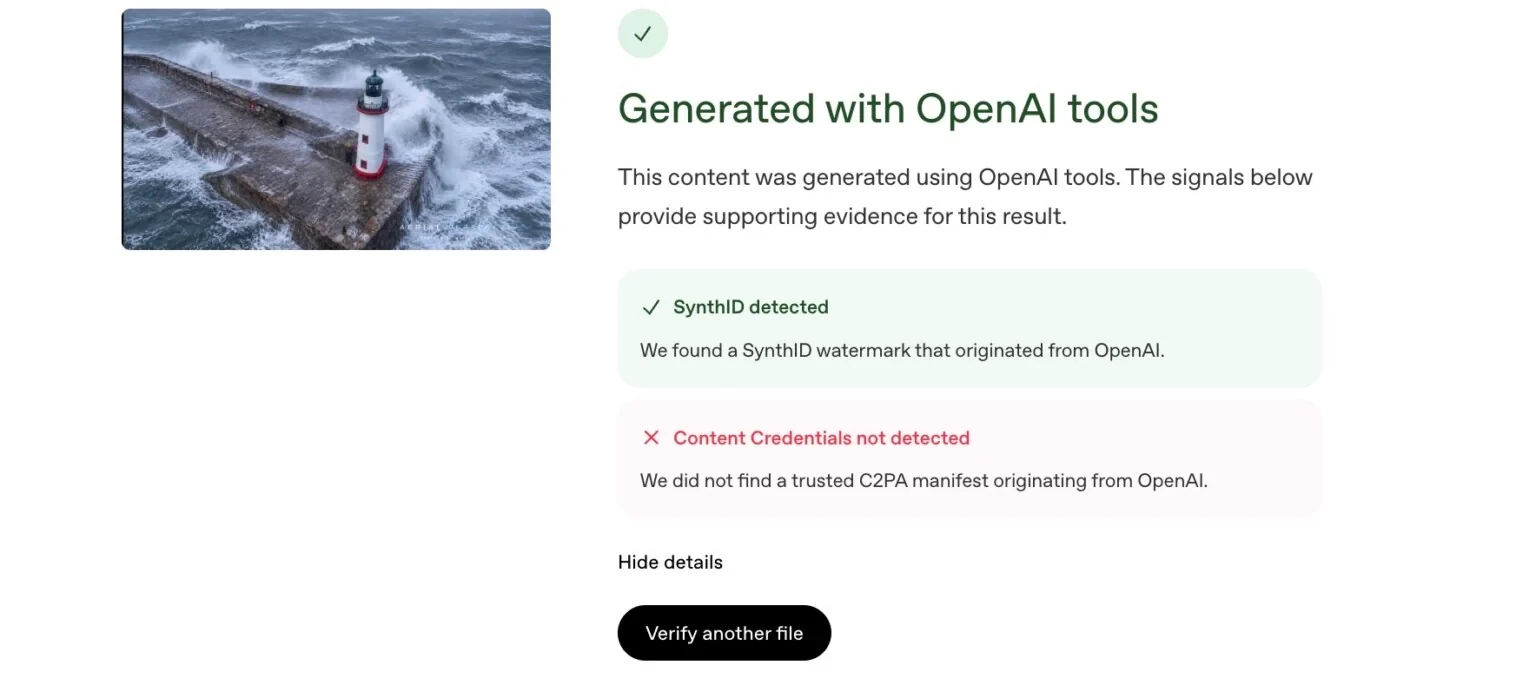
Wilson then examined more pictures from the Aerial Perspectives portfolio. He reported that virtually all the pictures he checked produced a similar AI signal. This raises substantial questions about generative processing or creation, but it does not by itself prove that every depicted landscape was entirely fabricated.
What the company acknowledged — and what it disputes
Aerial Perspectives initially maintained that the storm pictures were genuine, stating that its team included three drone pilots and two people handling administration. Later, a representative identified as Jake acknowledged that the storm image should not have been presented as authentic photography, attributing its creation to a former team member.
At the same time, the company rejected the assertion that its entire portfolio was AI-generated. It said it had genuine photography from Cumbria, with original files and supporting metadata. It also said it used ChatGPT to add its business watermark to photographs, which, in its view, could explain AI detection on other images.
The November 3 report noted that the company had been asked to supply the original RAW files for examination. Without reviewing those files, it would be premature to label all of the remaining photographs synthetic. Wilson returned to the issue in a follow-up video assessing the company’s responses.
Why authenticity matters in a professional portfolio
A file can show signs of AI use because generative editing took place, even when the underlying frame began as a real photograph. Distinguishing actual location photography, substantial manipulation, and fully synthetic scenes matters when a portfolio is presented as evidence of on-location shooting skills.
Similar questions arose when Tokina withdrew a winning photograph after an AI-related controversy, and in the Airbnb claim supported by an AI-altered damage image. These are distinct cases, but each turns on the same essential question: what was captured, and what was changed afterwards?
What we think
An image of a lighthouse engulfed by waves can be striking on its own. But when a creator says they flew a drone through those conditions to get it, the claim becomes about real photographic work too: preparation, flying skill, risk and experience. If that story is fabricated, it changes what the image represents.
The commercial portfolio is the crucial part. Clients are not just buying attractive files. They trust that the person behind the camera can actually produce that work on location. An AI composite may be a legitimate creative piece, but it needs to be described as one, not used as evidence of capture skills that were never demonstrated.
The verification also needs proportion. A positive AI tool result is evidence to investigate, rather than a verdict on an entire body of work. For a serious review, ask for the source RAW or DNG files, examine the editing history and, for drone work, flight records where available. There is no need to condemn every image in the portfolio to state plainly that the picture the company acknowledged should never have been presented as an authentic capture.
Frequently asked questions
Does SynthID prove an entire image was generated by AI?
Not necessarily. A detected watermark indicates the use of compatible AI tools, but does not on its own show how much of an image was altered or whether an original photograph existed.
How can a disputed drone photograph be checked?
Useful evidence includes the original RAW or DNG file, editing history, capture data and any available flight logs. Automated detection results should be evaluated alongside these records, not treated as the only proof.