

Summary
- NASA and SpaceX are targeting the Roman launch for August 30, 2026.
- Liftoff is scheduled for no earlier than 11:26 UTC.
- NASA's live coverage begins at 10:20 UTC.
- Roman has a field of view at least 100 times larger than Hubble's.
- It will investigate dark energy, dark matter, exoplanets and billions of galaxies.
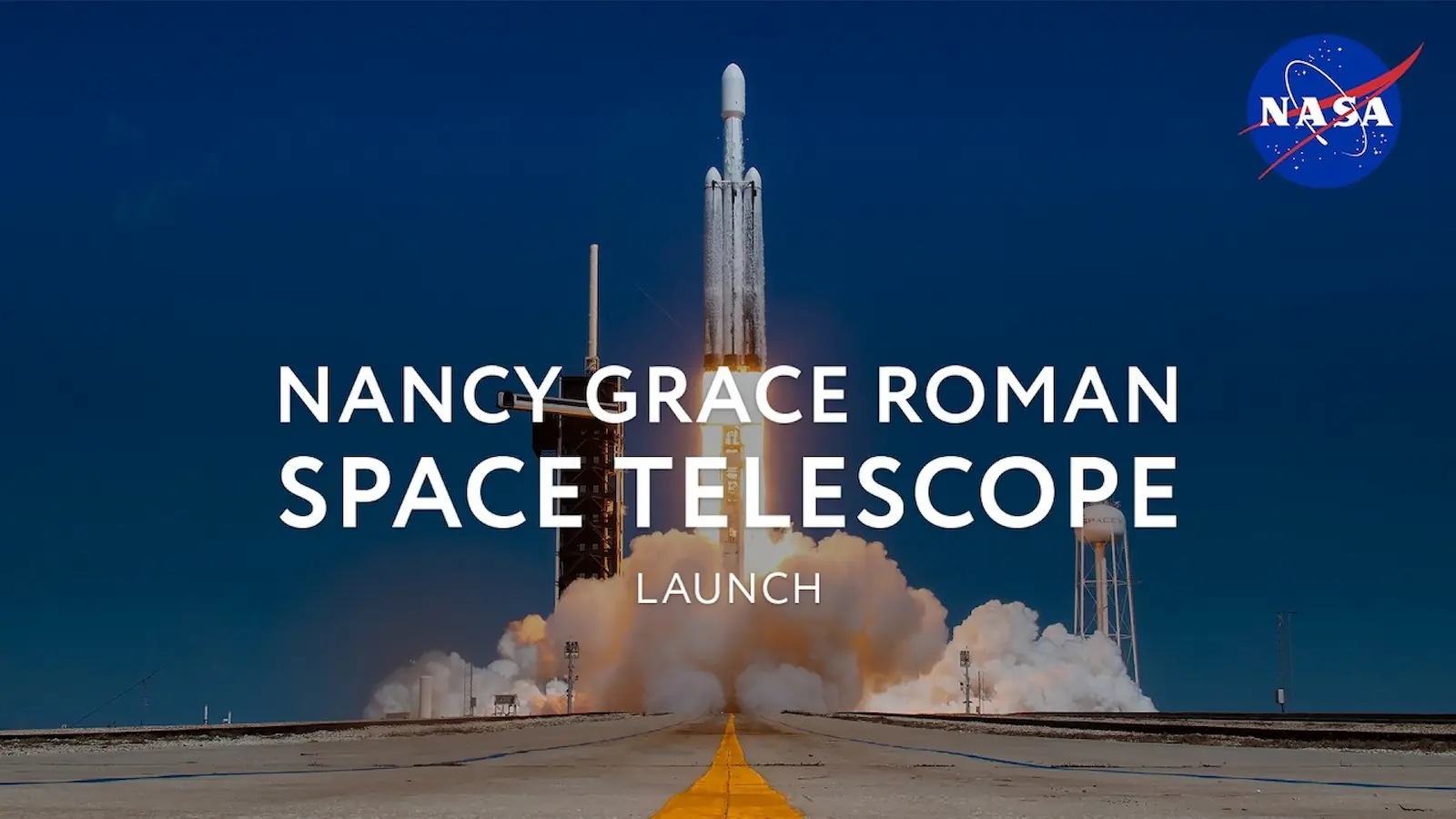
In three days, NASA and SpaceX plan to launch the Nancy Grace Roman Space Telescope, a new observatory combining Hubble-like sharpness with a field of view at least 100 times larger.
Liftoff is scheduled for Sunday, August 30, 2026, no earlier than 11:26 UTC. Roman will ride a Falcon Heavy from Launch Complex 39A at NASA’s Kennedy Space Center in Florida.
Launch time and live coverage
- 10:20 UTC: NASA’s official live coverage begins.
- 11:26 UTC: Scheduled Falcon Heavy liftoff.
- 13:30 UTC: Planned postlaunch news conference.
NASA notes that all times are subject to weather and real-time operations. The “no earlier than” wording matters because a space launch can still be delayed during the final countdown.
A field at least 100 times wider than Hubble’s
Roman has a 2.4-meter primary mirror, similar in diameter to Hubble’s. The major difference is the amount of sky it can record in each observation.
Its field of view is at least 100 times larger than Hubble’s, allowing it to create deep and sharp infrared images across enormous regions of the sky. Surveys that would demand vast amounts of Hubble time can be completed far more efficiently.
The Wide Field Instrument at its core is a 288-megapixel camera built for large-scale mapping. NASA says Roman could measure light from up to a billion galaxies over its operational lifetime.
Dark energy and dark matter
One of Roman’s central goals is to help explain why the expansion of the universe is accelerating. By measuring galaxies, supernovae and the distribution of matter across huge cosmic scales, it will investigate dark energy and dark matter.
Roman is not designed to replace Hubble or the James Webb Space Telescope. Instead, it adds an exceptionally broad view to the detailed, narrow-field observations delivered by those observatories.
Exoplanets and direct-imaging technology
Roman will conduct a statistical census of planetary systems in the Milky Way using gravitational microlensing. Its observations can reveal planets far from their stars as well as free-floating planets without host stars.
The observatory also carries the Coronagraph Instrument, a technology demonstration designed to block the overwhelming light of nearby stars and image much fainter exoplanets and planet-forming disks.
Destination: Sun-Earth L2
After launch and separation from Falcon Heavy, Roman will travel to the second Sun-Earth Lagrange point, or L2. It lies about 1.5 million kilometers from Earth, in the same broad region used by James Webb.
The primary mission is planned for five years, with a goal of operating for ten. Scientific data will be made publicly available after processing.
From completion to the launchpad
In December 2025, PTTL covered the completion of the Nancy Grace Roman Space Telescope. Since then, the observatory has passed final tests, traveled to Florida, been fueled and been enclosed inside Falcon Heavy’s payload fairing.
Only final checks, weather and the countdown now remain. If everything proceeds as planned, one of the decade’s most important astronomy missions will begin at 11:26 UTC on Sunday.