Summary
- Brian May and Claudia Manzoni created stereoscopic views of Didymos using ESA photographs.
- Hera captured the images on 6 November 2026.
- Three viewing formats include red-cyan glasses and two side-by-side stereo pairs.
- Hera is studying the asteroid system where NASA’s DART struck the smaller Dimorphos.
Queen guitarist and astrophysicist Brian May has teamed up with Claudia Manzoni to turn two Hera spacecraft photographs of asteroid Didymos into striking stereoscopic images.
The European Space Agency unveiled their work on 19 November 2026. This is neither digital painting nor an imagined reconstruction: the depth effect comes from actual photographs of the same surface captured from slightly different viewpoints.
Two frames captured from 29.7 kilometres away
Hera photographed Didymos on 6 November while moving around the binary asteroid system. The two adjacent frames were captured from roughly 29.7 kilometres away, at a scale of 2.8 metres per pixel. They came from the monochrome Asteroid Framing Camera, whose principal investigator is Jean-Baptiste Vincent of the German Aerospace Center (DLR).
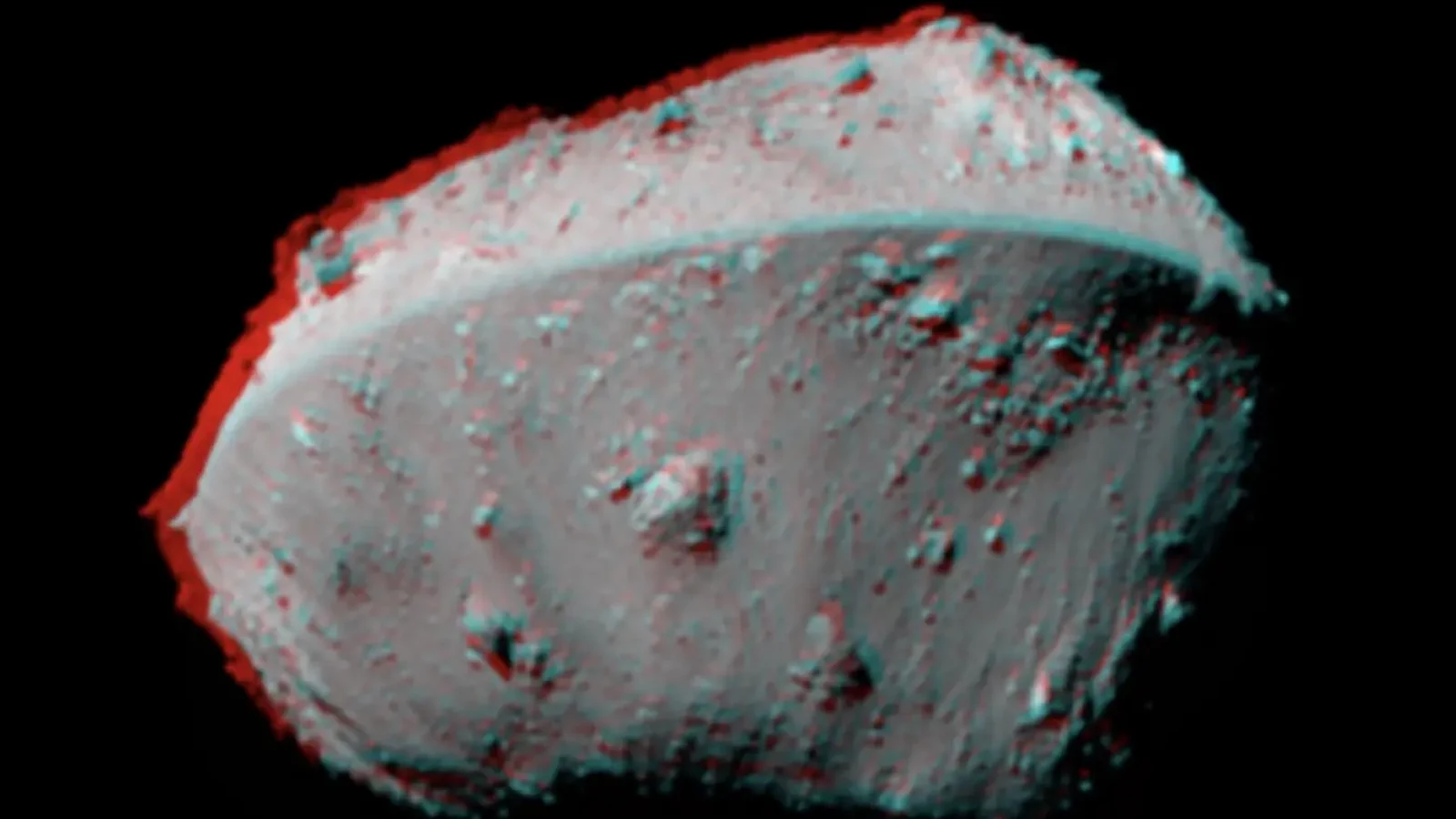
May and Manzoni aligned the frames so that the tiny shift in perspective works much like the difference between the views captured by our own eyes. Didymos’s pronounced equatorial ridge stands out from its otherwise boulder-strewn surface. As May points out, the ridge’s sharp yet smooth appearance becomes especially clear when seen in depth.
Three ways to see the asteroid in 3D
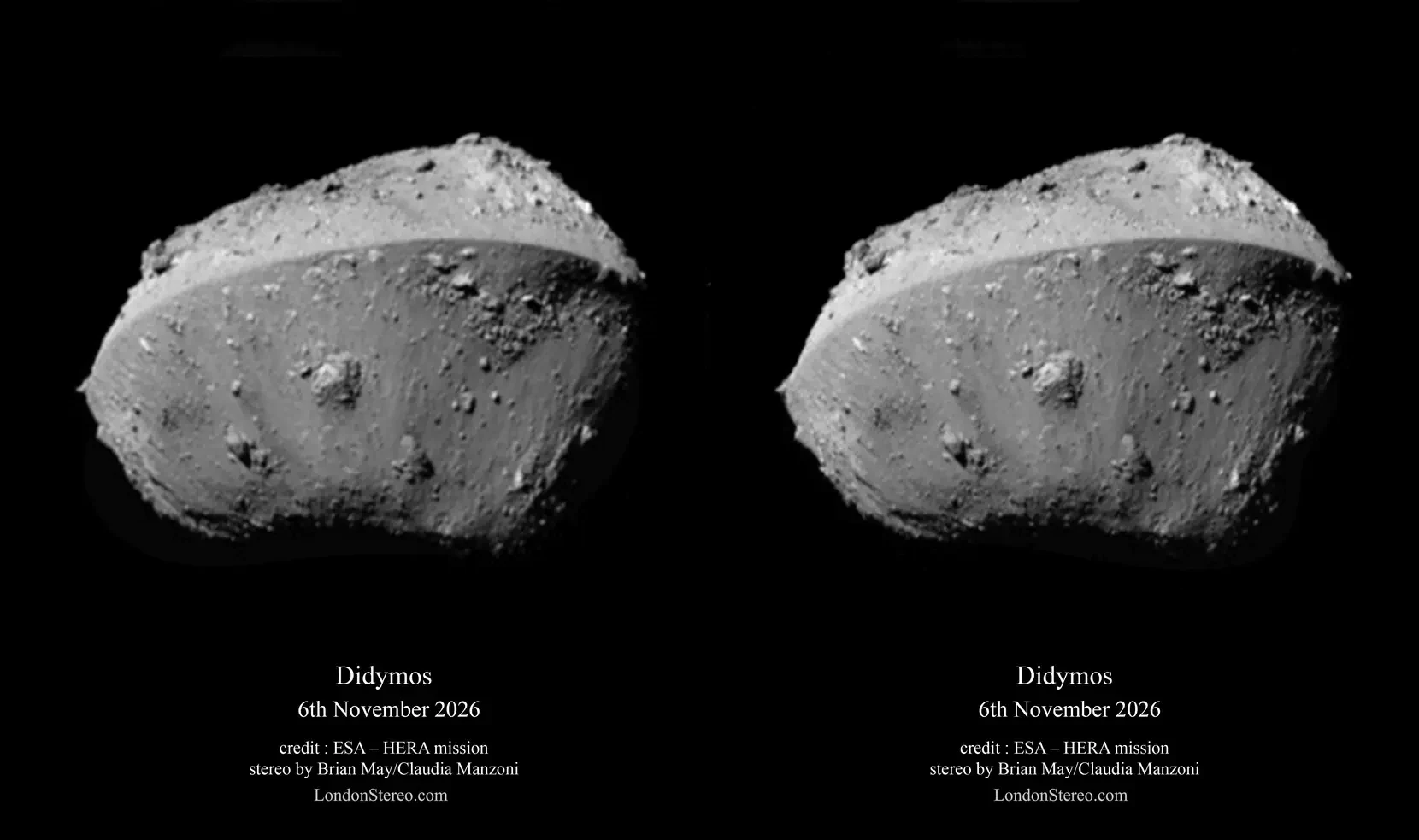
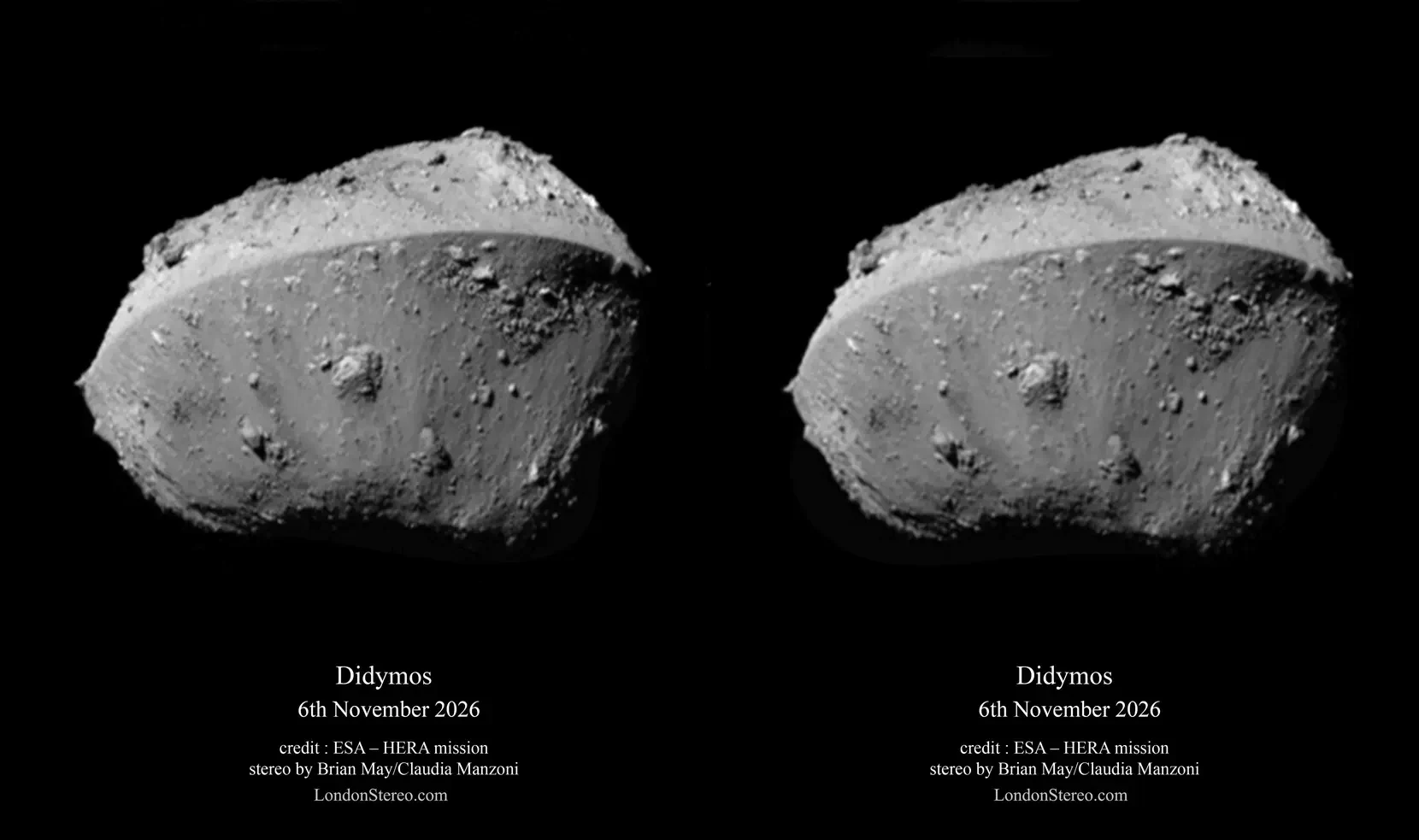
The first composite is a red-cyan anaglyph, with the colour channels separated by matching 3D glasses. Two other versions place the images side by side: one for cross-eyed viewing, and the other for parallel viewing, where the eyes are directed as though looking beyond the screen. A compatible stereoscope also works.
Free-viewing stereoscopic pairs takes practice and may not be comfortable for everyone. May also designed the OWL stereoscope, sold by the London Stereoscopic Company. All three images show the same asteroid; only the presentation method changes.
Brian May is part of the science team for a reason
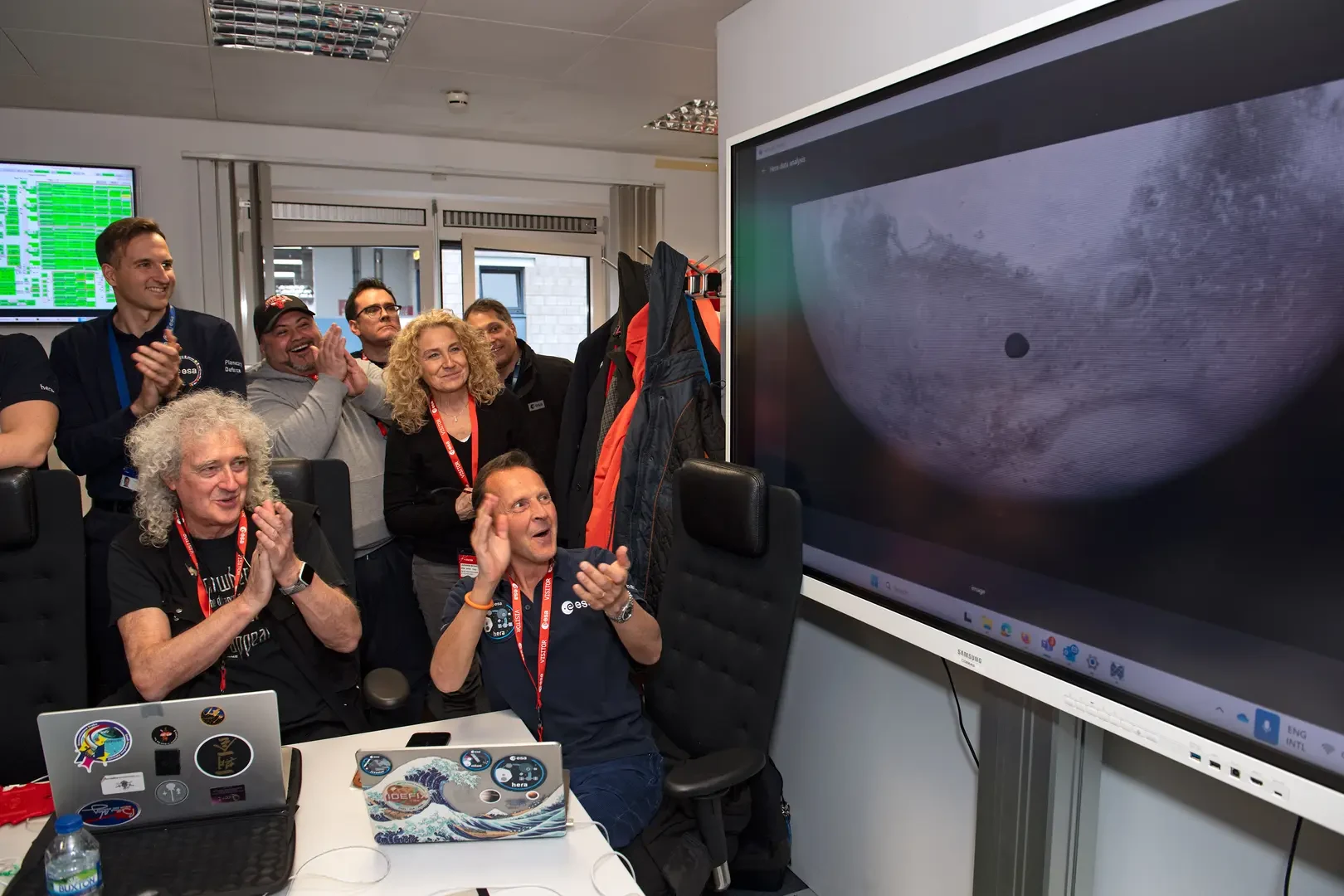
Beyond his music career, May is an astrophysicist and member of Hera’s science team. Stereoscopic imaging is a longstanding interest of his. Similar composites made from Hera’s photographs of the Martian moon Deimos during its 2025 flyby were used in a simulation-based study of the moon’s past.
From stereoscopic depth to planetary defence
The frames were captured as Hera investigated the Didymos–Dimorphos system, around 197 million kilometres from Earth. The smaller Dimorphos does not appear in these particular stereo views. That is the asteroid struck by NASA’s DART spacecraft in 2022, which changed its orbital period around Didymos.
Hera is now investigating the system at close range to better understand the results of the impact and how future asteroid deflection might work. Hera’s first close-up photograph of Didymos had already revealed the rocky terrain; the stereoscopic treatment now makes its shape easier to perceive in depth.
ESA has scheduled another presentation of close-up images of Dimorphos for Wednesday 25 November, with a livestream from 19:45 to 20:30 CET.
What we think
The best part of this story is not simply that Queen’s guitarist is working with asteroid imagery. It is the way two nearly identical monochrome photographs, captured with a minute difference in angle, can reveal something a single flat picture struggles to convey: the shape and volume of an object.
For photographers, that is the useful lesson. There was no need for a new camera, colour information or processing that invents surface texture. What makes the difference is the geometry of the capture and careful alignment. Even a slight movement in viewpoint can supply the visual cues our brains use to sense depth.
Look closely at the long ridge across the top of Didymos in the red-cyan image, then at the individual boulders. Those are the details that make stereoscopy valuable for reading complex terrain, rather than merely producing a striking visual effect.
Frequently asked questions
Do you need 3D glasses to see these images?
Only for the red-cyan anaglyph version. The two monochrome stereo pairs can be viewed without glasses using cross-eyed or parallel viewing respectively, or with a suitable stereoscope.
Is this a complete 3D model of Didymos?
No. It is stereoscopic imagery made from two real photographs, creating a sense of depth when both frames are presented correctly to the eyes. It is not a fully rotatable geometric model.