Summary
- ESA has published Hera’s first close-up view of the Didymos–Dimorphos system.
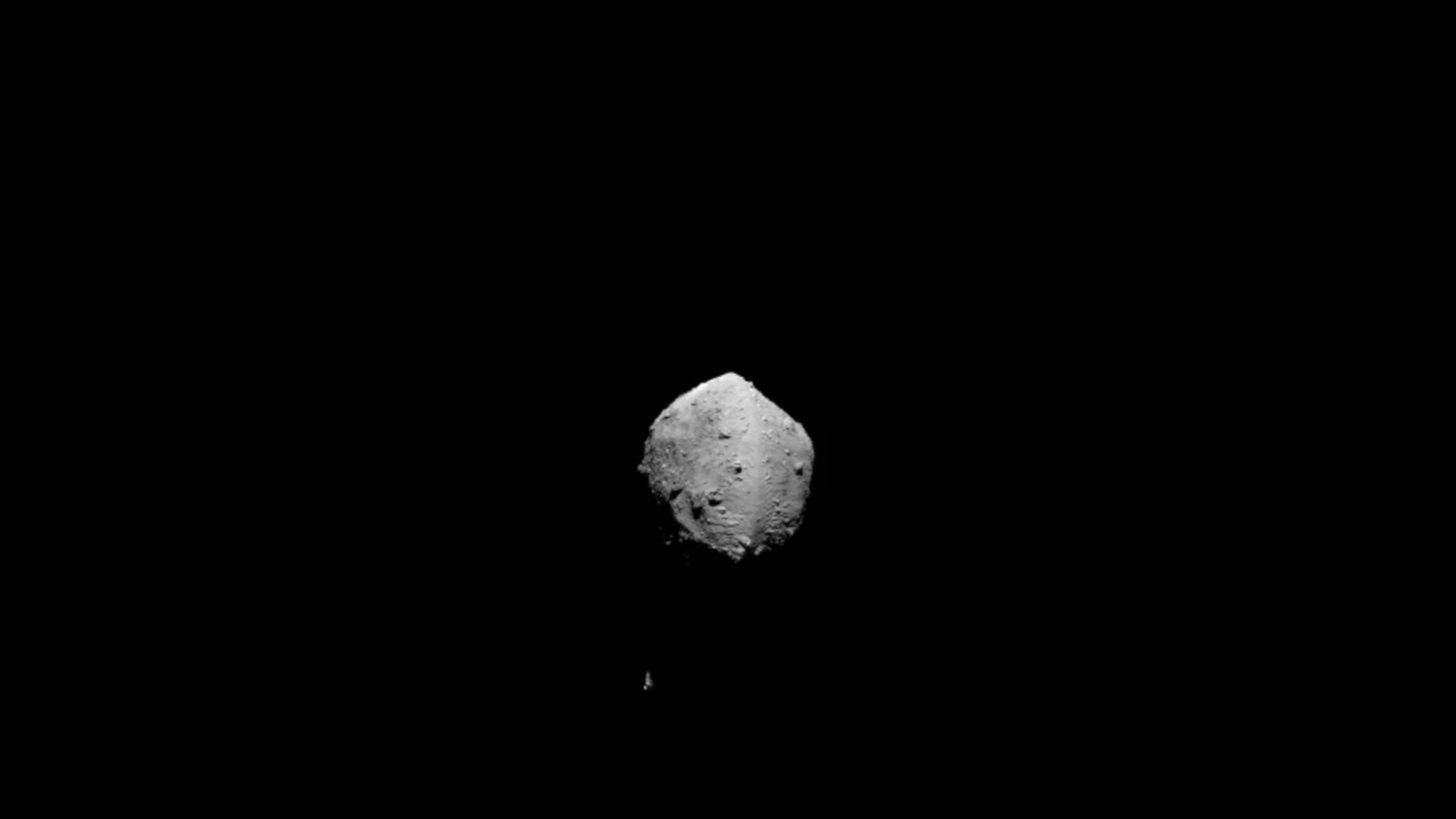
- Its monochrome camera reveals boulders, craters and surface features on Didymos.
- Hera will investigate the effects of DART’s impact on the smaller Dimorphos.
- More detailed images are expected on 25 November 2026.
ESA’s Hera mission has returned a striking new close-up of asteroid Didymos, revealing rocky details on a side that NASA’s DART camera had not shown in this way.
Published on 5 November 2026, the image was captured by the European spacecraft’s monochrome Asteroid Framing Camera. Didymos appears in clear relief, while its smaller companion Dimorphos remains largely obscured in shadow.
A new face of the asteroid
Didymos is approximately 780 metres across, while Dimorphos measures about 151 metres. This newly observed side of the larger body shows boulders, craters and features resembling grooves or ridges. Its central equatorial ridge is also visible, a feature already recognised in earlier observations.
Hera principal investigator Patrick Michel describes the image as showing the opposite side of Didymos from the one seen by DART’s camera shortly before impact. Scientists are investigating whether material ejected from Dimorphos reached its larger companion and contributed to the surface features. That remains a hypothesis to examine, not a conclusion from one photograph.
Why Hera is revisiting DART’s impact site
On 26 September 2022, NASA’s DART spacecraft deliberately struck Dimorphos, shortening its orbital period around Didymos by approximately 33 minutes. This was the first measurable change to a celestial body’s orbit caused by human action.
Hera is now visiting the binary system to study it up close, map its surfaces and help researchers understand how effectively momentum is transferred during such an impact. Its measurements could make kinetic asteroid deflection a better understood and more reliable planetary defence method if it is ever needed.
A camera built for science
The Asteroid Framing Camera does much more than produce dramatic pictures. It supports optical navigation and geological observations, allowing images taken from different positions to contribute to detailed mapping. Monochrome imagery shows variations in brightness and shadows that make surface relief easier to distinguish.
Close-up images have also been central to other small-body missions: OSIRIS-REx’s sampling of asteroid Bennu used surface imaging to plan and execute a carefully targeted approach.
ESA plans to unveil more detailed images of both asteroids on 25 November 2026. This first view is an opening look at a system that will soon be mapped much more extensively.
What we think
What stands out is how much the shadows reveal in an almost black-and-white picture. At first glance, it is a small rock against a black background. Look a little closer and the texture, contours and marks across its surface begin to emerge.
For photographers, it is a great demonstration of how much the direction of light matters. In space, you cannot move a light to fill a shadow or ask the subject to turn. You need the right trajectory, carefully planned imaging and repeated observations.
There is something else we like about this frame: it works both as an image and as measurable scientific data. Its real usefulness will increase when the next photographs can be compared with it and with the evidence from DART’s impact.
Frequently asked questions
Was Didymos the asteroid struck by DART?
No. DART struck the smaller Dimorphos, which orbits the larger Didymos.
Why is the picture monochrome?
The Asteroid Framing Camera captures monochrome visible-light images. Brightness differences and shadows help scientists study surface shape and navigate near the asteroid.