

Summary
- MTG-I2 launched successfully aboard Ariane 6 on August 27, 2026.
- ESA’s Malindi ground station received the first signal immediately after separation.
- The satellite will image Europe and North Africa every 2.5 minutes.
- Together with MTG-I1 and MTG-S1, it completes the first trio of Europe’s new Meteosat generation.
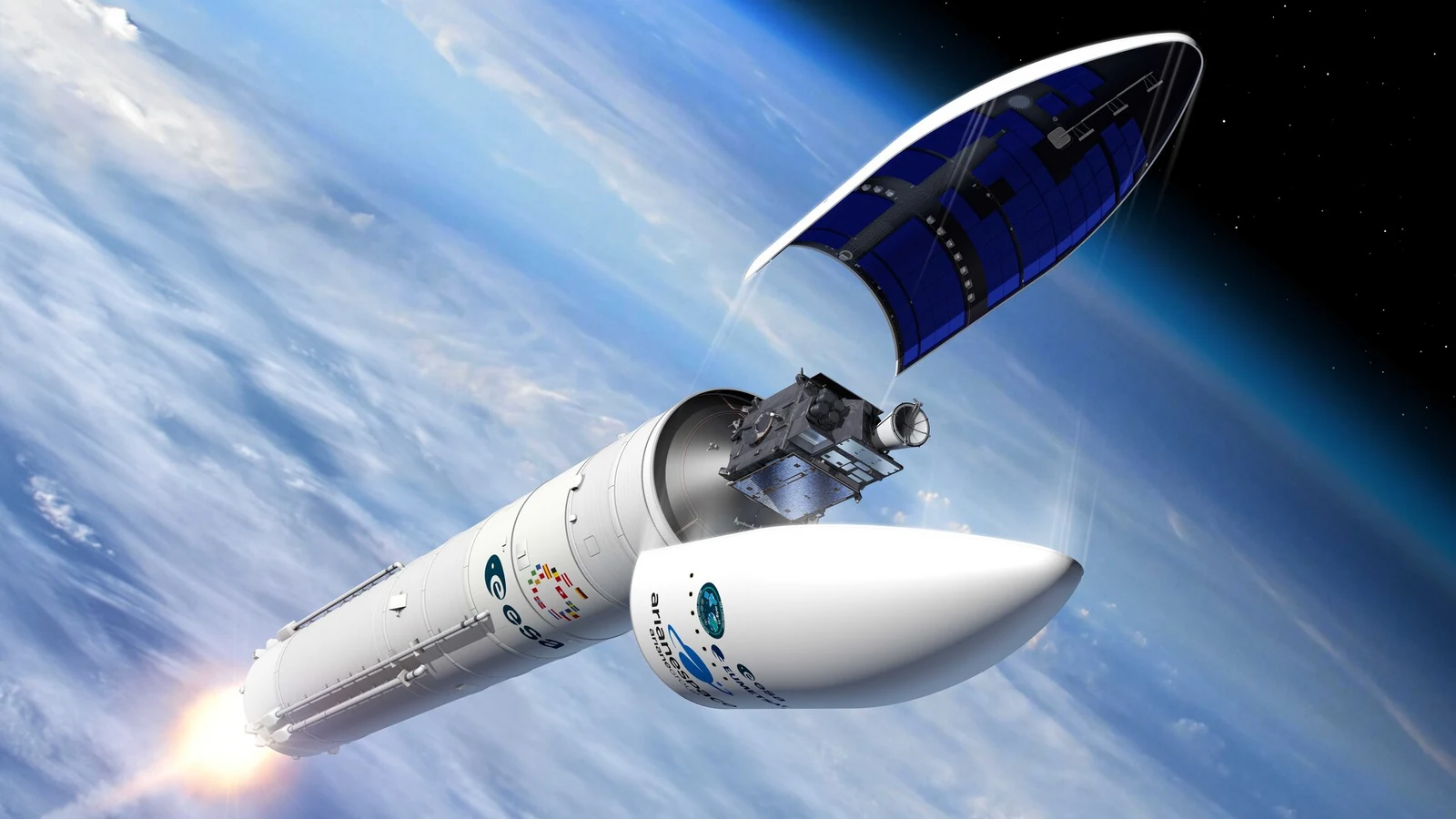
The Meteosat Third Generation Imager 2 satellite has launched successfully aboard Ariane 6, completing the first trio of Europe’s new-generation weather satellites.
MTG-I2 lifted off from Europe’s Spaceport in Kourou, French Guiana, at 22:11 Central European time on Thursday, August 27, or 23:11 in Greece. After separation from Ariane 6, ESA’s Malindi ground station in Kenya immediately received the first signal, confirming that the spacecraft was communicating with Earth.
The launch has practical significance for Europe because the satellite will do more than add another weather image. Together with MTG-I1 and MTG-S1, it creates a three-dimensional observing system that combines rapid optical imaging, lightning detection and vertical atmospheric profiles, allowing forecasts and early warnings to use more frequent and comprehensive data.
The launch and first signal
Mission VA270 was the ninth flight of Ariane 6 and its first mission to geostationary transfer orbit. According to ESA, it was also the new European rocket’s farthest flight to date. MTG-I2 will use its own propulsion to raise its orbit gradually and reach the geostationary belt, approximately 36,000 kilometres above the Equator.
Reception of the signal at Malindi was the first critical milestone after launch. Deployment, transfer to the final orbital position and an extensive period of testing and calibration now follow. Only after commissioning is complete will the satellite join Eumetsat’s operational meteorological service.
What MTG-I2 will image
The main imaging instrument is the Flexible Combined Imager, a multispectral sensor observing Earth in 16 channels. It can provide a full view of the visible Earth disc every ten minutes and higher-temporal-resolution images of Europe and North Africa every two and a half minutes. That frequency is crucial when clouds and storms develop quickly.
The satellite also carries the Lightning Imager, the first European instrument in geostationary orbit to monitor lightning continuously across the full visible disc. This capability helps meteorologists identify rapidly intensifying storms, including over seas and areas without dense networks of ground sensors.
The first complete MTG trio
MTG-I2 joins the two satellites already launched: MTG-I1 in 2022 and MTG-S1 in 2025. The two Imager satellites provide rapid imagery and resilience, while the Sounder measures the vertical distribution of temperature and humidity. ESA describes the combination as a “weather cube” because it adds height information to successive views of the atmosphere.
The system was developed by ESA in cooperation with Eumetsat. The industrial team includes Thales Alenia Space and OHB, while Leonardo contributed to the instruments. After development and launch, Eumetsat operates the satellites and distributes their data to national meteorological services.
What changes for forecasting and civil protection
Images every two and a half minutes allow forecasters to follow the formation of severe storms almost in real time. Combined with lightning detection and atmospheric profiles, the data can improve warnings for extreme weather, aviation hazards and flash flooding.
Multispectral observation is useful beyond day-to-day forecasting. The sensors can assist with the detection of wildfires and smoke, the monitoring of dust and air pollution, and the assessment of clouds, surfaces and water bodies. In the Mediterranean, where fires and rapidly developing extreme events are an increasing risk, shorter intervals between images have direct operational value.
What we think
The successful launch of MTG-I2 matters more than another spectacular Ariane 6 flight. It completes a European observing infrastructure that combines imagery, lightning and atmospheric sounding at frequencies useful for real decisions. The mission’s full value will become clear after calibration and operational entry, but the ability to monitor Europe every two and a half minutes already represents a clear advance over previous generations.
Frequently asked questions
When was MTG-I2 launched?
It launched on August 27, 2026, at 22:11 CEST or 23:11 in Greece, aboard Ariane 6 from French Guiana.
What images will it deliver?
It will observe the entire visible Earth disc every ten minutes and Europe with North Africa every two and a half minutes, using 16 spectral channels.
At what altitude will it operate?
It will be positioned in geostationary orbit, approximately 36,000 kilometres above the Equator.
Is it operational already?
No. Orbit raising, deployment, testing and calibration must be completed before it assumes an operational role for Eumetsat.