

Summary
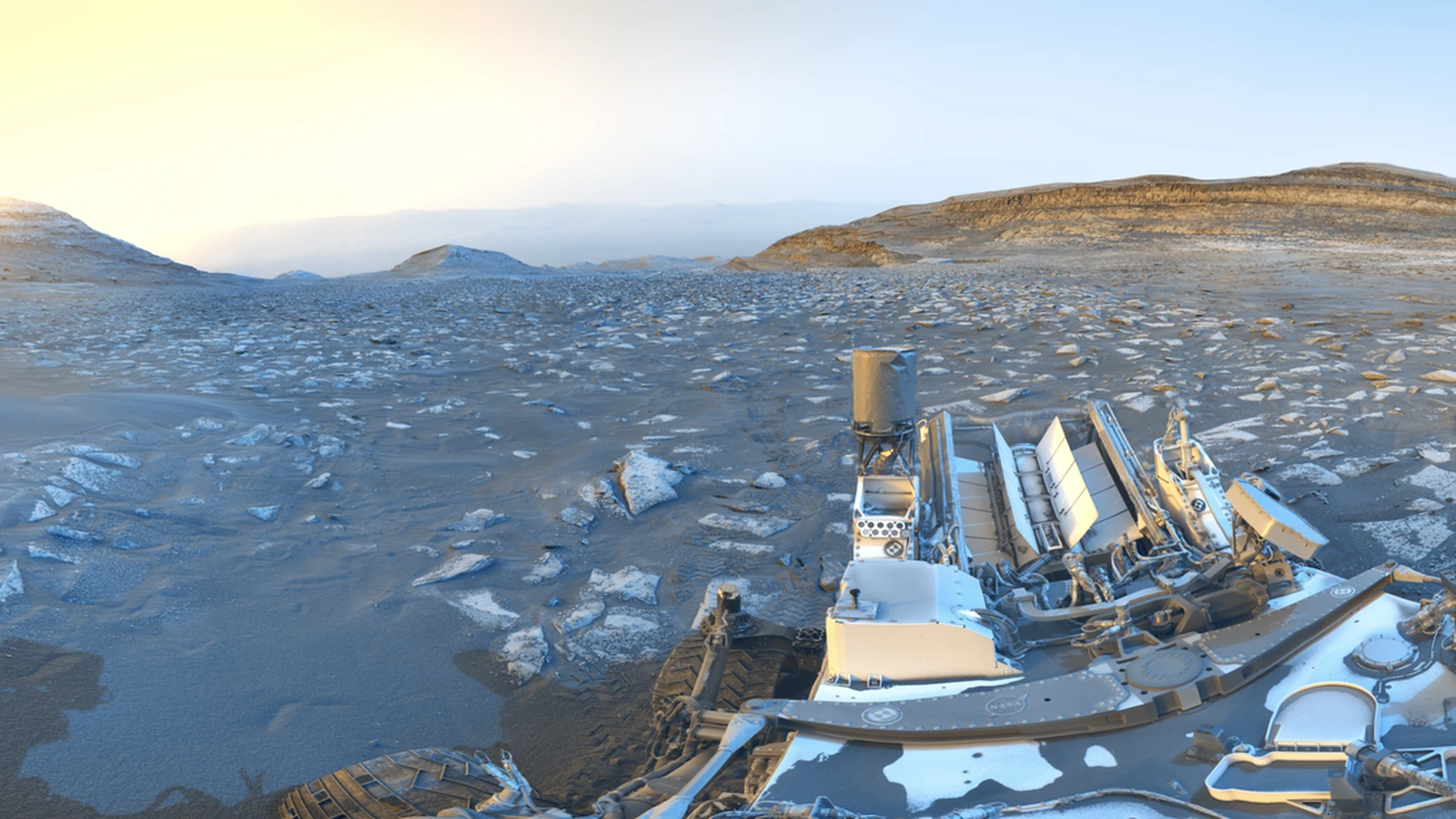
NASA’s Curiosity rover marked 5,000 Martian days with a striking panorama combining two views of the same landscape captured at different times.
The scene shows a rocky and sandy stretch of Mars with the rover in the foreground. Its blue and yellow palette brings morning and afternoon together in a single composition.
Two different days, one panorama
Curiosity was parked on a sandy ridge nicknamed Chocolatal when it used its black-and-white navigation cameras (Navcams) to photograph the surroundings.
The first panorama was captured on August 30, 2026, at 9:56 a.m. local Mars time, on sol 5000. The second was taken on September 2, 2026, at 5:39 p.m., on sol 5003.
After the data reached Earth, the panoramas were combined. NASA added blue tones for the morning view and yellow tones for the afternoon.
These are not the natural colors of the Martian scene. They are an artistic treatment of real black-and-white photographs.
What the image shows
Curiosity’s deck and cylindrical UHF antenna appear in the foreground. The antenna relays data to spacecraft orbiting Mars.
Also visible is the Multi-Mission Radioisotope Thermoelectric Generator (MMRTG), which supplies electrical power using heat from radioactive decay.
Tracks left by the rover extend across the ground, while rocky slopes, low hills and sandy areas fill the distance.
Curiosity is exploring the lower foothills of Mount Sharp, a mountain rising about 5 kilometers inside Gale Crater. The panorama looks toward the crater floor, with the distant rim barely visible on the horizon.
A different approach to space photography
Navcams were designed for navigation rather than artistic photography. They record monochrome data for mission operations.
By combining multiple frames, using different lighting conditions and applying selective color, the Curiosity team turns technical imaging data into a picture with a clear visual narrative.
NASA created a similar Curiosity postcard from images captured in November 2021.
What we think
The panorama demonstrates how composition and editing can turn scientific data into an engaging and accessible image. Viewers should know that its colors are a creative choice, not an accurate depiction of the Martian landscape.
Frequently asked questions
How long has Curiosity been on Mars?
On August 30, 2026, it completed 5,000 sols, or Martian days, on the surface.
Are the colors real?
No. The original panoramas were monochrome; NASA added blue and yellow tones during processing.
Which cameras were used?
Curiosity’s black-and-white navigation cameras, or Navcams.
Where was the panorama captured?
At the Chocolatal sandy ridge in the lower foothills of Mount Sharp, within Gale Crater.