

Summary
- The strange bright shape was recorded by Curiosity’s right Navcam on 20 August 2023.
- The official frame taken just 13 seconds earlier shows no corresponding object.
- The shape spans roughly 15 pixels and is accompanied by a row of black pixels, clues consistent with a sensor or processing artifact.
- There is no confirmed evidence that it is a physical object or life on Mars.
A bright, translucent shape resembling a “jellyfish” appears in one Curiosity raw image but is absent from a frame taken only 13 seconds earlier.
NASA’s official image comes from the rover’s right Navigation Camera on Sol 3924 and was recorded on 20 August 2023 at 22:27:46 UTC. The strange shape appears above the rocky landscape, spans roughly 15 pixels and is accompanied by a short horizontal row of black pixels. The frame resurfaced in 2026 with descriptions of an “alien jellyfish.”
The timeline is the most important clue: in the preceding official frame, at 22:27:33 UTC, the landscape is almost identical but the bright form is missing. That does not identify the cause by itself, but it significantly narrows the plausible explanations and shows why interpreting a single space image can be misleading.
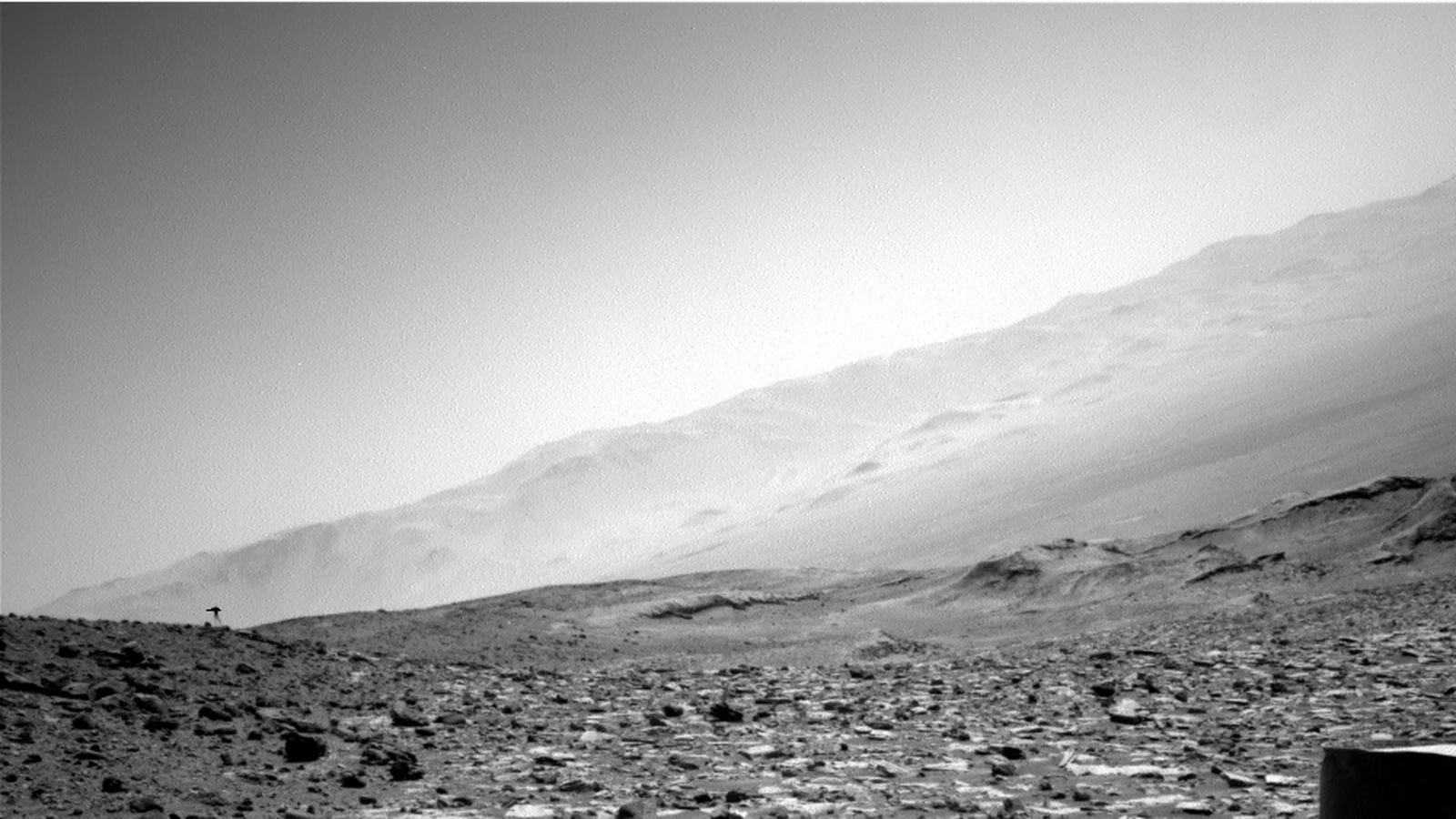
Comparison of the two official right Navcam frames: the bright “jellyfish” appears only in the second. Credit: NASA/JPL-Caltech.
What the official raw files actually show
Both frames are 1024×512 pixels and come from the same camera with the same viewing direction. In the first, at 22:27:33 UTC, the rocks and horizon appear without the bright anomaly. In the second, 13 seconds later, a small white shape with thin extensions is visible.
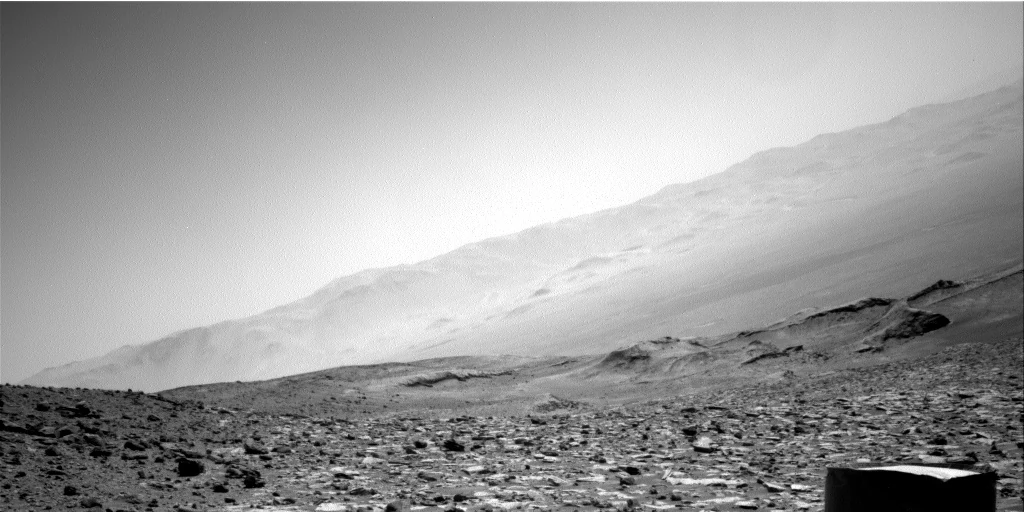
The right Navcam at 22:27:33 UTC, without the bright anomaly. Credit: NASA/JPL-Caltech.
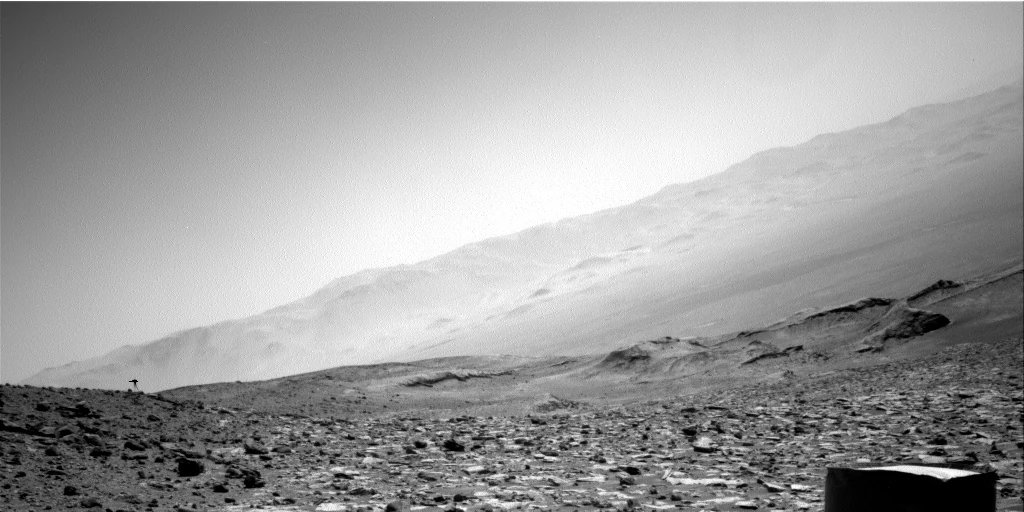
The right Navcam at 22:27:46 UTC, with the small bright artifact above the landscape. Credit: NASA/JPL-Caltech.
NASA provides the shots as raw material, images released quickly for scientific and public use that may contain imperfections. The agency does not accompany this frame with an announcement of an unusual natural phenomenon. Without a second record from another camera or a nearby frame, there is no stereoscopic information for distance, size or motion.
Why an artifact is the most likely explanation
Digital sensors in space are exposed to energetic particles and cosmic rays. A particle can strike the detector and create a very bright, irregular trace in a single exposure. Similar anomalies can arise from sensor readout, saturated pixels, electronics or data transmission.
The shape’s tiny scale, its appearance in only one frame and the row of black pixels beside it fit a technical artifact better than a large object floating in front of the rover. The human eye also readily recognises familiar forms in random patterns, especially when viewing a magnified crop without its full timeline; this is the phenomenon known as pareidolia.
Could it be dust or something physical?
A nearby dust particle, a small fragment or a transient atmospheric structure cannot be ruled out absolutely from two frames alone. Dust devils and particles passing close to cameras have been observed on Mars. A physical object, however, would be more convincing if it appeared in additional consecutive shots, in a matching left Navcam frame, or with measurable displacement. No such corroboration has been presented.
The key is the level of certainty: a technical explanation is the one most consistent with the available evidence, not an official laboratory diagnosis of the specific pixels. By contrast, a claim involving an organism or unknown life form has no supporting data.
How to read an image from another planet
The proper process starts with the original file and metadata, continues with the frames before and after it, and checks whether the same feature appears in a second camera. Scientific observation must also be separated from visual resemblance. In this case, NASA’s official raw image and the frame taken 13 seconds earlier are more useful than any sensational headline.
What we think
The “jellyfish” is a useful lesson in visual literacy. The image is real, but that does not make the first interpretation of it real. With the evidence now available, a momentary camera artifact is far more likely than a physical object, and incomparably more likely than any biological scenario.
Frequently asked questions
When was the image taken?
On 20 August 2023 at 22:27:46 UTC, during Sol 3924 of the Curiosity mission.
How large was the object?
Its physical size cannot be calculated because there is no reliable distance. In the image, the bright shape spans roughly 15 pixels.
Did NASA say it was alien life?
No. NASA publishes the frame in its raw image collection and does not attach that interpretation to it.
Why is one photograph not enough?
Without a second angle or a sequence of frames, distance, motion and real shape cannot be established safely, while sensor artifacts can appear in only one exposure.