


Summary
- NASA’s Curiosity rover has entered a light-toned region on Mars covered with polygonal structures.
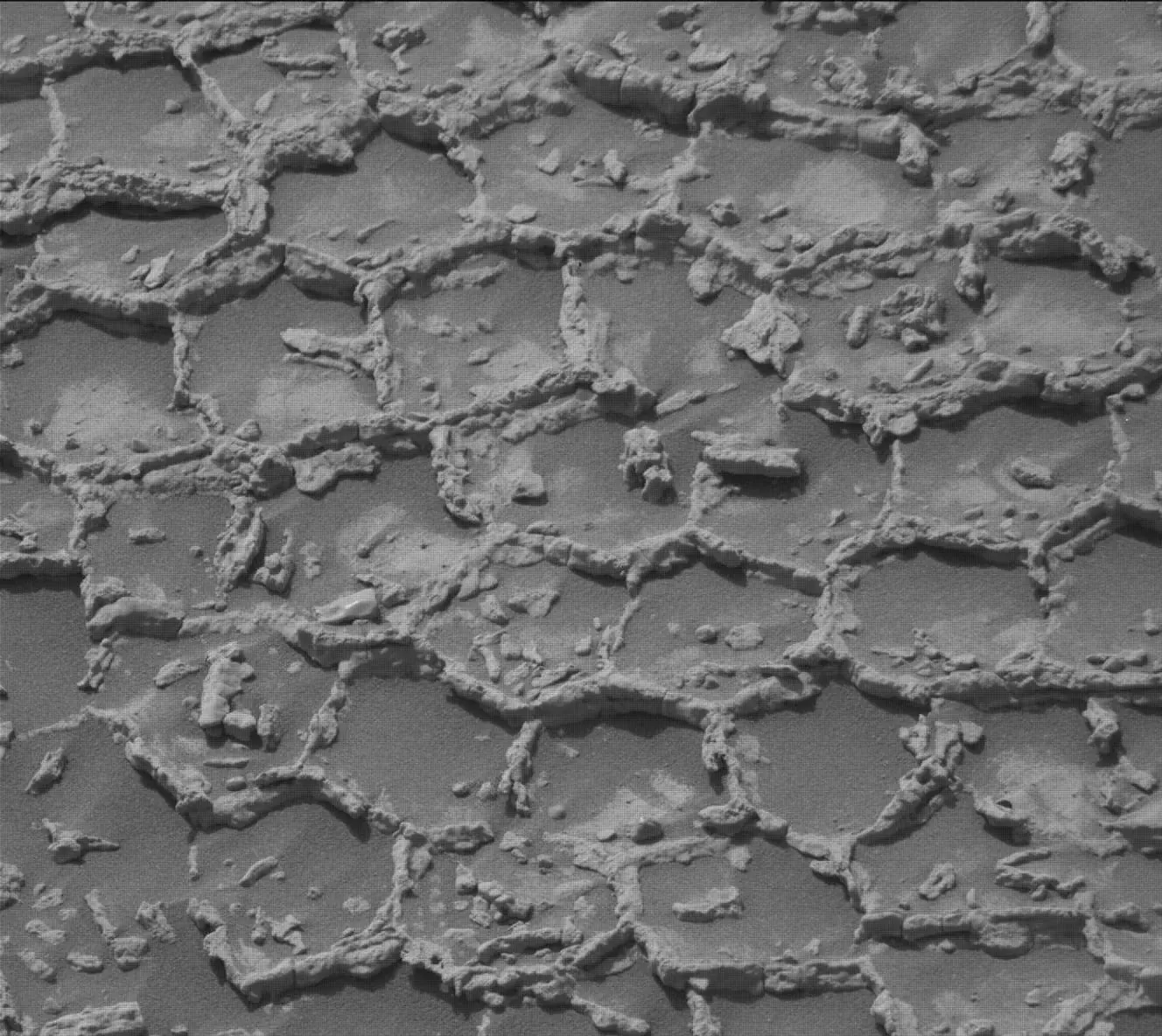
- The terrain resembles a giant Martian honeycomb or dried mud cracks.
- Dark-toned pebbles and cobbles scattered across the area remain a scientific puzzle.
- NASA is investigating whether some of them could be meteorites.
- The rover is preparing to move into a darker and rougher geological band.
NASA’s Curiosity rover is exploring a region of Mars with striking polygonal structures and dark rocks of uncertain origin.
The Curiosity rover reached a light-toned geological unit in Gale crater that appeared smooth in orbital images, but from the ground it turned out to be covered with raised polygonal structures, resembling the surface of a giant Martian honeycomb.
The finding matters because these structures, together with the scattered dark rocks in the area, may provide new clues about Mars’ geological history, erosion processes and the origin of materials now found on the surface.
Curiosity in the “land of the polygons”
According to the Mars Science Laboratory mission team update, planning for sols 4934 to 4940 included two planning cycles.
During the first cycle, Curiosity was located inside a light-toned area that had appeared relatively smooth from orbit. Once the rover reached it, however, the team found that the ground was covered with polygonal ridges forming a network reminiscent of dried mud cracks or a honeycomb.
As the rover moved farther into the unit, the polygonal ridges appeared more eroded. This suggests that Curiosity is passing through zones with different levels of preservation of the same or similar geological formations.
The puzzle of the dark rocks
Among the polygonal structures are dark-toned rocks, ranging from pebbles to larger cobble-sized stones. Their origin remains an open question for the science team.
One possibility is that they are pieces of Martian material that broke away from higher geological layers and moved into the area. Another is that they were ejected there by distant impacts outside Gale crater. A third, more intriguing possibility is that they are meteorites that reached Mars from space.
NASA notes that previous examinations of dark “float” rocks showed the presence of nickel, an element common in meteorites but less common in Martian rocks. However, this does not mean that all of the dark pebbles and cobbles in the area are meteoritic in origin.
The instruments NASA is using
The observation plan included measurements with APXS and MAHLI on both the ridges and centers of the polygons. This allows the team to compare the composition and texture of different parts of the same geological structure.
ChemCam was also used for LIBS measurements on two different polygon ridges and on a polygon center. At the same time, RMI images were planned for the small knob “Miraflores” and the mesa-like feature “Cordillera.”
The plan also included a ChemCam passive reflectance measurement on one of the dark rocks, while environmental activities included a Navcam dust-devil search and atmospheric opacity measurements.
The dark rock “Cortadera”
In the next planning cycle, after another drive toward the upper boundary of the light-toned polygon-covered unit, Curiosity planned new APXS and MAHLI measurements on another polygon ridge and on one of the dark-toned cobbles, named “Cortadera.”
The same rock was also targeted for ChemCam LIBS measurements, along with another polygon ridge. Mastcam was planned to capture mosaics of “Cordillera,” nearby troughs, part of the “Valle Grande” channel, documentation of LIBS targets and the Mastcam calibration target.
The rover’s next target
The team reports that in the coming week Curiosity is expected to cross into another band of materials, which appears darker in orbital images and rougher in texture from the rover’s current view.
This transition is important because it allows the mission to compare neighboring geological units with different textures and tones, helping scientists better understand the stratigraphy and geological evolution of the region.
What we think
Curiosity’s latest stop shows why surface exploration remains irreplaceable. A region that looked simple and smooth from orbit turned out to be far more complex up close, with structures and rocks that raise new questions about Mars’ past.
Frequently asked questions
What are the polygonal structures seen by Curiosity?
They are raised geological structures forming polygonal patterns on the surface, resembling dried mud cracks or a honeycomb.
Where is Curiosity located?
Curiosity is exploring Gale crater on Mars, moving through regions near Mount Sharp.
Why are the dark rocks interesting?
Their origin is still unclear. They could be Martian rocks, impact-ejected material or even meteorites.
Which instruments were used for the measurements?
NASA used instruments including APXS, MAHLI, ChemCam, Mastcam and Navcam for chemical, imaging and environmental observations.
What is the mission’s next step?
Curiosity is expected to move into a darker and rougher geological band to continue comparing different materials in the area.