

Summary
- NASA published its July 2026 skywatching tips
- On July 11 and 12, the Moon helps observers find Mars, Saturn and Uranus
- Around the July 14 New Moon, conditions favor Comet 10P/Tempel 2
- The same dark nights are ideal for viewing the Milky Way
- Saturn becomes a rewarding telescope target as its rings appear unusually thin
NASA has presented the main skywatching events for July 2026, with the Moon, planets, a comet, the Milky Way and Saturn taking center stage.
According to NASA, July offers several opportunities for sky observation, beginning with the Moon’s meetup with Mars, Saturn and Uranus before sunrise on July 11 and 12.
What makes the month especially interesting is that the same nights around the New Moon provide darker skies, helping observers look for Comet 10P/Tempel 2 and the bright band of the Milky Way.
The Moon meets planets before sunrise
Before sunrise on July 11 and 12, the waning crescent Moon will appear in the eastern sky and help observers locate Mars.
Mars will appear as a small reddish point of light, while Saturn will be brighter and easier to spot. Uranus will also be in the same general area of the sky, but because it is much fainter, binoculars or a telescope will be needed.
Comet 10P/Tempel 2 returns
Around the New Moon on July 14, Comet 10P/Tempel 2 passes through the inner Solar System.
It is a short-period comet, returning on a regular orbit about every five and a half years. It is not expected to be a dramatic naked-eye comet, but through binoculars or a telescope it may appear as a small fuzzy glow, possibly with a brighter central region and a short, broad, fan-shaped tail.
NASA recommends looking from a dark site, away from city lights, once the sky is fully dark, about 45 to 60 minutes after sunset. The search area is near the constellation Capricornus.
Ideal nights for the Milky Way
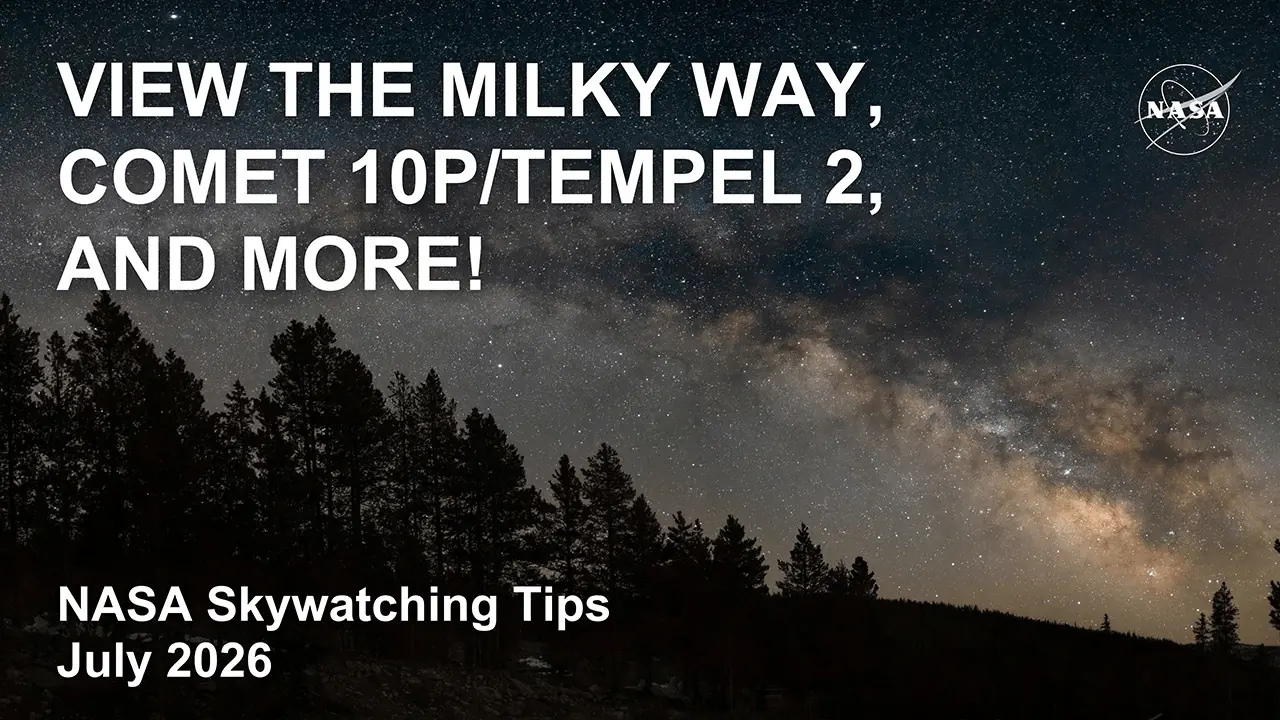
The dark nights around the July 14 New Moon are also the best time of the month to observe the Milky Way.
From a location without strong light pollution, the Milky Way appears as a faint, cloudy band across the summer sky. Its brighter region points toward the galactic center, where the line of sight passes through a very dense part of the galaxy, filled with stars and dark clouds of cosmic dust.
Late in the evening, observers can look low in the southern sky, near Scorpius and Sagittarius. For the best experience, they should choose a dark location, allow their eyes time to adjust and avoid looking at a phone screen.
Saturn with unusually thin rings
Later in July, Saturn becomes a particularly rewarding target for telescope users.
Its rings are still seen from Earth at a very shallow angle, making them appear unusually thin. They are not actually disappearing, but the viewing geometry changes as Saturn moves in its orbit around the Sun.
The Moon phases in July
NASA also highlights the main Moon phases for July 2026.
The Last Quarter Moon is on July 7, the New Moon is on July 14, the First Quarter Moon is on July 21 and the Full Moon is on July 29.
What we think
July 2026 is a very good month for those who want to combine easy skywatching with more demanding targets. The Moon’s meeting with the planets is accessible to everyone, while the comet, the Milky Way and Saturn offer extra reasons to head out under dark skies.
Frequently asked questions
When can the Moon, Mars, Saturn and Uranus be seen?
The best time is before sunrise on July 11 and 12, 2026, looking toward the eastern sky.
Will Comet 10P/Tempel 2 be visible to the naked eye?
No. According to NASA, it is not a dramatic comet that can be seen simply by looking up. Binoculars or a telescope and a dark location will be needed.
When is the best time to see the Milky Way?
The best nights are around the July 14 New Moon, when the sky is darker.
Why do Saturn’s rings look so thin?
Because the angle from which we see them from Earth is very shallow during this period. Their appearance changes as Saturn moves in its orbit.