

Summary
- NASA released four new composite images from Chandra.
- The set was created for the 250th anniversary of the United States.
- The images include Cassiopeia A, NGC 3603, Messier 94 and ZwCl 0024+1652.
- The release combines data from Chandra, Hubble, Webb and ground-based observations.
- NASA also presented new sonifications of astronomical data.
NASA has released four new composite images from the Chandra X-ray Observatory, rendered in red, white and blue for the 250th anniversary of the United States.
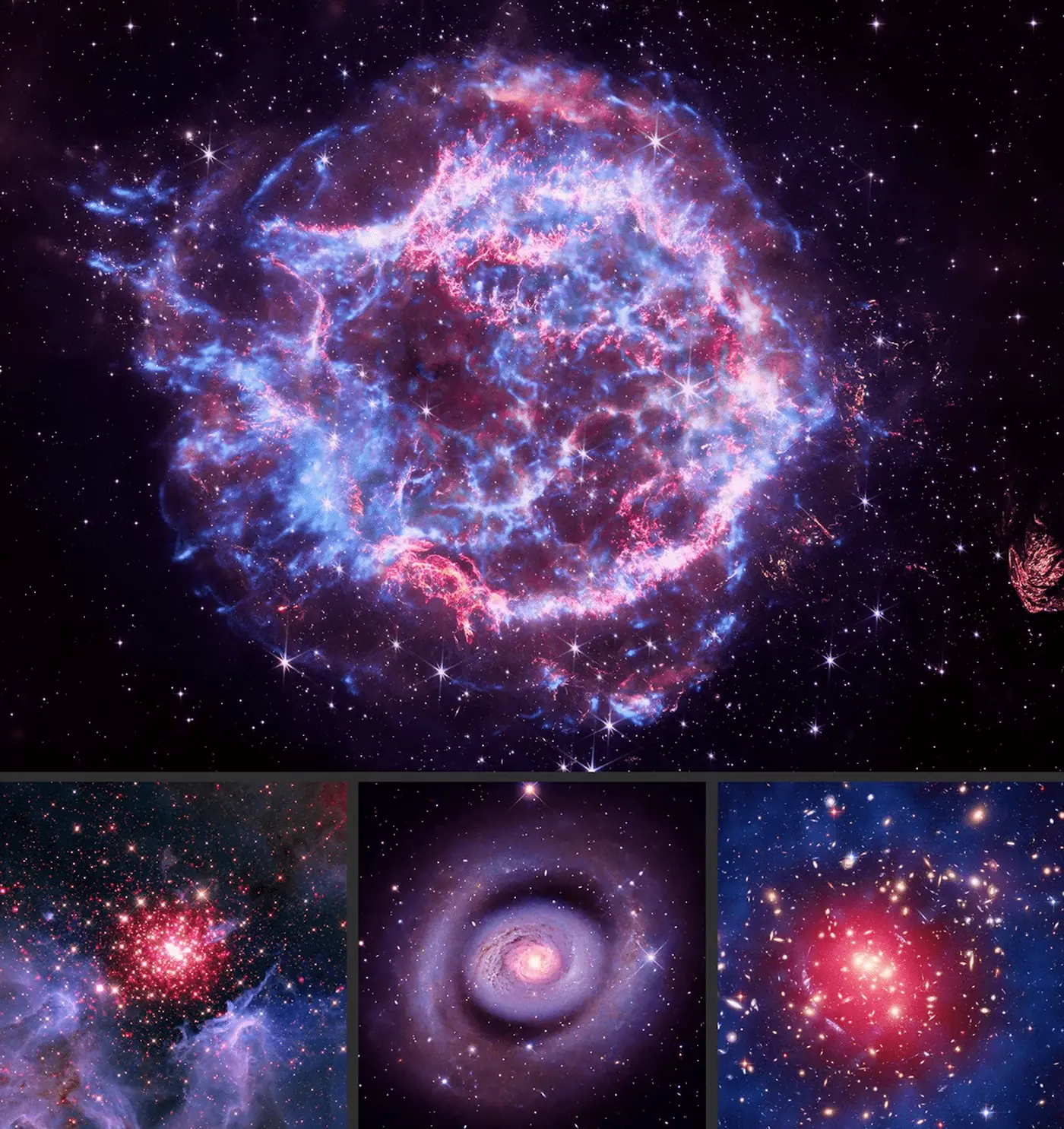
The US space agency published a new image set featuring the supernova remnant Cassiopeia A, the NGC 3603 nebula, the galaxy NGC 4736, also known as Messier 94, and the distant galaxy cluster ZwCl 0024+1652.
The release is notable not only for its symbolic color treatment, but also because it combines X-ray, infrared, visible and ultraviolet data, while also being accompanied by new sonifications of astronomical data.
Four different windows into the Universe
At the top of the new mosaic is Cassiopeia A, one of the most studied supernova remnants. Chandra’s X-ray data reveal the blast wave and elements such as iron, calcium and oxygen, while infrared data from the James Webb Space Telescope show expanding material and dust surrounding the remnant.
The lower-left image shows NGC 3603, a region of intense star formation in our Milky Way galaxy. Chandra data reveal X-ray emission and point-like sources, while Hubble observations in visible, infrared and ultraviolet light reveal stars, gas and dust.
Messier 94 and the ZwCl 0024+1652 cluster
At the center of the bottom row is NGC 4736, also known as Messier 94. It is a spiral galaxy with a bright inner ring where new stars are forming. NASA combined X-ray data from Chandra with visible-light imagery from ground-based observations.
The fourth image features ZwCl 0024+1652, a distant galaxy cluster. There, Hubble data have been used to highlight evidence for dark matter, while Chandra reveals the superheated gas that fills the cluster and contains much more mass than the galaxies themselves.
When data become sound
NASA accompanies the three images in the bottom row with new sonifications, a technique that turns astronomical data into sound.
In NGC 3603, the brightness of sources is linked to sound volume, while compact X-ray sources are represented as piano notes. In NGC 4736, the sonification follows a circular scan, with X-rays translated into wind-like sounds and compact sources into notes on a glass marimba.
In ZwCl 0024+1652, the scan begins at the outside of the image and moves inward, with the volume rising as it passes through regions associated with dark matter and superheated gas.
The science behind the aesthetics
Although the color choice is connected to the 250th anniversary of the United States, the images are not simply commemorative material. They are composite views that bring together observations from different telescopes and wavelengths, allowing scientists to study phenomena that are invisible to the human eye.
Chandra remains a key tool for studying the hot and energetic Universe, from the remnants of stellar explosions to galaxy clusters and regions where new stars are being born.
What we think
NASA’s new release shows how scientific imaging can serve both as a research tool and as a way to communicate science to the public. The sonifications are especially valuable, as they offer a different way to access data beyond the visual image.
Frequently Asked Questions
What is Chandra?
Chandra is NASA’s X-ray space telescope, designed to study energetic phenomena such as superheated gas, supernova remnants, black holes and galaxy clusters.
Which objects are included in the new image set?
The set includes Cassiopeia A, the NGC 3603 nebula, the galaxy NGC 4736 or Messier 94, and the galaxy cluster ZwCl 0024+1652.
Are the colors in the images real?
The colors are scientific representations of data from different wavelengths, such as X-rays, infrared, visible and ultraviolet light. They do not necessarily correspond to what the human eye would see.
What is astronomical data sonification?
Sonification is the conversion of data into sound. In NASA’s release, characteristics such as brightness, position and type of radiation are translated into notes, volume and different sound textures.
Why were red, white and blue used?
The colors were chosen for the 250th anniversary of the United States, with NASA presenting four cosmic objects in a visual treatment inspired by the colors of the American flag.