

Summary
- Annie Leibovitz photographed Vanity Fair’s revived New Establishment.
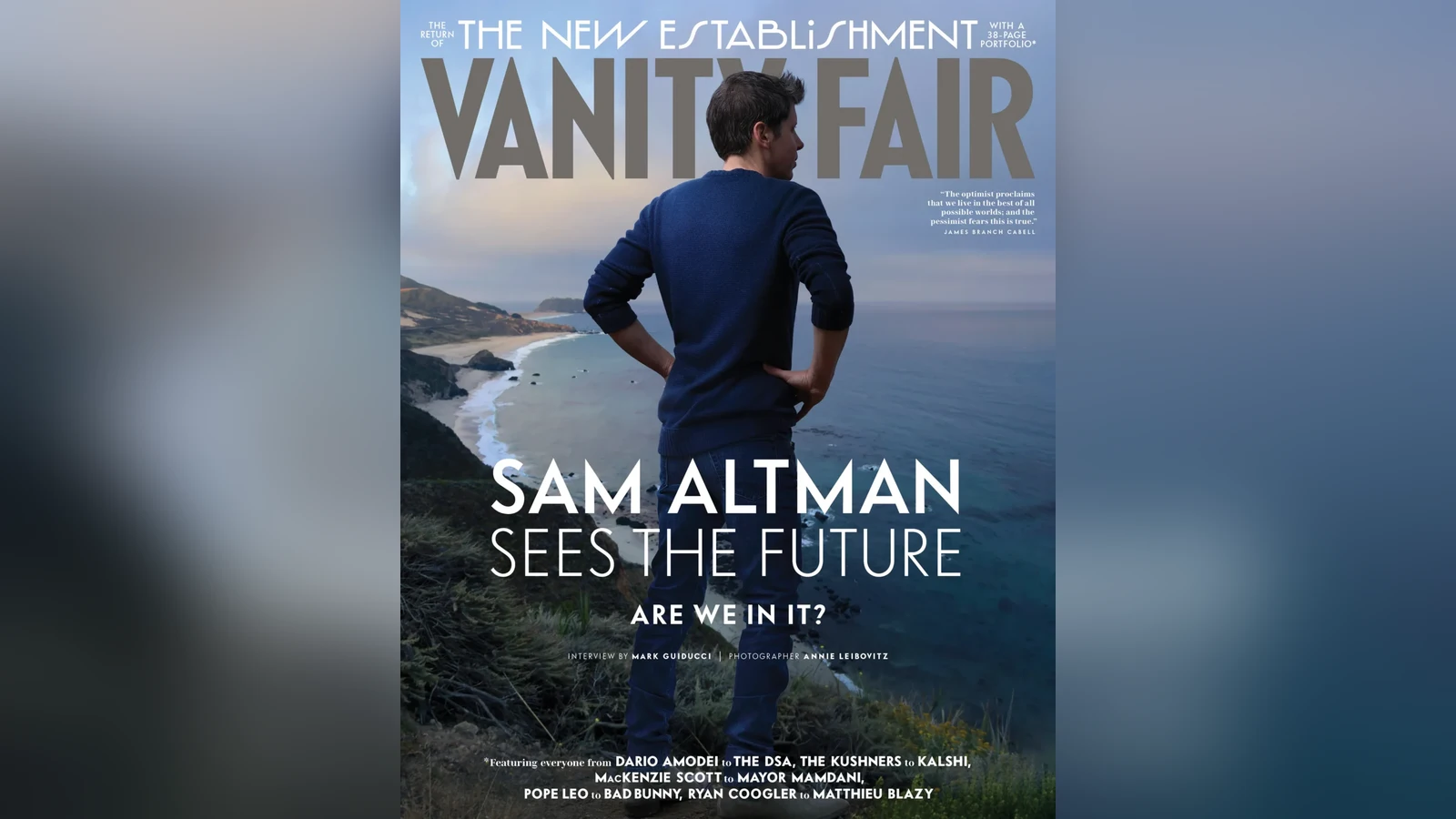
- Sam Altman appears on the cover in a coastal landscape.
- Further portraits feature the Murdochs, Ryan Murphy and Gavin Newsom.
- The series uses different environments, poses and group arrangements.
Annie Leibovitz did not photograph only Sam Altman for the new Vanity Fair. The New Establishment 2026 features a wider portrait series in which setting, body language and relationships between subjects help shape each image.
On October 5, the magazine revived a list that began in 1994 and had been absent for nearly a decade. OpenAI cofounder and CEO Sam Altman takes the top spot. Leibovitz’s photographs accompany profiles spanning technology, politics, media and entertainment.
Sam Altman on the cover: a figure in the landscape
On the cover, Altman stands with his back to the camera and his head turned sideways. Wearing a dark blue sweater and jeans, he rests his hands on his hips. The coastline and ocean occupy much of the frame, while his figure anchors the center. The masthead runs behind his head, and the question “Sam Altman Sees the Future. Are We In It?” fills the lower part of the cover.
The full-body framing, rather than a conventional close-up, gives the surroundings a substantial visual role. Cool blues and grays connect the sky, water and clothing. We cannot see his entire face, but his pose remains prominent.
The other portraits: from the Murdochs’ office to Ryan Murphy’s circle
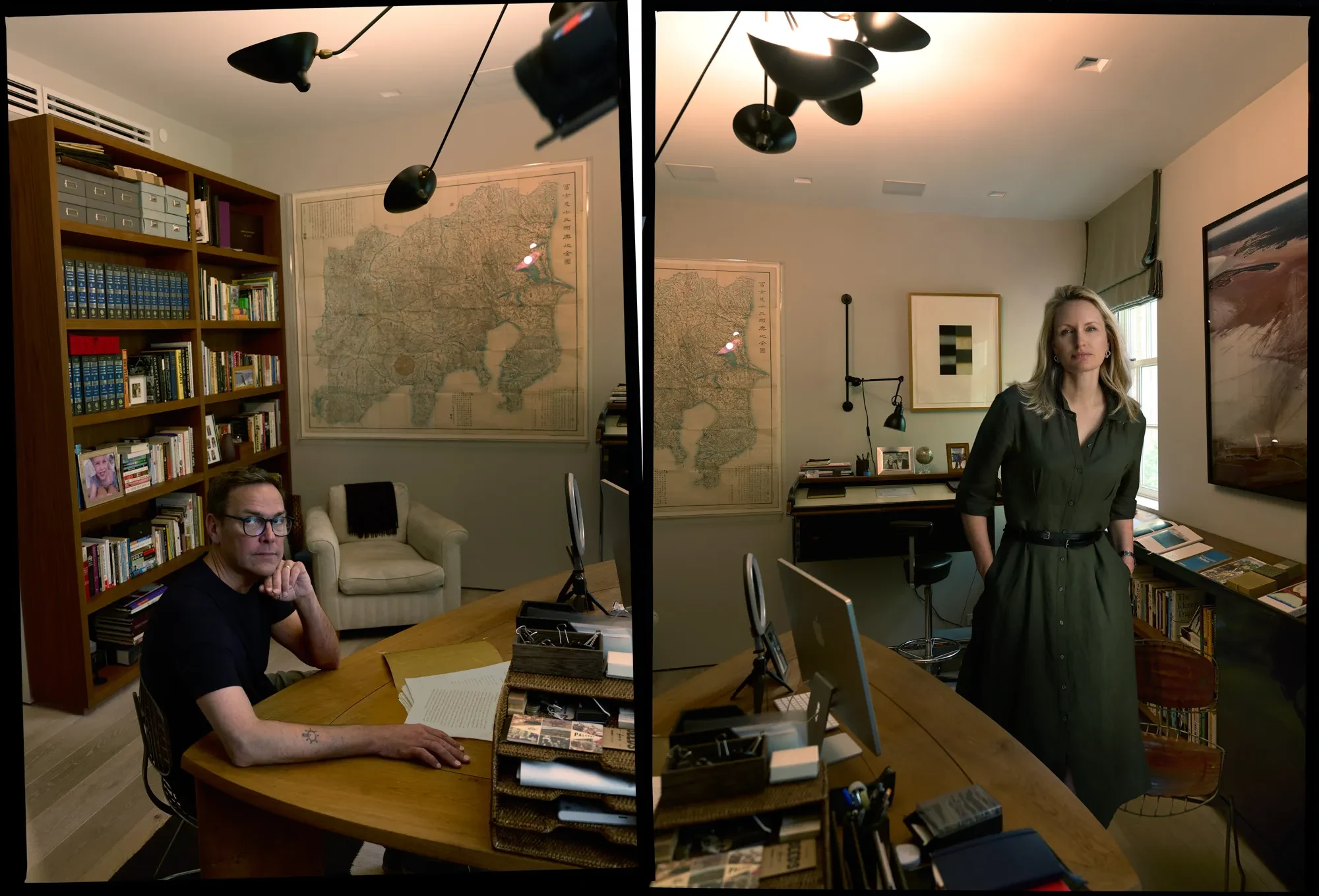
The project extends far beyond the cover. In her portrait of James and Kathryn Murdoch, the couple appear in an office setting. The magazine describes the photograph as a composite portrait. Its composite construction brings the couple and their office surroundings together into a single directed portrait.
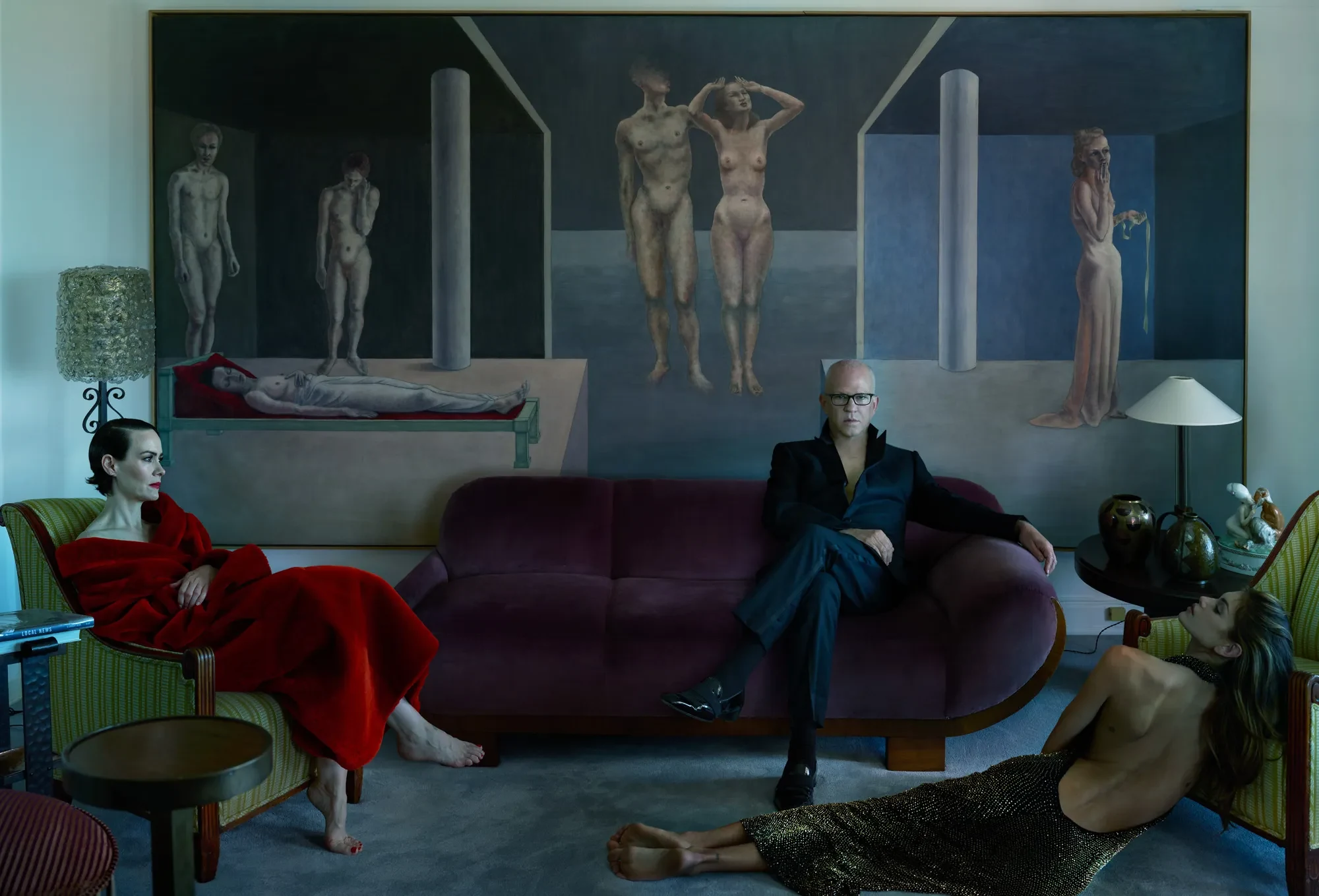
For Ryan Murphy, Leibovitz photographed the television producer alongside Sarah Paulson and Kaia Gerber. A group portrait invites a different reading: the arrangement of three people, their spacing and the way they share the frame become part of the composition. The subjects also connect the photograph to Murphy’s creative work and collaborations.
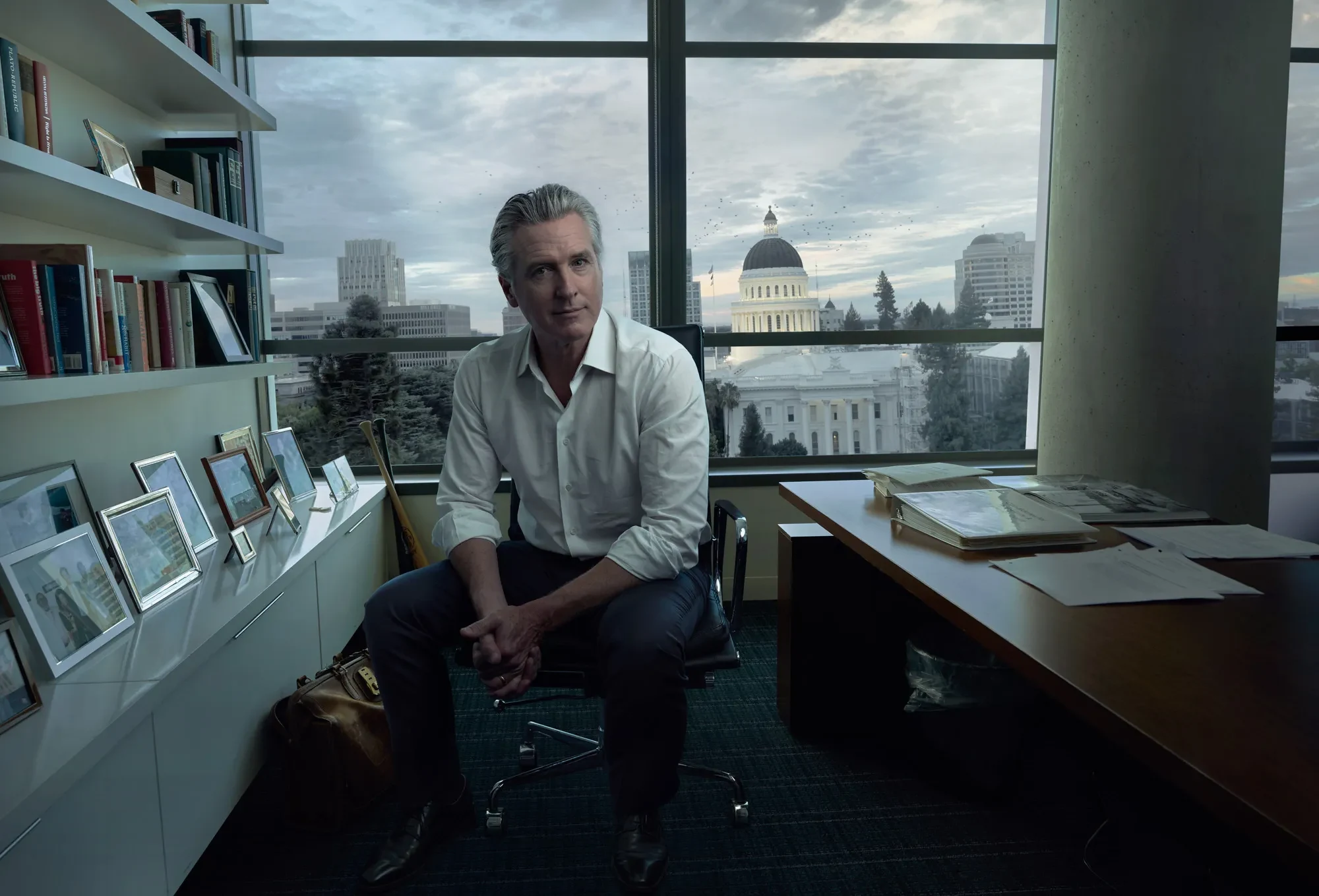
Another portrait features Gavin Newsom seated, with the chair and his posture contributing to the image. This seated arrangement operates differently from Altman’s standing figure or the Murphy group shot. The variation is evidence that the series does not rely on a single portrait template.
The visual approach: direction, space and color
Annie Leibovitz has built a career around carefully directed portraits, from Rolling Stone to Vanity Fair. In this project, the presentation shifts with the subject: open landscape for Altman, an office for the Murdochs, a group composition for Murphy and a seated pose for Newsom. The portraits belong to one editorial project without all looking alike.
Scale is particularly revealing. On Altman’s cover, a human figure shares the frame with a broad coastal landscape. The Murdochs’ office evokes the professional world associated with the subjects. Murphy’s portrait must organize three people instead of one. In each case, the spatial arrangement changes how the viewer encounters the subject.
Portraits alongside the people shaping the news
The revived New Establishment features 50 influential people from different fields. Mark Guiducci, Vanity Fair’s global editorial director, makes clear that inclusion is not an endorsement. The selection includes Elon Musk, Kaitlan Collins, Zohran Mamdani and Pope Leo XIV, alongside figures from music and film. In its Instagram post introducing the feature, the magazine also acknowledges that the list remains predominantly white and male.
Altman’s top ranking is accompanied by a two-part interview discussing AI development, safety, regulation and his public image. That image also extends into cinema: Andrew Garfield plays Altman in Luca Guadagnino’s Artificial. The magazine is treating a technology executive as a recognizable cultural figure, not just the leader of a company making announcements.
What we think
The most rewarding aspect of Leibovitz’s contribution is the range of photographic decisions across the series. If we looked only at Altman’s cover, the discussion would end with one carefully composed portrait in a coastal setting. The other images make the story richer: where to place a subject, how to direct a group and how each photograph can serve a different reported piece.
The contrast between Altman and the Murdochs is particularly instructive. One portrait uses open space and a full-length figure; the other is anchored to a workplace and is expressly identified as a composite. The contrast is striking: one portrait relies on distance and a broad natural landscape, while the other places its subjects inside the world of their work.
These are also portraits of people who wield considerable influence. Giving someone a striking photograph is not the same as endorsing their decisions. We can appreciate the craft behind each image while remaining critical of its subject and the power that subject represents.