

Summary
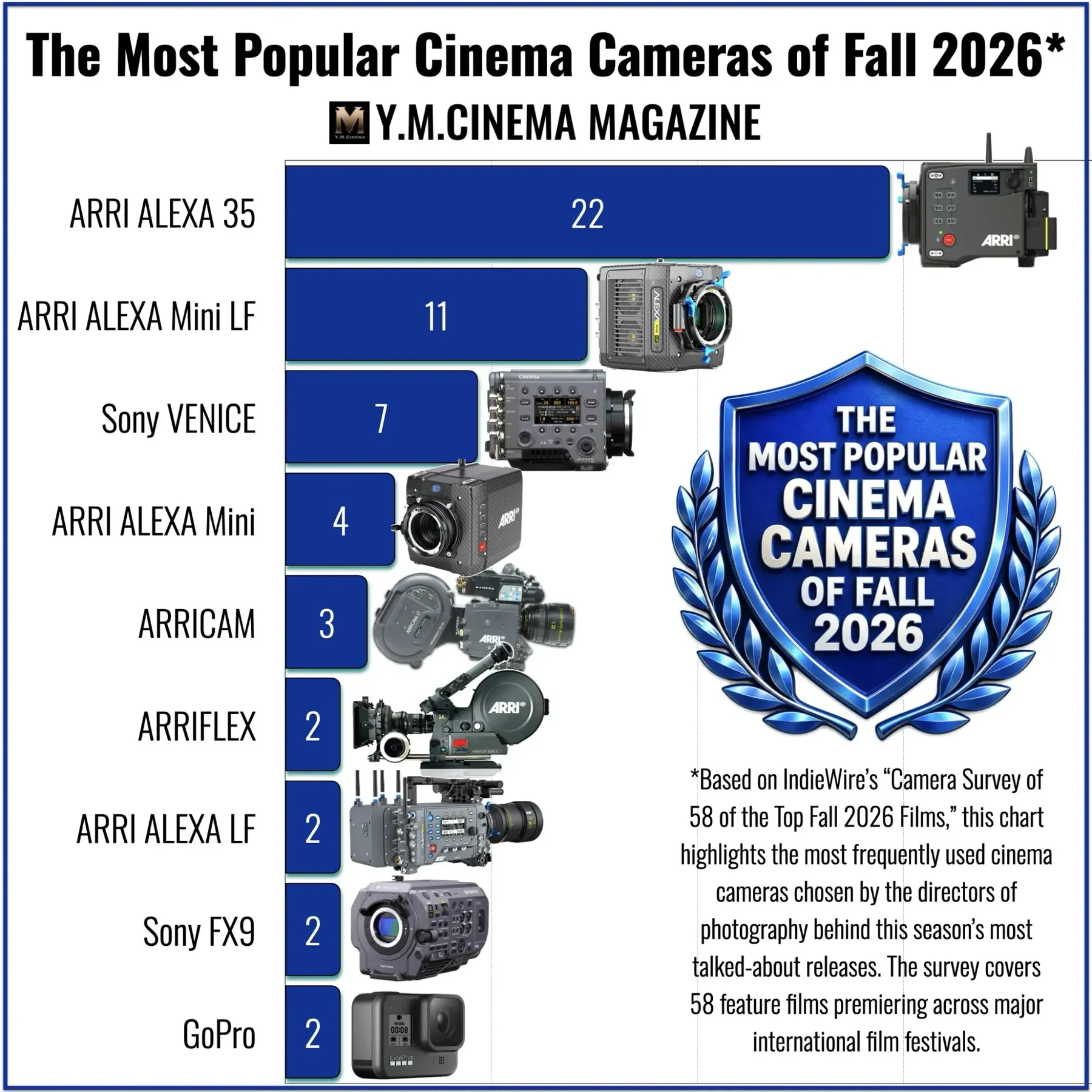
- ARRI ALEXA 35 leads a 58-film festival sample with 22 appearances.
- ALEXA Mini LF follows with 11 and Sony VENICE with 7.
- ARRICAM and ARRIFLEX show that film remains a viable creative option.
- These numbers describe the sample, not the entire cinema-camera market.
ARRI ALEXA 35 is the most frequently listed camera in a sample of 58 films from the fall 2026 festival circuit, yet the persistence of film and older cameras may tell us just as much about how cinematic images are being made.
The survey covers films shown at Telluride, Toronto and New York, with cinematographers discussing not only their camera and lens choices but also the reasons behind them. The result is a reminder that increasingly capable capture technology does not produce a single visual language.
The numbers: 22 appearances for ALEXA 35
ALEXA 35 leads the comparison with 22 appearances, followed by ALEXA Mini LF with 11 and Sony VENICE with 7. The remaining entries include both digital systems and film cameras.
| Camera / family | Appearances in chart |
|---|---|
| ARRI ALEXA 35 | 22 |
| ARRI ALEXA Mini LF | 11 |
| Sony VENICE | 7 |
| ARRI ALEXA Mini | 4 |
| ARRICAM | 3 |
| ARRIFLEX | 2 |
| ARRI ALEXA LF | 2 |
| Sony FX9 | 2 |
| GoPro | 2 |
These figures count model or family mentions in the chart; they are not global market shares. Productions can use multiple cameras, so they should not be read as exclusive camera choices per film. General labels such as VENICE, ARRICAM and ARRIFLEX also do not identify every model variant.
Why ARRI holds its position
For After Elena, Pau Monras paired ALEXA 35 with Cooke S4 lenses and an Angénieux 25–250mm HR zoom, drawing heavily on handheld camera work, natural light and practical fixtures. On Faith, Simona Susnea used Cooke Anamorphic Super 35 lenses with restrained lighting setups. The same camera body did not produce the same look.
A mature cinema system offers a dependable starting point, leaving cinematographers room to shape the image through lenses, lighting, filtration and grading. ALEXA 35’s lead also demonstrates that Super 35 remains central to ambitious filmmaking, even as large-format cameras attract substantial attention.
ALEXA Mini LF holds second place, while Sony VENICE is the most prominent individual alternative digital camera family in this particular chart. Sony also appears through models such as the FX9, an important distinction when comparing manufacturers rather than individual product names.
Film is still on set
ARRICAM and ARRIFLEX cameras continue to appear in the survey. Jon Peter shot Atonement on an ARRI 416 with ARRI/Zeiss Ultra16 and Canon 6.6–66mm lenses. Film is not necessarily a nostalgic choice: its grain, color response, exposure discipline and handling change creative decisions long before post-production.
A similar approach shapes The Beloved, filmed with six cameras across multiple formats. Its 16mm, 35mm, 65mm and digital material was deliberately allowed to retain different textures rather than being flattened into a uniform look.
From unconventional cameras to modern digital capture
The survey is not limited to the traditional ARRI-versus-Sony discussion. Bardi used a first-generation Fujifilm GFX100 and GF lenses, while Always Lalisa combined ALEXA Mini LF, Sony FX9, Sony FX3 and an iPhone 16 Pro. A single project can call for multiple capture tools serving different scenes.
On Primetime, ALEXA 35 shared the production with MiniDV and a medical camera, with the older systems’ shortcomings becoming intentional narrative devices. These examples help explain why filmmakers sometimes seek noise, instability or softness rather than trying to eliminate them.
ARRI itself continues to evolve, as seen with the ALEXA 35 Xtreme and its higher-frame-rate capabilities. But a new camera revision does not automatically erase the visual or practical relevance of existing tools.
What we think
The striking part of this list is not simply the expensive ARRI at the top. It is the coexistence of that camera with much older systems and very different capture technologies. As modern digital cameras become cleaner and more capable, cinematographers have greater freedom to decide where they want to move away from technical perfection.
That does not mean any vintage lens or diffusion filter adds meaningful character. Texture can quickly become a mannerism when it has no relationship to the film. The more convincing approaches are those where format, optics and exposure choices are tied to a scene or to the audience’s understanding of a character.
For filmmakers with far smaller budgets, this may be the most useful lesson. The chart is not a shopping guide, nor does it imply that renting an ALEXA is a prerequisite for cinematic images. A camera choice matters when you can explain what it gives your film and which compromises you are willing to accept.
Frequently asked questions
Is ALEXA 35 the most popular camera across the entire film industry?
Not necessarily. It is the most frequently listed camera in this sample of 58 fall festival films, not a census of every film production in 2026.
Do 22 ALEXA 35 appearances mean 22 films were shot exclusively on that camera?
No. Individual productions can combine multiple capture systems, so the count does not indicate exclusive use.