

Summary
- “Traversées” brings together 30 black-and-white prints by René Burri from 1950 to 1971 and offers an entry point into his life and career.
- The exhibition is on view in Paris through December 12, 2026.
Event Details
Magnum Gallery in Paris is presenting “René Burri: Traversées” through December 12, 2026, a retrospective exhibition of 30 black-and-white prints by Swiss photographer René Burri (1933–2014), covering work made between 1950 and 1971.
The opening took place on September 24 at 7:00 p.m., followed at 7:30 p.m. by a discussion about Burri’s work with Clotilde Burri, representing the photographer’s Estate, and photographer Richard Kalvar. The exhibition has been open to the public since September 25 at Magnum Gallery & Bookstore, 2 Impasse Delaunay, 75011 Paris.
Who was René Burri?
René Burri was born in Zurich in 1933. At the age of 13 he photographed Winston Churchill, and from 1950 he trained in photography at the Kunstgewerbeschule Zürich, now Zurich University of the Arts. From 1953 to 1955 he worked as a documentary filmmaker and began using a Leica while completing his military service.
In 1955 Burri became a nominee member of Magnum and gained international attention with one of his early reportages, “Touch of Music for the Deaf”, published in Life. He subsequently travelled through Europe, the Middle East and Latin America, and for the Swiss magazine Du photographed figures including Pablo Picasso, Alberto Giacometti, Jean Tinguely, Yves Klein and Le Corbusier. He became a full member of Magnum in 1959.
His career became associated with some of the most recognisable images of postwar photography, from divided Germany and the new Brasília to Cuba, China and his emblematic portrait of Che Guevara with a cigar. His first book, “Die Deutschen”, appeared in 1962, followed by the French edition “Les Allemands” in 1963. In 1965 he helped create Magnum Films and spent six months in China, where he made “The Two Faces of China” for the BBC. Burri died in 2014.
A journey from Paris to the Americas
“Traversées” is organised geographically, following Burri through Europe, South America, Cuba, China and the United States. The selection combines acclaimed and lesser-known photographs, focusing on the way he connected street photography with architecture and form.
The early photographs from 1950 already show the visual approach that would become a lasting feature of his work: close attention to small human gestures within the built environment, a sense of movement and a subtle, often playful observation of everyday life.
The city as geometry and human stage
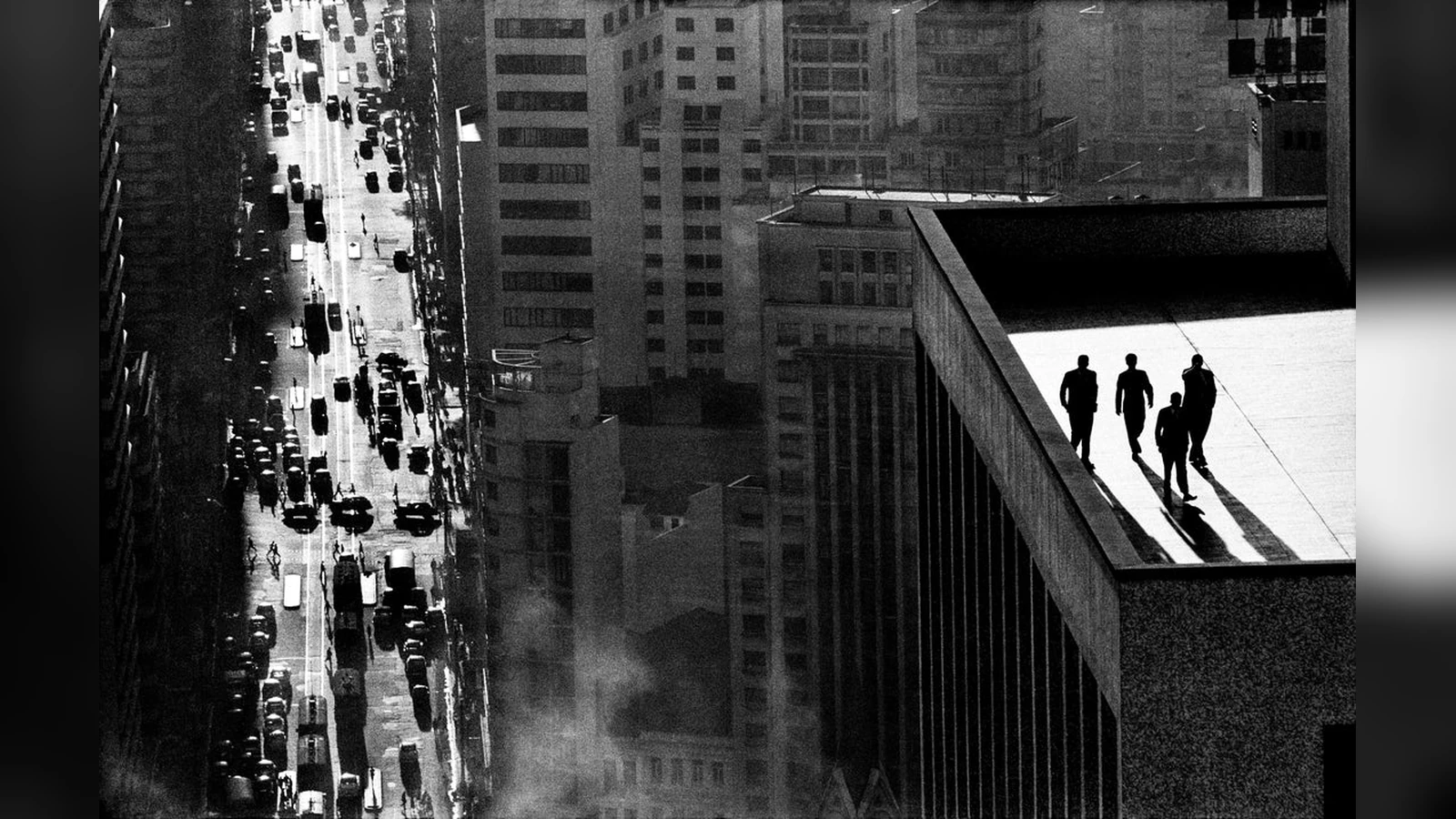
The exhibition’s central thread is not architecture as a neutral record of buildings. Lines, shadows, volumes and scale become a framework for human presence: passers-by, workers and residents who turn the urban landscape into a stage for everyday life.
That combination is especially useful to photographers studying composition and street photography. Burri uses the environment not simply as a background, but as an active element that organises the frame and shapes the viewer’s relationship with the people inside it.
From postwar Germany to Brasília and Havana
In 1957, two years after joining Magnum, Burri began documenting postwar Germany. He photographed both East and West Germany before and after the construction of the Berlin Wall, with part of this body of work published in the book “Die Deutschen” in 1962 and reissued the following year as “Les Allemands” by Delpire.
The same broader period includes photographs of Brazil’s rapid transformation, including the new capital Brasília, as well as his famous encounter with Che Guevara in Havana in 1963. “Traversées” places these different geographies along one route, showing how Burri repeatedly returned to the relationship between space, history and people.
São Paulo in 1960
The photograph accompanying this article, made in São Paulo in 1960, shows four male figures on a bright rooftop while, far below, the traffic of the city forms a second dense axis. The strong contrast, elevated viewpoint and long shadows condense the relationship between scale, geometry and human presence that characterises much of Burri’s work.
Practical information
“René Burri: Traversées” is on view at Magnum Gallery & Bookstore, 2 Impasse Delaunay, 75011 Paris, from September 25 to December 12, 2026. Gallery opening hours are Tuesday to Friday from 10:00 a.m. to 7:00 p.m. and Saturday from 11:00 a.m. to 7:00 p.m.; it is closed on Sunday and Monday.
What we think
“Traversées” works best when read not only as a selection of important photographs, but as a concentrated entry point into a much larger photographic career. For photographers, its value lies in observing how Burri used geometry, architecture and movement to strengthen human storytelling without reducing it to simple illustration.
Frequently asked questions
Who was René Burri?
He was a Swiss photographer, born in Zurich in 1933, and a full member of Magnum from 1959. His work ranged from street photography and architecture to major historical events and portraits of prominent figures.
When does “René Burri: Traversées” run?
The exhibition is open to the public from September 25 to December 12, 2026. The opening took place on September 24.
Where is the exhibition held?
At Magnum Gallery & Bookstore, 2 Impasse Delaunay, 75011 Paris, France.
How many photographs are included?
Magnum Gallery states that the exhibition features 30 prints from René Burri’s archive.
What period and regions does the exhibition cover?
The selection spans photographs from 1950 to 1971, with work from Europe, South America, Cuba, China and the United States.