Summary
- Mass General Brigham built FAHR-Face using more than 40 million facial images.
- FAHR-FaceAge estimates biological age.
- FAHR-FaceSurvival examines associations between facial features and outcomes in cancer patients.
- Both remain research tools rather than clinical diagnostic tests.
A simple face photograph may contain clues about a person’s health that are not immediately visible, according to new artificial-intelligence research from Mass General Brigham.
Published on October 19, 2026, in The Lancet Digital Health, the study introduces FAHR-Face, an AI foundation model trained on more than 40 million facial images. The team adapted it into two tools: FAHR-FaceAge estimates biological age, while FAHR-FaceSurvival investigates associations between facial appearance and survival in patients with cancer.
How the two models work
FAHR-FaceAge examines a photograph and estimates biological age, which can differ from chronological age.
FAHR-FaceSurvival has another objective. It was trained using photographs of patients with cancer and information about their outcomes to identify visual patterns statistically associated with mortality risk.
Researchers used 34,363 cancer-patient photographs to train the survival model and tested it on independent datasets, including a cohort in the Netherlands. The highest-risk group showed more than three times the relative mortality risk of the lowest-risk group after statistical adjustment. These findings concern risk across patient groups, not an exact prediction for any individual.
Which facial areas does the AI examine?
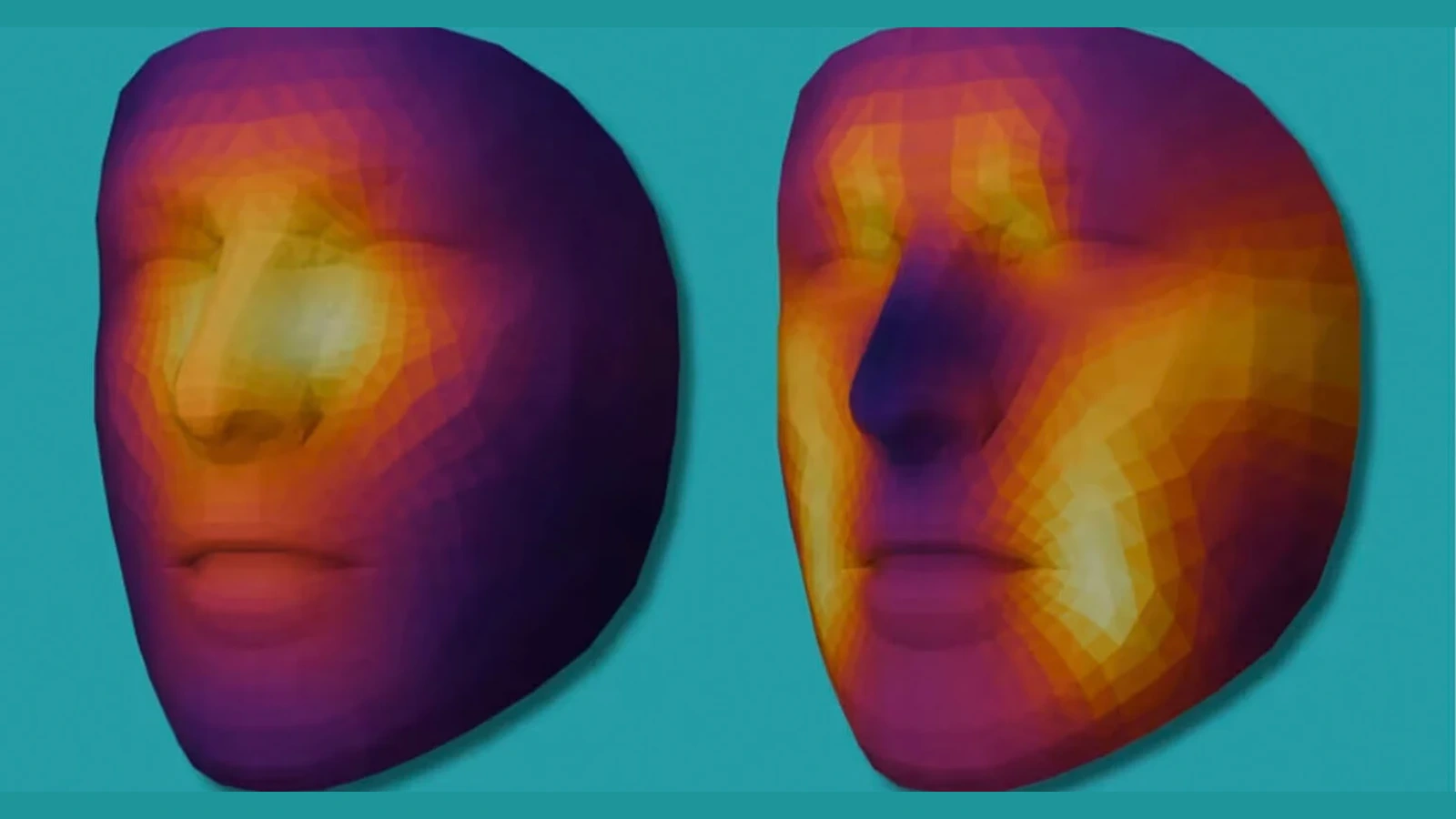
The researchers generated attention maps to examine the facial regions contributing most to each prediction. FAHR-FaceAge emphasizes the nasolabial folds, the forehead above the eyes and the temples. FAHR-FaceSurvival pays greater attention to the area beneath the eyes and around the nasal bridge.
The colored areas in the accompanying graphic do not represent temperature. They show the relative influence of image regions on predictions. Attention maps reveal where the algorithms focus, not precisely which underlying biological characteristics they recognize.
What the research found about biological age
The difference between estimated biological age and actual age was independently associated with survival. Smoking, heavy alcohol consumption and drug use were also associated with a biologically older facial appearance.
FAHR-FaceAge remained relatively stable across everyday variations in lighting, viewpoint, expression and makeup. This matters because photographs captured outside the laboratory can differ considerably.
From photography to a potential medical tool
Assessing a patient’s physical resilience matters when considering intensive treatment such as radiotherapy, surgery or systemic therapy. The researchers are exploring whether facial image analysis could add information to support physicians’ decisions rather than replace their judgment.
This idea connects with other attempts to derive health information from images, including Google PhotoScan research estimating body composition from smartphone photographs. The two projects measure different things, but both show how computational imaging is expanding beyond the traditional uses of photography.
FAHR-Face models are not standalone diagnostic tests or established clinical tools. Additional clinical validation, testing across diverse populations and strong safeguards for sensitive facial data are required before routine deployment.
What we think
As photographers, we look at faces through lighting, expression and detail. Here those same pixels have a strikingly different role: identifying associations with the health of the person in front of the camera.
The fact that two models extract information from different regions of the same face is fascinating. But an attention map does not explain the biology behind a prediction. That distinction matters when numbers could eventually influence real medical decisions.
There is also a direct implication for the imaging community: consent to taking a portrait is not the same as consent to inferring health information from it. As more can be learned from a face photo, access controls and limits on how images are used become more important.
Frequently asked questions
Can a selfie diagnose cancer?
No. The survival model was evaluated using data from people who already had cancer. It is not a cancer detection tool.
Can it predict exactly how long a patient will live?
It estimates relative statistical risk, not the certain life expectancy of a particular individual.
Can doctors use it routinely today?
These are research development and validation results. Routine clinical use requires further studies and evaluation.