Summary
- The exhibition “We Did What We Could.
- Remember Us” runs at Romantso from November 20 to December 3, 2026.
- It features 55 AFP photographs, video and MSF audio testimonies.
- Its title comes from a message left by doctor Mahmoud Abu Nujaila, who was killed in 2023.
- Admission is free.
Event Details
The war in Gaza, seen through photojournalists’ lenses and the testimonies of those working amid the violence, is the focus of an Athens exhibition presented by Médecins Sans Frontières (MSF) and Agence France-Presse (AFP).
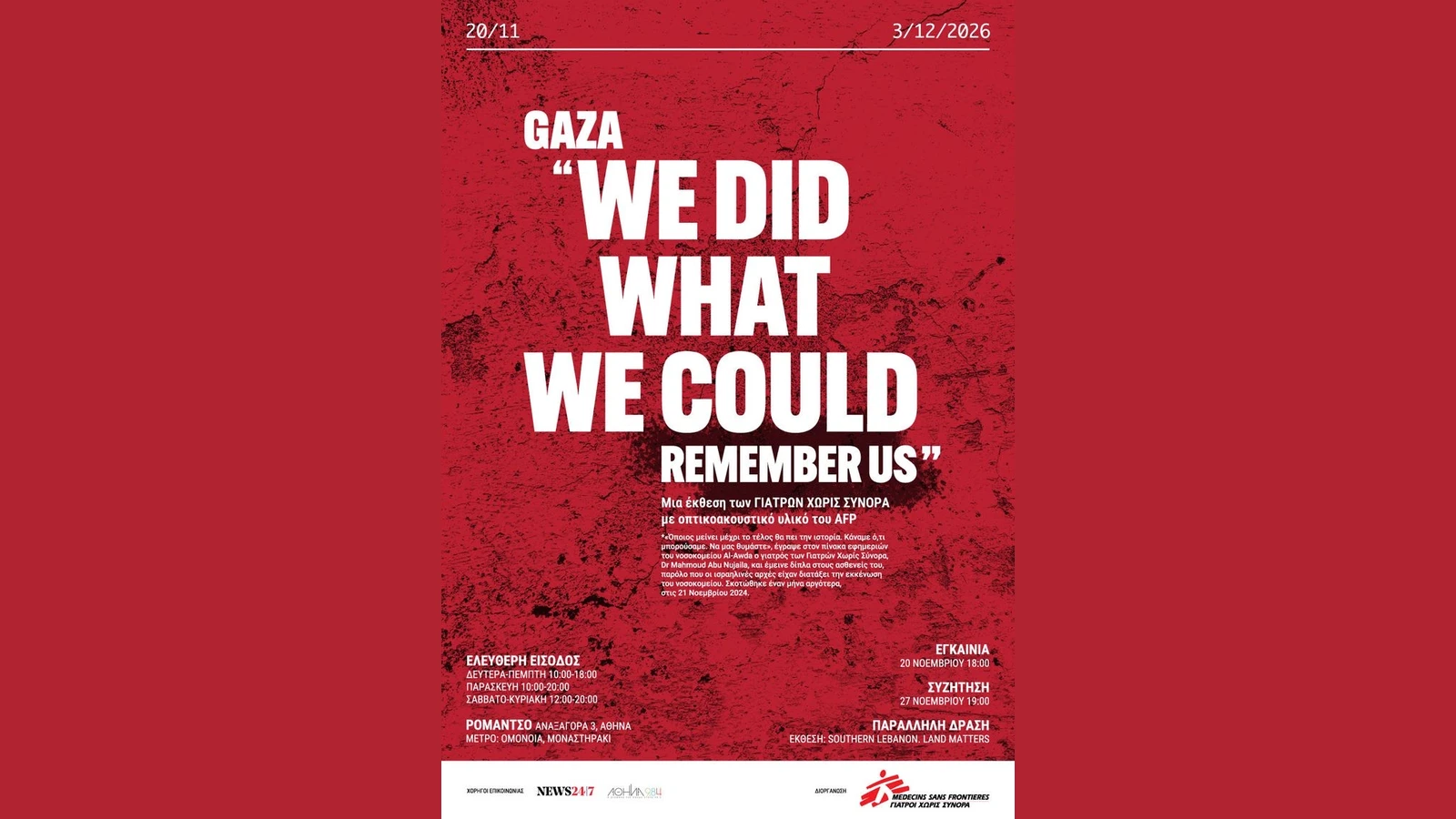
The multimedia exhibition “Gaza: We Did What We Could. Remember Us” runs from November 20 to December 3, 2026 at Romantso, with free admission. It brings together 55 photographs, videos and audio testimonies.
The doctor’s message behind the title
“Whoever stays until the end will tell the story. We did what we could. Remember us.” MSF doctor Mahmoud Abu Nujaila wrote these words on an Al-Awda hospital whiteboard on October 20, 2023.
Abu Nujaila remained to treat patients despite an evacuation order. On November 21, 2023, he was killed in a strike on the hospital alongside doctors Ahmad Al Sahar and Ziad Al-Tatari. MSF’s original announcement confirms that date.
Photojournalism and humanitarian testimony
The AFP photographs document displacement, devastated neighbourhoods and daily life during a humanitarian catastrophe. MSF video and audio testimonies bring in the experience of medical workers, the loss of colleagues and the struggle to care for patients.
The exhibition announcement cites figures covering October 2023 to October 2025: more than 67,000 Palestinians killed, almost 170,000 wounded, 15 MSF staff killed and at least 565 humanitarian workers killed. These are figures for that particular period, not an updated November 2026 total.
The importance of documenting Gaza has also been recognised internationally, including in the 2026 Prix Bayeux awards honouring photographers who covered the war.
The Athens exhibition and a companion show on Lebanon
The exhibition was conceived by Clothilde Mraffko and MSF and adapted for Greece by Pinelopi Thomaidi. MSF Greece general director Christina Psarra describes it as an act of remembrance and a collective responsibility not to forget what has happened in Palestine.
The venue is also hosting “Southern Lebanon: Land Matters”, a companion photography exhibition about southern Lebanon produced with award-winning photographer Panagiotis Rontos.
Dates, opening hours and admission
Venue: Romantso, 3 Anaxagora Street, Athens, first floor. Dates: November 20 – December 3, 2026. Opening: Friday, November 20, 18:00. Discussion on Gaza and Lebanon: November 27, 19:00. Admission: free.
Hours: Monday–Thursday 10:00–18:00, Friday 10:00–20:00, Saturday–Sunday 12:00–20:00. Nearest metro stops: Omonia and Monastiraki.
What we think
War photography matters most when images retain their names, places and facts. In Gaza, where photographs of destruction are countless, hearing from someone who was there can change how we understand the scene, rather than simply scrolling past it.
The partnership between AFP photojournalists and MSF makes that context possible. Images sit alongside the experiences of medical workers who stayed to treat patients. Mahmoud Abu Nujaila’s message is a painful reminder that documentation is also about preserving memory, not merely attracting attention.
For photographers, the exhibition is also a reason to talk about protecting journalists, preserving evidence and writing accurate captions. Images like these should never be separated from the circumstances in which they were made.