Summary
- NASA selected Mark Killion’s Orion image as its November 19, 2026 APOD.
- The Horsehead and Flame Nebulas stand out alongside other nebulae.
- Nearly six hours of data were collected in Utah.
- The telescope was controlled from Illinois, over 2,000 kilometers away.
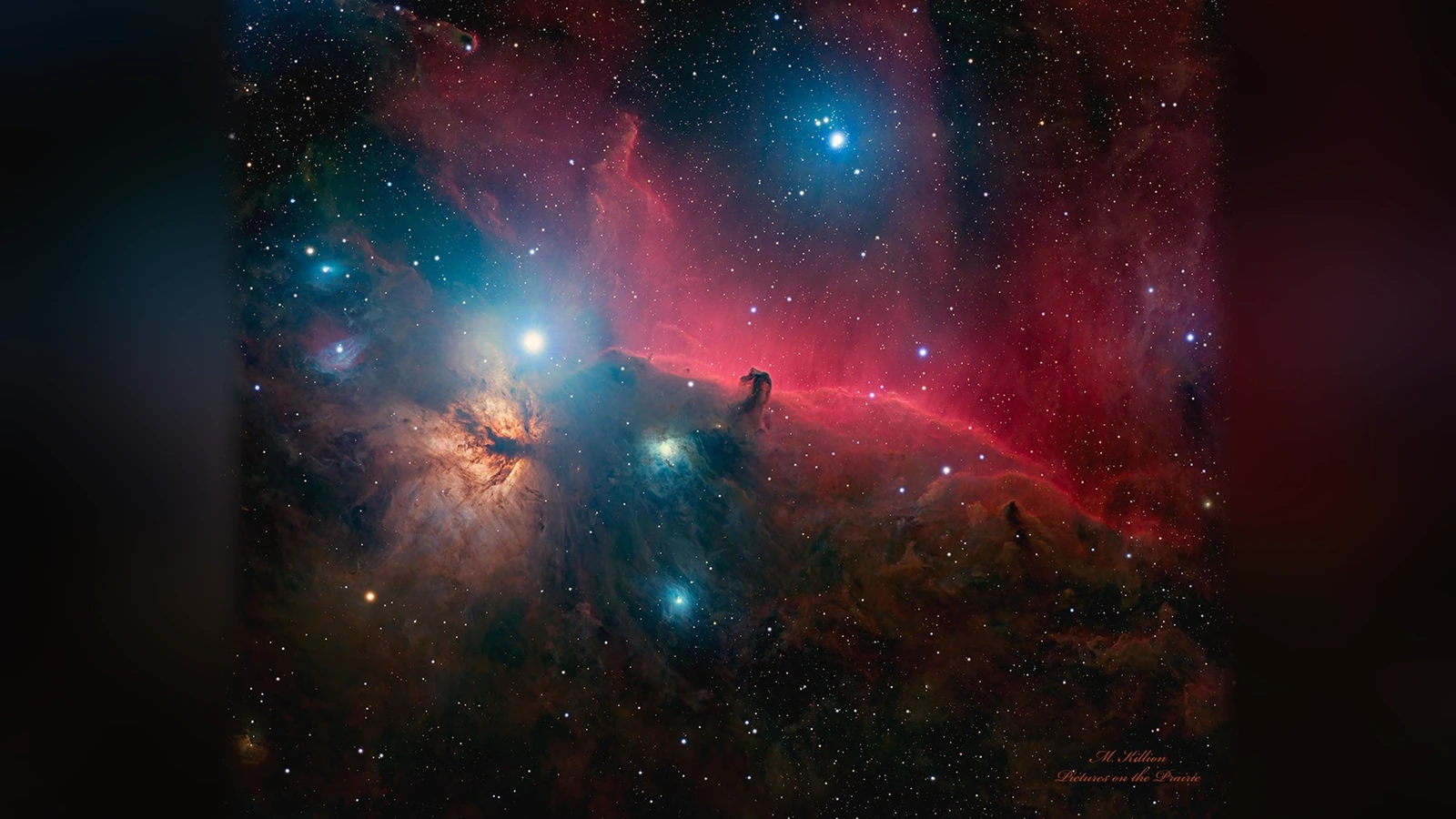
NASA chose an astrophotograph that looks almost like a painting, featuring the Horsehead and Flame Nebulas in Orion, as its Astronomy Picture of the Day for November 19, 2026.
The image is by Mark E. Killion, who collected nearly six hours of data using equipment at a Utah observatory while operating it from his home in Illinois, more than 2,000 kilometers away.
Four regions of Orion in a single frame
Near the center is the Horsehead Nebula (Barnard 33), a dense dark cloud of gas and dust that creates the familiar silhouette. NASA places it around 1,500 light-years away and describes the visible horsehead as roughly five light-years tall.
The dark appearance does not mean the area is empty. Dust blocks the red glow of ionized hydrogen behind the cloud. Radiation from the bright star Sigma Orionis, higher in the frame, excites the hydrogen gas that provides the striking backdrop.
To the left is the orange Flame Nebula (NGC 2024), crossed by intricate dark dust filaments. The blue NGC 2023, near the base of the Horsehead, is a reflection nebula where stars are actively forming. The brightest star left of center is Alnitak, a triple-star system at the eastern end of Orion’s Belt.
How the image was captured from more than 2,000 km away
Observations were made at Utah Desert Remote Observatories, where the imaging equipment was installed. Killion controlled it from Illinois. The place where the photons were recorded and the place where the photographer was working were therefore far apart.
The almost six hours refer to the total collection of imaging data, not necessarily one uninterrupted shutter exposure. In deep-sky astrophotography, combining multiple exposures can reveal faint structures while helping manage noise. NASA’s APOD description does not provide a detailed exposure log, filter list or specific camera and telescope models for this image.
The importance of patiently gathering data also emerges in projects such as the 100-hour astrophotograph of faint structures in Cassiopeia, where extended observation helped bring extremely subtle features into view.
What the colors are telling us
The red glow is associated with light emitted by ionized hydrogen. Blue reflection nebulosity results from starlight scattered by dust, while the dark lanes mark material obscuring whatever lies behind it. These colors are not merely decorative: they help distinguish different physical processes in the same field of view.
This is also why the photograph works so well visually. The luminous Flame, the dark Horsehead silhouette and the blue nebulosity create a clear composition, even though the main subject is roughly 1,500 light-years away.
What we think
What stands out here is not only the color but the decision to bring so many distinct features of Orion into one frame. The Horsehead provides a clear focal point, and the brighter structures around it put that silhouette into context. It is a good example of how thoughtful composition can make an astronomical subject easier to understand.
For anyone who photographs the night sky, Killion’s setup also illustrates something practical: reaching an observatory under dark skies does not always require being physically beside the telescope. Remote operation can change how an entire project is organized, while careful framing, patient data collection and considered processing remain essential.
Frequently asked questions
Was this photograph captured by a NASA space telescope?
No. NASA selected it for Astronomy Picture of the Day, but Mark E. Killion gathered the data with ground-based equipment at Utah Desert Remote Observatories.
Why does the Horsehead look black?
It is a dense cloud of gas and dust blocking light from the bright red hydrogen emission behind it. This creates its instantly recognizable dark silhouette.