

Summary
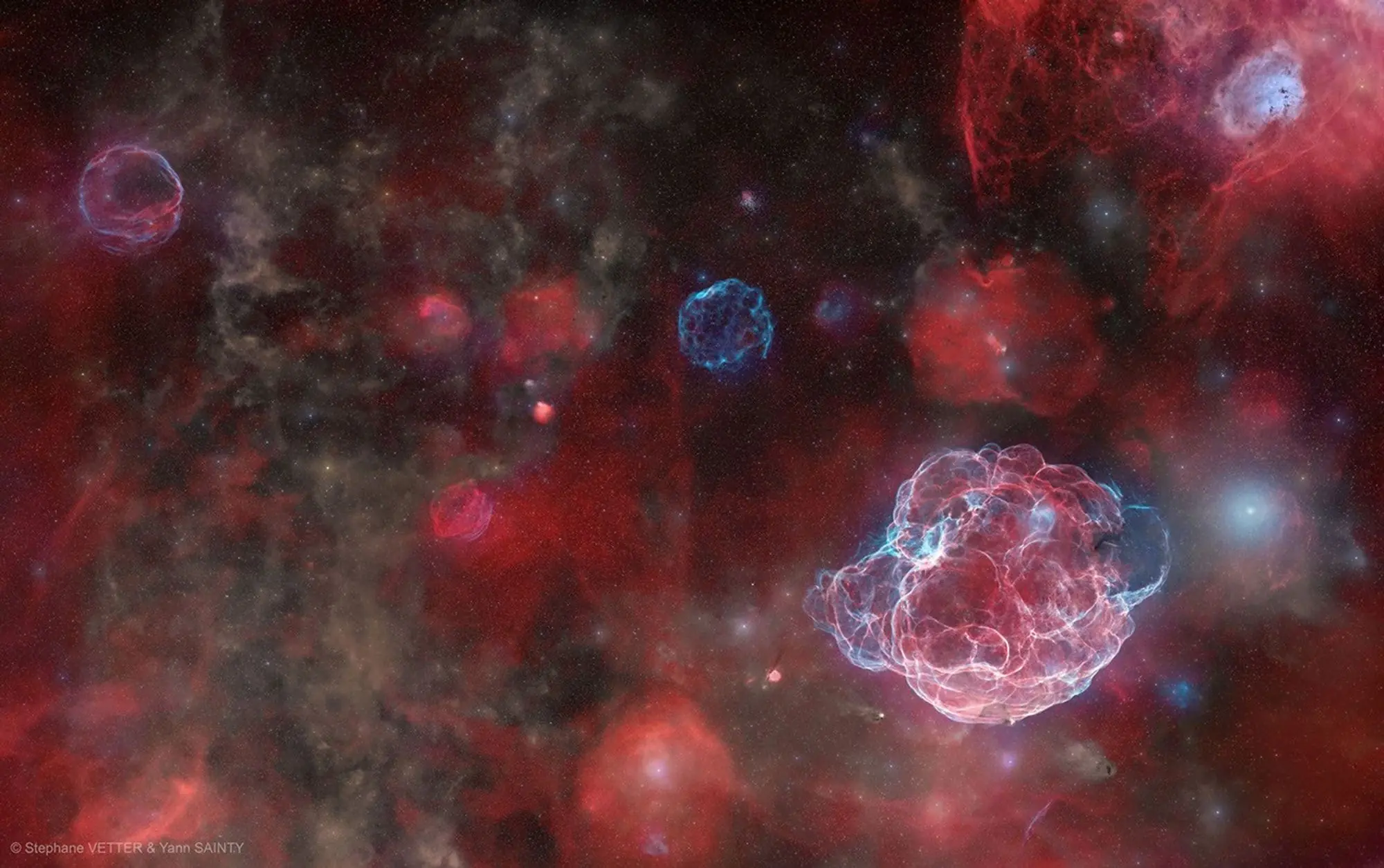
An astrophotographic mosaic brings together the remnants of five separate stellar explosions, revealing structures captured through approximately 200 hours of observations.
The image by Stephane Vetter and Yann Sainty was created from observations at Oukaïmeden Observatory in Morocco and selected as NASA’s Astronomy Picture of the Day for 24 September 2026.
The field lies in the constellation Auriga and covers an angular area equivalent to approximately 1,000 full moons. The comparison concerns the area it occupies in the sky, not the brightness or physical dimensions of the objects.
Ten fields, not one continuous exposure
The project’s AstroBin entry, titled Five SNR in Auriga (HORGB version), lists a ten-panel mosaic and a total integration time of 196 hours and 40 minutes. This is therefore a combination of data, not a single frame taken with the shutter open for eight days.
Vetter handled data acquisition and preprocessing, while Sainty carried out the processing. This division of work also highlights the photographic side of the result: collecting the light is one part of the process, while bringing the individual fields together shapes the final composition.
Five independent explosions in the same frame
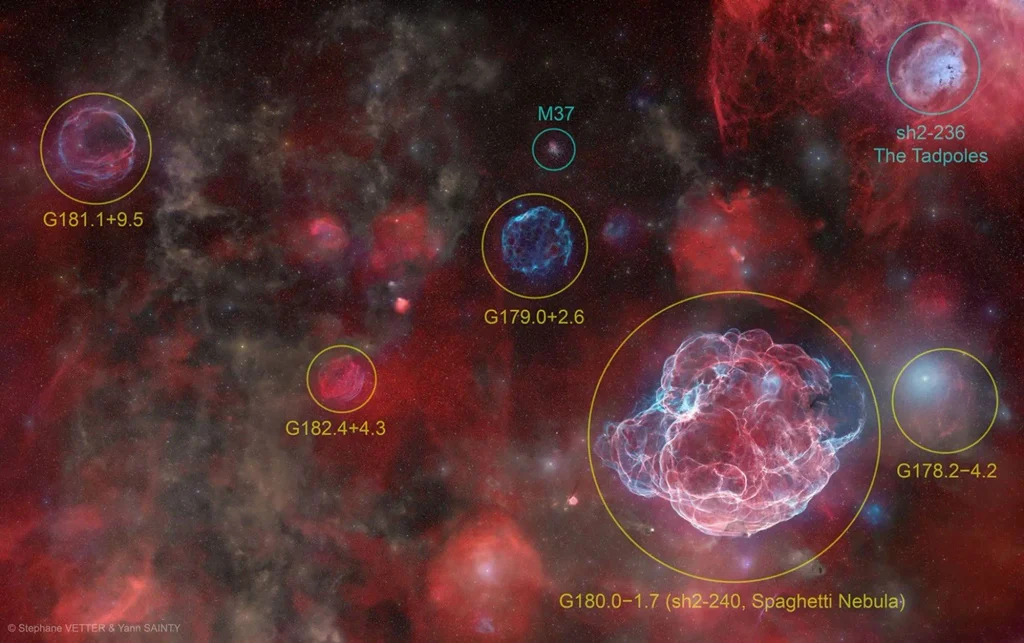
From left to right, the remnants are G181.1+9.5, G182.4+4.3, G179.0+2.6, G180.0−1.7 and G178.2−4.2. G180.0−1.7 is also known as Sh2-240 or the Spaghetti Nebula, with its distinctive network of fine filaments.
The remnants lie at different distances, reaching several thousand light-years from Earth, and their estimated ages extend to tens of thousands of years. The image brings together the consequences of separate explosions, not a single event that happened simultaneously.
The annotated version also identifies the open cluster M37 and the Tadpole Nebula as additional reference points in the field.
Colour as information
Red represents emission from hydrogen and blue from oxygen. The gas shells and filaments are associated with the shock waves of the explosions. The colour mapping therefore does more than serve an aesthetic purpose: it helps distinguish different emissions within the same composition.
What we think
The appeal lies in the connection between the large scale and the fine detail. Rather than isolating a single nebula, the composition allows different forms to be compared within the same frame. It is also a good example of why astrophotography benefits from an explanation of the whole process, rather than just an impressive number of hours.
Frequently asked questions
Was this image taken by a space telescope?
No. The data were collected at a ground-based observatory in Morocco.
Are the five remnants next to one another?
They appear in the same field of view but lie at different distances. Their positions in the frame do not mean that they are neighbours in space.
Can the image be freely republished?
It is not a NASA public-domain image. APOD credits the copyright to the two creators and explains that permission for public or commercial use of such images must be sought from the rights holders.