Summary
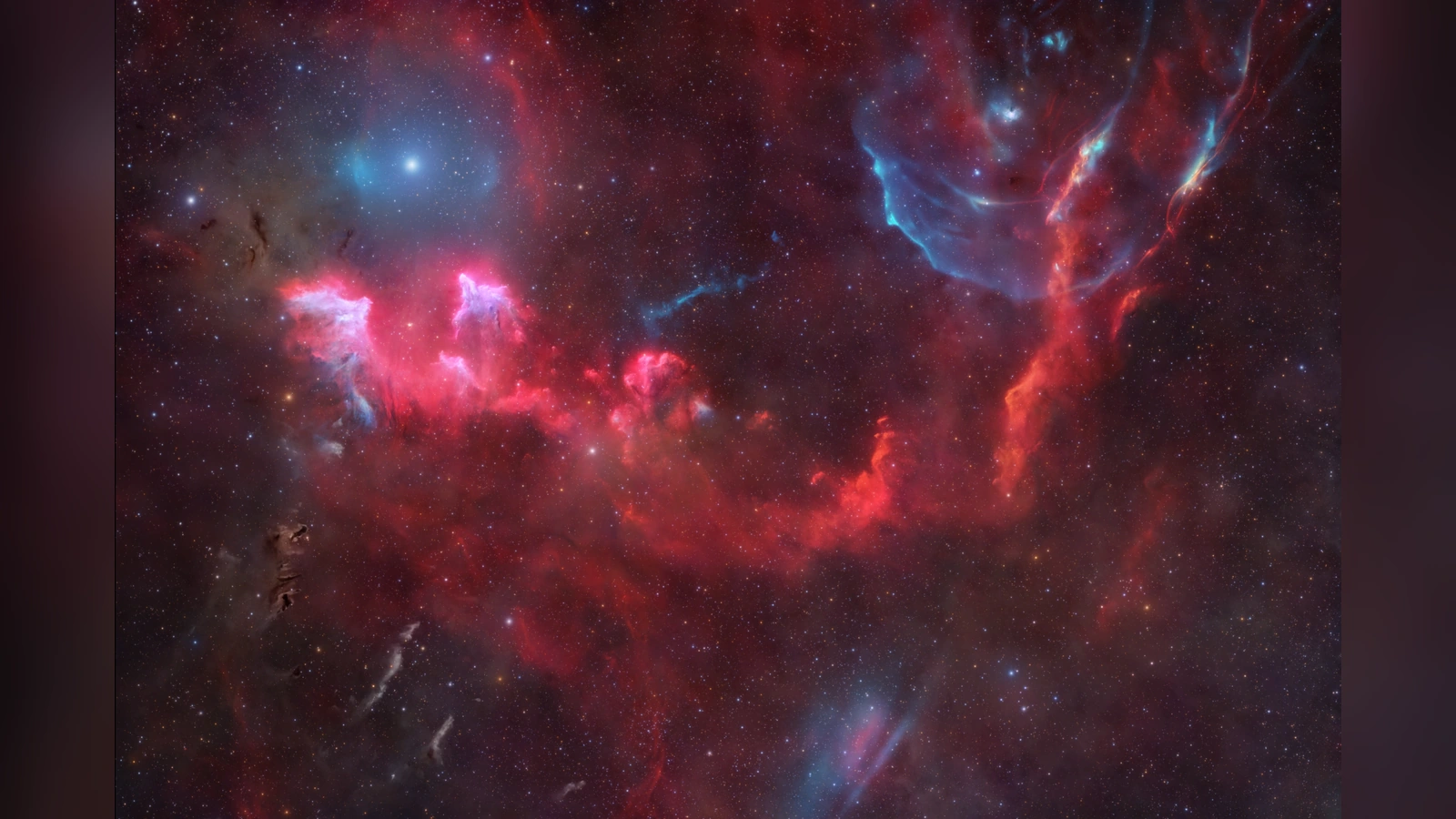
A remarkable astrophotograph built from roughly 100 hours of observations has revealed three extraordinarily faint structures in the constellation Cassiopeia that had previously gone unidentified.
NASA selected the image as its Astronomy Picture of the Day (APOD) for October 21, 2026. The credited creators are Louis Leroux-Géré, Thibault Rouillée, Vincent Martin and Cédric de Decker of Starfront Observatories.
Beyond the striking red and blue filaments stretching across a crowded star field, the image contains something more intriguing: three objects whose true nature has yet to be established.
The familiar ghosts and three newly revealed objects
The region contains IC 59 and IC 63, two nebulae known as the Ghosts of Cassiopeia. They lie near the bright multiple-star system Gamma Cassiopeiae.
Energetic radiation from Gamma Cassiopeiae excites hydrogen gas in the nebulae, producing the red glow that dominates portions of the image. Interstellar dust also reflects and scatters bluish-white starlight, contributing to its blue hues.
The new photograph exposes three additional faint structures, provisionally called Object 1, Object 2 and Object 3. They appear prominently in ionized-oxygen emission, distinct from the familiar nebulae.
The observations reveal ionized oxygen in these areas, but they have not yet established what physical process is responsible for ionizing it.
Why 100 hours of observation were needed
Capturing structures this faint is an exceptionally demanding task in astrophotography.
When a nebula produces a very weak signal, a single exposure cannot cleanly resolve its detail. By acquiring and combining many exposures, astrophotographers can improve the signal relative to noise.
Here, approximately 100 hours of observations were combined with a specialized oxygen filter to isolate the characteristic emission of ionized oxygen.
That selective capture was crucial to showing the three objects in a region where much brighter hydrogen emissions and stars can easily overpower weaker structures.
This demanding process recalls the 196 hours and 40 minutes of observations behind an astrophotographic mosaic of five supernova remnants, another image selected as a NASA APOD in September 2026.
What could the three objects be?
NASA outlines two particularly interesting possible explanations.
Object 3 could be associated with a bow shock, an arc-shaped shock front that can form as a star system moves through interstellar gas and dust.
As Gamma Cassiopeiae moves through interstellar material, it may compress and heat gas ahead of its motion. That process could account for the ionized oxygen seen in Object 3.
Object 1 poses a different possibility. It might be a planetary nebula, a shell of gas expelled by a star late in its evolution.
Finding a central white dwarf would strengthen that interpretation.
No comparable specific explanation is offered for Object 2. The origin of all three structures remains under investigation.
What we think
This is one of those astrophotographs worth looking at beyond its impressive colors. The 100 hours were not simply spent making a cleaner picture. They brought out information that could otherwise have been lost beneath noise and the glow of the familiar nebulae.
For photographers, there is a useful lesson here: choosing the right filter and patiently gathering data can fundamentally change what we are able to capture. In narrowband astrophotography, how much light you collect matters, but so does which part of the spectrum you record.
What we especially like about this image is that it opens scientific questions rather than settling them. The three blue structures are now recorded, but identifying them will require further observations and analysis. A photograph can still be the starting point for a new discovery.