


Summary
- Hubble and Gaia have revealed a third ancient merger in the Milky Way
- LKH was absorbed about 12 billion years ago, 1.8 billion years before Gaia-Sausage-Enceladus
- The study examined 39 globular clusters, with 12 linked to LKH
- LKH is estimated to have contained about 500 million solar masses in stars
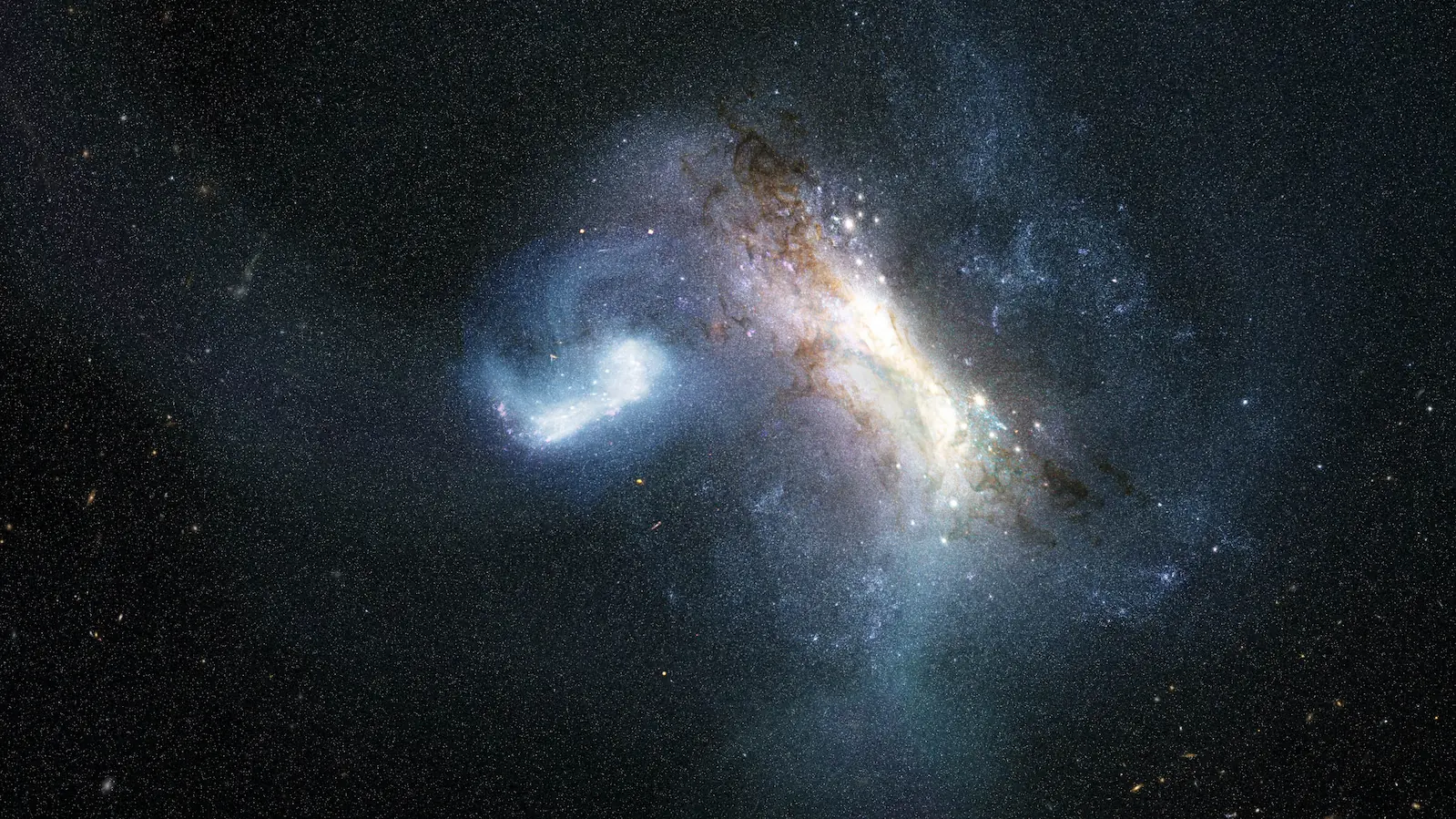
- The collision image is an artist’s impression rather than a direct photograph
- From 17 newly analysed clusters to a total sample of 39
- Why globular clusters preserve the record
- The different roles of Hubble and Gaia
- The third sequence that exposed LKH
- When the merger happened
- How large the lost galaxy was
- What this changes about the Milky Way’s history
- The collision image is not a photograph
- What remains unknown and what comes next
- What we think
- Frequently asked questions
Data from Hubble and Gaia have revealed that the young Milky Way absorbed a dwarf galaxy about 12 billion years ago, extending the documented history of its major mergers 1.8 billion years further into the past.
An international research team identified a distinct population within a sample of 39 globular clusters that formed neither in the Milky Way’s main progenitor nor in the known Gaia-Sausage-Enceladus dwarf galaxy. The study was published in Nature Astronomy and attributes these clusters to an earlier galaxy named Low-energy-Kraken-Heracles, or LKH.
The discovery matters because LKH is estimated to have contained about 500 million solar masses in stars alone, an amount comparable to Gaia-Sausage-Enceladus and significant relative to the size of the young Milky Way at the time. The result shows that external stellar populations contributed to the Galaxy’s formation much earlier than had previously been firmly demonstrated.
From 17 newly analysed clusters to a total sample of 39
The researchers analysed 17 globular clusters in the inner Milky Way for the first time using the same homogeneous method. Fifteen had previously been associated with the so-called “low-energy” group, while the other two were considered to have formed within the Milky Way itself. When earlier homogeneous measurements were included, the complete sample reached 39 clusters.
The Hubble observations were obtained through the F606W and F814W optical filters. Careful processing enabled relative age estimates with typical uncertainties of a few hundred million years, precise enough to separate events that occurred within comparatively close periods on cosmic timescales.
Why globular clusters preserve the record
Globular clusters are dense, roughly spherical collections containing tens of thousands to millions of stars. Many hold some of the oldest stars in the Milky Way and can preserve information about the environment in which they formed, even after their original galaxy has been disrupted and incorporated into a larger one.
As a visual example of this class of object, PTTL recently covered the NGC 6723 globular cluster, also known as the Chandelier Cluster. In the new research, however, the decisive element is not a single striking image but the ability to compare the ages, chemical composition and motion of many clusters at the same time.
The different roles of Hubble and Gaia
Hubble provided the deep, high-resolution photometry required to construct colour-magnitude diagrams and compare them with stellar-evolution models. This allowed the team to estimate the clusters’ relative ages and metallicities consistently, with metallicity describing the abundance of elements heavier than helium.
Gaia supplied the precision astrometry needed to reconstruct their orbits and dynamical properties. By combining age, metallicity and motion, the team tested statistical models involving two, three and four different galactic progenitors. The model containing three populations received the strongest support from the data.
The third sequence that exposed LKH
Three distinct sequences appeared in the age-metallicity diagram. One corresponds to clusters born in the Milky Way’s progenitor, the second to clusters brought in by Gaia-Sausage-Enceladus, and the third occupies an intermediate position, remaining separate from the other two even when clusters of comparable metallicity are considered.
Twelve of the 15 clusters initially placed in the low-orbital-energy group were associated with the third population at probabilities above 50%. They are now located within the inner six kiloparsecs, or nearly 20,000 light-years, of the Galactic Centre. Their shared chronological and dynamical signature indicates that they came from an independent system that was later absorbed.
When the merger happened
ESA’s public announcement places the event about 11.8 billion years ago, while the available v2 version of the scientific paper gives a value of roughly 12.3 billion years and a redshift above z=4. The central and more robust result is relative: the LKH merger occurred about 1.8 billion years before the Gaia-Sausage-Enceladus merger. Because the absolute date is anchored to the estimated timing of that later event, “about 12 billion years ago” is the safest concise description.
Gaia-Sausage-Enceladus was incorporated into the Milky Way about 10 billion years ago, while the later interaction with the Sagittarius dwarf galaxy began more than six billion years ago and is still continuing. LKH now sits before both of these major chapters in the Galaxy’s history.
How large the lost galaxy was
LKH’s estimated stellar mass was approximately 5×10^8 solar masses. This figure describes the mass in stars, not the galaxy’s total matter content, which would also have included gas and dark matter. Although LKH is classed as a dwarf by present-day galactic standards, it was a major object relative to the smaller and younger Milky Way of that era.
The name Low-energy-Kraken-Heracles combines three earlier lines of research. “Low-energy” refers to clusters with low orbital energy, “Kraken” to an ancient galactic progenitor predicted through studies of globular clusters, and “Heracles” to a stellar population previously identified in the inner Milky Way. The new paper argues that these clues describe different aspects of the same major merger.
What this changes about the Milky Way’s history
Until now, the oldest widely documented major merger was the one involving Gaia-Sausage-Enceladus. Identifying LKH moves the observational record 1.8 billion years further back and shows that the early Milky Way was not shaped solely by stars born within it. A significant portion of its first building material came from another galaxy.
The study does not attribute a specific present-day structure, such as the entire Galactic disc or central bulge, to LKH alone. It does, however, provide a clearer timeline and a new initial condition for models attempting to explain the formation of the inner stellar halo and the Galaxy’s oldest stellar populations.
The collision image is not a photograph
The image accompanying the announcement is an artist’s impression of LKH encountering the young Milky Way, not a photograph of the event. No telescope directly observed a collision that occurred about 12 billion years ago. Hubble imaged the globular clusters as they exist today, and the ancient merger was reconstructed from their ages, chemical composition and orbits.
The distinction matters: the scientific evidence lies in the surviving stellar “fossils” and their statistical coherence, not in the visual fidelity of the illustration.
What remains unknown and what comes next
The method is particularly effective for progenitor galaxies massive enough to form globular clusters. It may, however, miss smaller systems that never acquired such clusters or whose clusters were completely disrupted. The authors do not rule out additional, probably less massive mergers in the Milky Way’s early history.
Hubble continues to observe globular clusters that have not previously been studied to comparable precision. Meanwhile, although Gaia ended its science observations on 15 January 2025 and was powered down in March that year, its fourth major data release is scheduled for 2 December 2026. The study also notes that more precise stellar ages from asteroseismology, including measurements from Europe’s PLATO mission planned for early 2027, could provide a more detailed view of the Milky Way’s earliest period.
What we think
The strength of this discovery does not lie in the striking artist’s impression but in the convergence of three independent types of information: age, chemical composition and orbital motion. The clear appearance of a third population in a homogeneously analysed sample provides a much stronger foundation than the earlier, isolated clues.
The absolute date and the assignment of every individual star or cluster will continue to depend on models and future measurements. Nevertheless, the gap of about 1.8 billion years relative to Gaia-Sausage-Enceladus and LKH’s estimated mass materially change the timeline used to describe how the Milky Way was assembled.
Frequently asked questions
What is Low-energy-Kraken-Heracles?
LKH is the progenitor dwarf galaxy to which the new study attributes a distinct population of 12 ancient globular clusters. It no longer exists as an independent galaxy because it was absorbed by the young Milky Way.
When did the merger happen?
The event is broadly placed about 12 billion years ago. The stronger relative measurement indicates that it preceded the Gaia-Sausage-Enceladus merger by approximately 1.8 billion years.
Did Hubble photograph the ancient collision?
No. The collision image is an artist’s impression. Hubble observed the surviving globular clusters, and researchers reconstructed their origin from their present-day properties.
Why can globular clusters reveal their original galaxy?
Their ages, metallicities and orbits can retain a shared formation signature. When multiple clusters follow the same distinct sequence, they can be statistically associated with a common galactic progenitor.
Could there have been other unknown mergers?
Yes. The method may miss smaller galaxies without globular clusters or systems whose clusters were completely destroyed. This study identifies one major progenitor but does not rule out smaller events.