Summary
- James Webb captured the star-forming region N159 in the Large Magellanic Cloud, about 161,000 light-years away.
- Its infrared view distinguishes ionised hydrogen, carbon-based molecules and dense filaments of molecular gas.
- NIRCam observations identified faint stars and multiple stages of star formation within the same nebula.
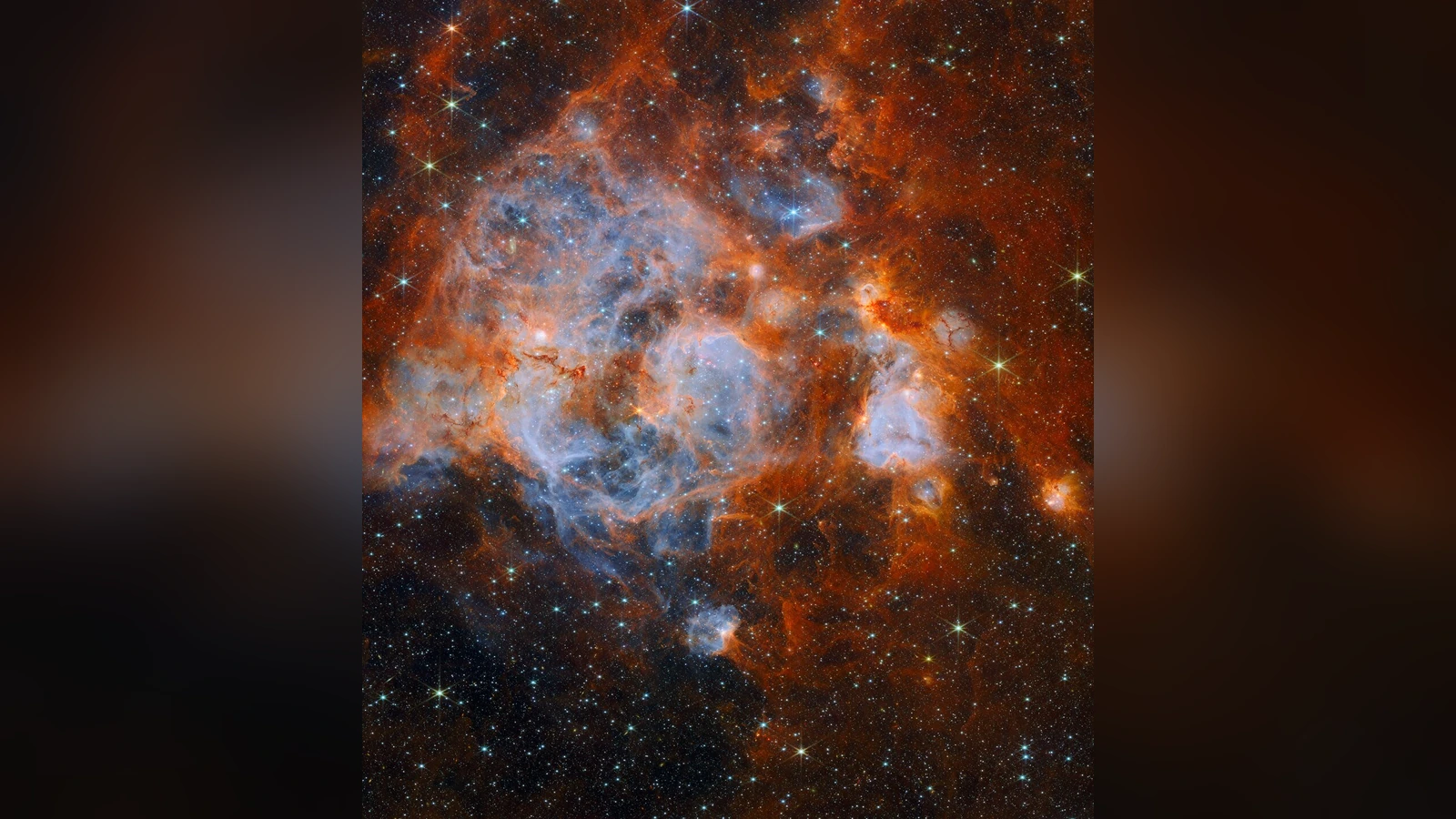
The James Webb Space Telescope takes us inside N159, a vast stellar nursery in the Large Magellanic Cloud, where glowing gas clouds and dark filaments produce one of Webb’s most striking infrared scenes.
ESA/Webb released the image on 22 October 2026 as its Picture of the Month. Also catalogued as LHA 120-N 159, the region lies about 161,000 light-years away and contains thousands of stars in the earliest stages of their lives.
ESA also explores N159 in a short episode of Space Sparks:
https://esawebb.org/videos/potm2610a/
What the orange, blue and dark clouds reveal
N159 is an H II region, where intense ultraviolet radiation from young, extremely hot stars ionises hydrogen gas. The pale blue areas represent this ionised gas, while the orange glow traces emission from polycyclic aromatic hydrocarbons (PAHs), carbon-based molecules.
Dark reddish filaments of cool molecular hydrogen run between these clouds. They form dense structures that shield emerging stars from harsh radiation and stellar winds. Elsewhere, stars that have already formed carve cavities and bright ridges into the gas with their radiation and outflows.
How infrared imaging sees through the dust
The observations were made with Webb’s Near-Infrared Camera (NIRCam). Unlike an ordinary visible-light photograph, infrared data can reveal structures and stars hidden by dust, while the colours assigned to the composite help distinguish different emissions. These are not the colours the human eye would see directly.
That makes infrared imaging particularly valuable in stellar nurseries. Stars begin their lives inside dense clouds, so visible light often leaves much of their earliest evolution out of sight. The same approach is demonstrated in Webb’s infrared panorama of the IC 348 region, where researchers found very low-mass objects.
A stellar nursery less than three million years old
N159 is less than three million years old, making it one of the youngest star-forming regions in the Large Magellanic Cloud. It also contains the compact Papillon Nebula, associated with massive star formation and first resolved by the Hubble Space Telescope in 1999.
The new observations come from Webb programme #5114. Researchers detected exceptionally faint stars with masses below one tenth that of the Sun and separated young stellar objects still embedded in their birth clouds from more evolved stars. The western part of N159 contains a higher concentration of young stellar objects, indicating an earlier phase of star formation.
A different view of this process can be seen in the FS Tau stellar system, where infrared observations reveal protostars and flows of material. N159 gives astronomers a much larger laboratory for examining multiple stages of star formation in the same nebula.
Why the Large Magellanic Cloud matters
The Large Magellanic Cloud is a satellite galaxy of the Milky Way and has a lower proportion of elements heavier than hydrogen and helium. That environment is useful for investigating star formation in conditions more similar to those of the early Universe.
What we think
For anyone who works with images, the compelling part is how the way we capture a scene changes what we can say about it. In visible light, much of the activity inside these dense clouds would remain obscured. Infrared observations let us examine the nebula’s structure and the places where stars are still forming.
We also like the fact that the colours serve a purpose. Orange is not there just to make the frame dramatic, and blue is not simply a design choice. Assigning colours to different emissions helps us read a physically complex environment. It is a particularly good example of scientific imaging bringing visual impact and useful information together.
Frequently asked questions
Are these the real colours of N159?
Not in the conventional visible-light photographic sense. This is a composite of infrared observations from NIRCam, with visible colours assigned to help separate different components of the nebula.
What is an H II region?
It is a region where radiation from hot, young stars has ionised hydrogen gas. Such regions are characteristic of active star formation.