

Summary
- NASA’s James Webb Space Telescope observed the FS Tau star system in infrared light.
- The image reveals protostars estimated to be 1 to 3 million years old.
- FS Tau B appears to be linked to striking outflows of material.
- The observation supports evidence that protostars may grow in separate episodes.
- A comparison with Hubble highlights Webb’s ability to see through cosmic dust.
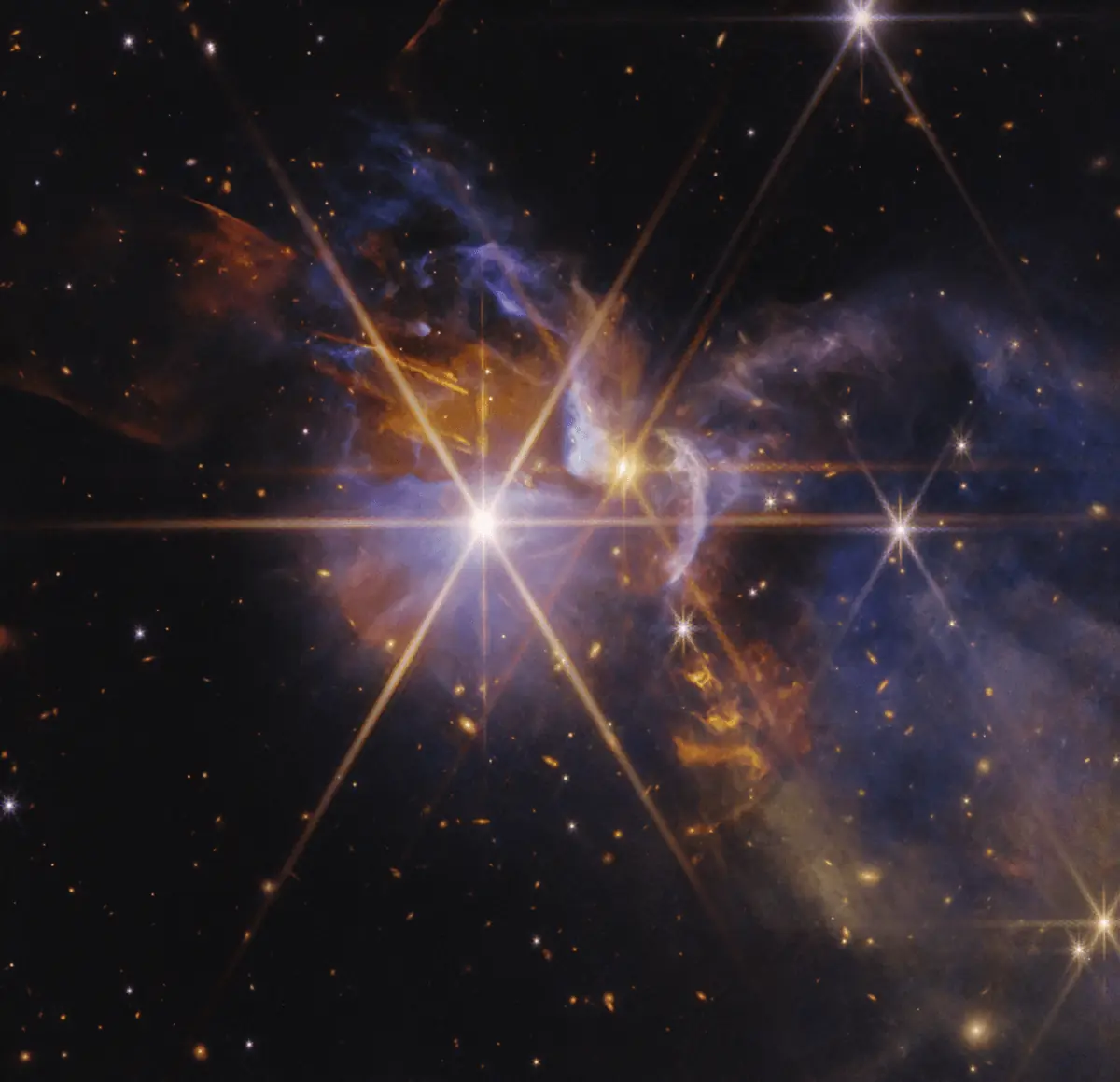
NASA’s James Webb Space Telescope has revealed newborn stars and gas structures in the FS Tau star system.
The new infrared image from Webb shows details that had previously been hidden behind thick clouds of dust, revealing protostars, material outflows, and distant background galaxies.
The observation is important because it allows scientists to study how low-mass stars evolve during the earliest stages of their lives, in a region where the influence of stronger stellar radiation is limited.
FS Tau Through Webb’s Eyes
FS Tau is a star-forming region where Webb detected several protostars, meaning very young stars that are still gathering mass from surrounding gas and dust.
According to NASA, the protostars in this region are about 1 to 3 million years old. On cosmic timescales, they are extremely young, especially compared with our Sun, which is about 4.6 billion years old.
Webb’s infrared vision made it possible to capture structures that are not easily visible in optical light, because dust absorbs and scatters shorter wavelengths.
Protostars and Material Outflows
One of the most interesting features in the image is FS Tau B, a protostar that appears to be associated with orange and red outflows of material within the region.
As FS Tau B gathers material from the surrounding disk of gas and dust, some of that material is ejected outward. These outflows form filaments, sheets, and structures that affect the surrounding environment.
NASA says the broader outflows are likely connected to the interaction between the protostar’s magnetic field and superheated material close to the accretion disk.
What the Gaps in the Outflows Reveal
The new Webb observation detected gaps between the outflows, a feature that strengthens the idea that protostars do not grow at a steady rate.
Instead, they appear to go through separate accretion episodes, during which they collect material and increase their mass. During these phases, they also eject superheated material in different directions.
Between these episodes, their activity seems to decrease, leaving traces that can be studied through the structure of the outflows.
The Comparison With Hubble
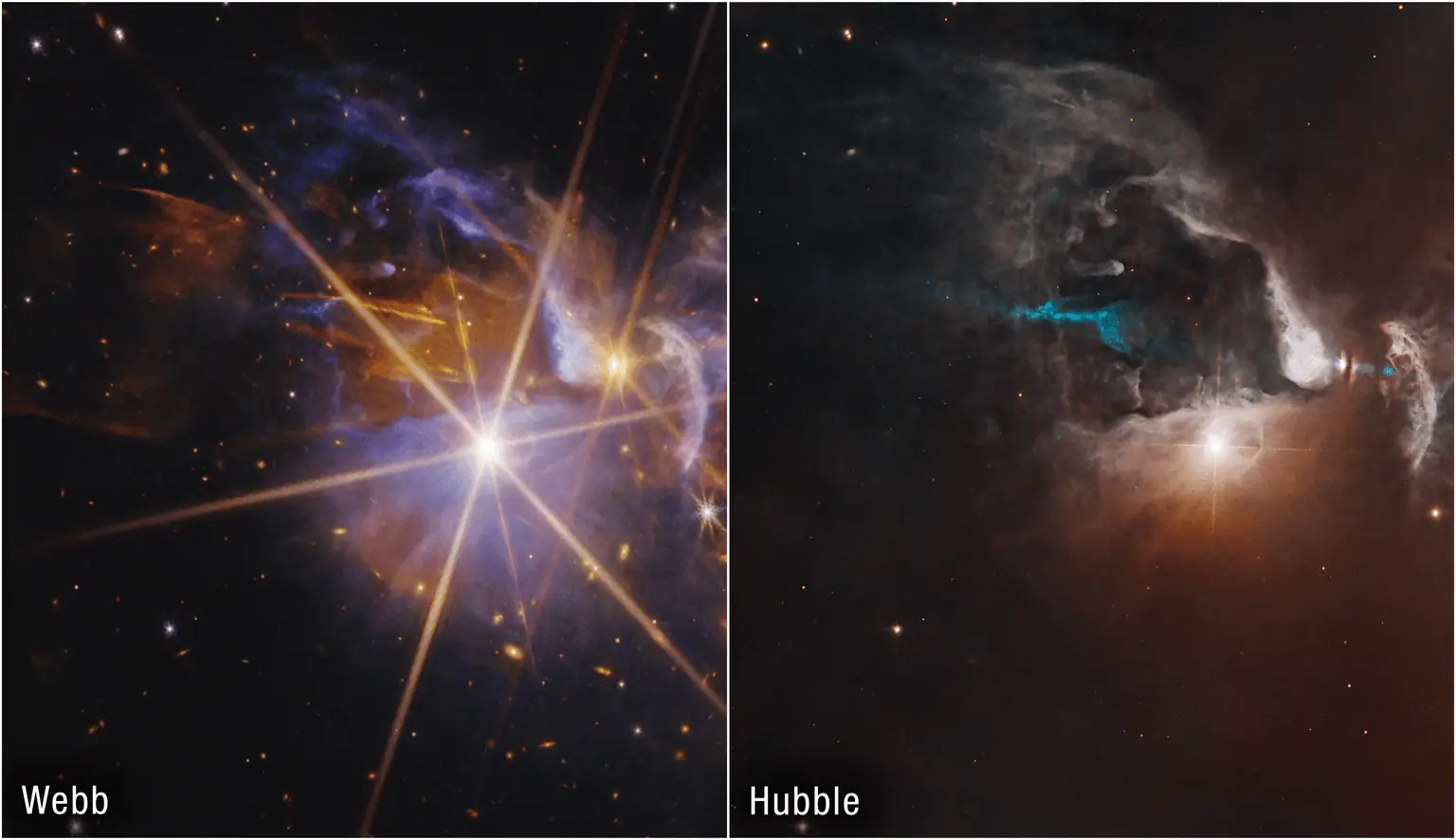
NASA also presented a comparison between Hubble and Webb observations of the same region.
Hubble, which observes mainly in visible light, shows FS Tau largely hidden behind thick dust. Webb, thanks to its infrared observations, sees through that dust and reveals in greater detail how young stars shape their surroundings.
The light-blue ridges near FS Tau B were likely created when outflows struck and compressed material in the region. Their brightness shows that they are reflecting light from the nearby protostar.
Colors as a Scientific Tool
The colors in the image are not only visually striking. They provide information about the amount and distribution of dust.
Bluer light is more easily absorbed and scattered by dust, while redder light can pass through it more effectively. As a result, background galaxies that appear redder are located behind thicker foreground dust, while yellower galaxies are less obscured.
The few white stars visible in the image are likely in the foreground, meaning they are closer to us than the FS Tau region.
What We Think
Webb’s new image is another example of how important infrared astronomy is for studying star birth. This is not just an impressive cosmic image, but data that helps scientists better understand the earliest stages of star formation, including the formation of stars similar to our Sun.
Frequently Asked Questions
What is FS Tau?
FS Tau is a star system in a star-forming region, where young protostars exist within clouds of gas and dust.
What are protostars?
Protostars are very young stars forming from dense pockets of gas and dust, before they fully evolve into stars that burn hydrogen in their cores.
Why can Webb see more than Hubble?
Webb observes in infrared light, which can pass through dusty regions more effectively than the visible light captured by Hubble.
How young are the stars in FS Tau?
The protostars in FS Tau are estimated to be about 1 to 3 million years old.
Why are material outflows important?
Outflows show how young stars interact with their surroundings and how their growth process may occur in separate episodes.