

Summary
- Hubble captured the globular cluster NGC 6723
- The cluster is also known as the Chandelier Cluster
- It lies in Sagittarius, about 27,000 light-years from Earth
- Globular clusters contain some of the oldest stars in the Milky Way
- Observations suggest two episodes of star formation in NGC 6723
The Hubble Space Telescope captured the globular cluster NGC 6723, also known as the Chandelier Cluster, revealing a striking collection of ancient stars in our Milky Way.
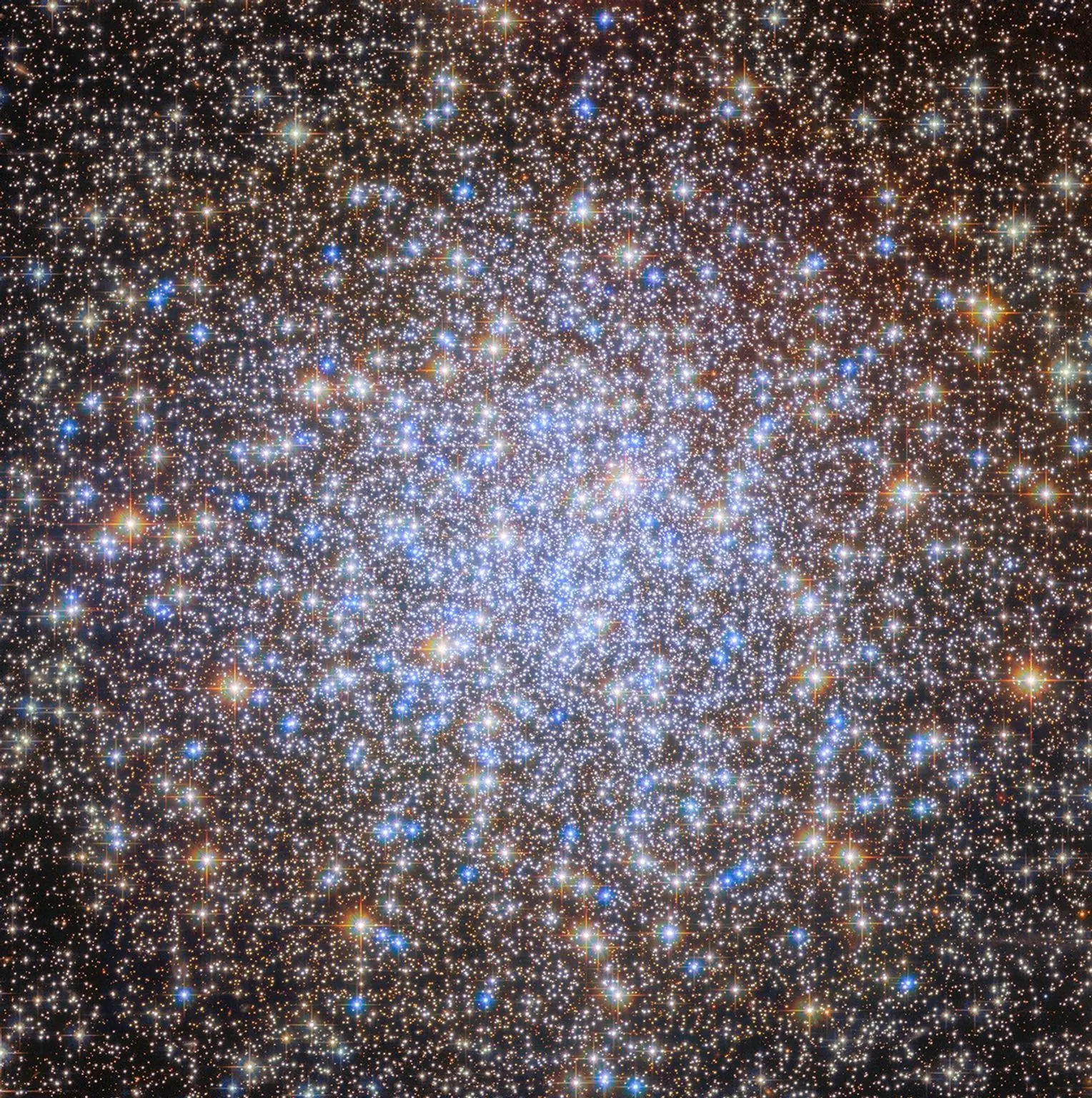
NASA and ESA presented a new image of NGC 6723, a globular cluster in the constellation Sagittarius, located about 27,000 light-years from Earth and resembling a bright chandelier because of the thousands of stars it contains.
The image matters because globular clusters are considered among the oldest structures in our galaxy, with ages often exceeding 10 billion years, offering valuable clues about how the first stellar systems formed.
An ancient cluster in Sagittarius
NGC 6723 is a globular cluster, meaning a dense concentration of tens of thousands to millions of stars held together by gravity.
More than 150 such clusters have been identified in the Milky Way, while others may still remain hidden behind dust or in densely packed star fields.
NGC 6723 is nicknamed the Chandelier Cluster because its appearance resembles a chandelier filled with countless points of light. In reality, each “light” in the image is an individual star.
Why astronomers are interested
Globular clusters such as NGC 6723 contain some of the oldest stars in the Milky Way. Scientists believe these structures formed very early in the galaxy’s history, possibly billions of years before the thin disk of stars where the Sun orbits.
For a long time, astronomers thought that all stars in a globular cluster formed almost simultaneously and shared a similar chemical composition. Hubble observations, however, showed that the reality is more complex.
What Hubble observations revealed
Hubble first observed NGC 6723 as part of a major survey of globular clusters in the Milky Way, using visible and near-infrared light.
These data helped researchers study the ages of the clusters, as well as how higher-mass stars tend to move toward the center while lower-mass stars drift toward the outer regions.
In a later observing program, scientists used Hubble’s sensitivity to ultraviolet light to detect subtle differences in the chemical composition of stars and to study age spreads within the same cluster.
Two episodes of star formation
For NGC 6723, researchers found evidence of two relatively close episodes of star formation. The second appears to have occurred within 634 million years of the first.
Although this is a vast period on a human scale, for a globular cluster older than 10 billion years it is considered short. The finding strengthens the view that such clusters are not simple, uniform stellar groups, but systems with a more complex evolutionary history.
What we think
The new Hubble image is not only visually impressive, but also scientifically meaningful. NGC 6723 shows why Hubble remains a valuable tool for astronomy, as it can still reveal details about the birth and evolution of the oldest structures in our galaxy.
Frequently asked questions
What is NGC 6723?
It is a globular star cluster in the constellation Sagittarius, about 27,000 light-years from Earth.
Why is it called the Chandelier Cluster?
The nickname comes from its appearance, as its many bright stars resemble a shining chandelier.
How old are such globular clusters?
Many globular clusters are older than 10 billion years and are considered among the oldest structures in the Milky Way.
What did Hubble observations show?
They showed that NGC 6723 likely had two episodes of star formation, with the second following the first within about 634 million years.