Summary
- Apple is expected to unveil 14-inch and 16-inch MacBook Pro models with OLED touchscreens on October 28.
- macOS is rumoured to adapt menus and controls for finger input.
- Separate updates may bring M6 to the iMac and entry-level 14-inch MacBook Pro.
- The OLED models reportedly use M5 Pro and M5 Max, while pricing remains unconfirmed.
- 14-inch and 16-inch MacBook Pro: OLED touchscreens for the first time
- How touchscreen input is expected to work in macOS
- M6 iMac and entry-level 14-inch MacBook Pro: a different kind of refresh
- What we already know about the M6 chip
- When to expect announcements and what else may arrive
- What we think
- Frequently asked questions
Apple is preparing for October 28, and the headline development could be its first MacBook Pro models with OLED touchscreens, alongside a new iMac and an entry-level MacBook Pro powered by M6.
The rumoured 14-inch and 16-inch touchscreen MacBook Pros are distinct from the base 14-inch M6 machine: they are expected to be premium versions with different chips and significant changes to how people interact with macOS.
Apple has teased its “Pro and tell” launch experience in Los Angeles, but it has not published specifications or a complete list of the devices it plans to announce.
14-inch and 16-inch MacBook Pro: OLED touchscreens for the first time
Reports point to touch-enabled OLED displays in both 14-inch and 16-inch high-end MacBook Pro models. OLED should offer deeper blacks and higher contrast than the current mini-LED screens, although real-world brightness and colour accuracy will require testing of production hardware. Reports on the October 28 media event had already indicated that these models would be separate from the standard M6 Macs.
The OLED machines are expected to use M5 Pro and M5 Max chips, weigh less and replace the notch with a Dynamic Island. There is no indication that they will turn into detachable or convertible tablets. Keyboard and trackpad input should remain central, with touch added as another option.
Pressing a laptop display also puts force on its hinge, so Apple is reportedly reinforcing the hinge to reduce wobble when the screen is tapped. The OLED machines are also expected to cost more: estimates suggest US starting prices could rise by as much as $500, although no prices have been officially announced.
How touchscreen input is expected to work in macOS
The most notable change may extend beyond the panel itself. macOS Golden Gate is reportedly gaining a dynamic interface that adjusts controls depending on whether the user recently interacted with the display or the trackpad. Tapping a button could bring up a menu around the finger, while the Dock and Menu Bar are said to be optimised for easier touch targets.
For photographers and filmmakers, touch might help with browsing takes, zooming into an image or selecting items during an edit. There is no confirmation, however, that Lightroom, Capture One, Photoshop, Premiere Pro or DaVinci Resolve will ship dedicated touchscreen tools or stylus support on day one. Practical value will depend on individual applications, not just macOS.
M6 iMac and entry-level 14-inch MacBook Pro: a different kind of refresh
Separately, the 24-inch iMac is rumoured to move from M4 to M6 while retaining its current all-in-one design. New colour choices have been suggested, but there is no confirmed redesign or touchscreen.
The entry-level 14-inch MacBook Pro is also expected to replace M5 with M6, without the premium models’ OLED touch panel. That is the key distinction for buyers: a “new MacBook Pro” might mean a processor upgrade, or it might mean a different display and input experience.
What we already know about the M6 chip
M6 has already been officially introduced, on August 25, in the Mac mini with M6. It uses a 2nm process and includes a 12-core CPU, 12-core GPU with Neural Accelerators, and up to 170GB/s of unified memory bandwidth. These are specifications of the announced chip, not verified configurations of the forthcoming iMac and MacBook Pro.
For Lightroom, Photoshop, 4K editing and large export batches, available memory, cooling, ports and sustained performance matter just as much. An M6 badge alone does not guarantee that a base MacBook Pro will outperform a system with M5 Pro or M5 Max in demanding workloads.
More information here on the already announced Mac mini with M6.
When to expect announcements and what else may arrive
Apple’s “Pro and tell” media experience is scheduled for Wednesday, October 28 in Los Angeles at 10 a.m. Pacific, or 7 p.m. in Greece. Apple may announce products through Newsroom rather than a traditional live keynote. A new iPad mini with an OLED display is also among the rumoured devices.
November 6 has been mentioned as a possible availability date for some devices. Exact prices, configurations and launch dates for Greece will remain unknown until official announcements.
What we think
A touchscreen MacBook Pro could be one of the biggest changes to how we work on a Mac in years. When reviewing RAW photos or going through footage with a collaborator, being able to point and select directly on the image feels natural. But if the task requires constantly lifting an arm to perform something already faster with a trackpad or keyboard shortcut, touch will be useful only at certain moments.
The part we care about most is how macOS and creative applications will work together. Larger touch targets in the Dock will not transform an editing session by themselves. If applications introduce genuinely effective touch controls, selecting clips, reviewing images and presenting work could become quicker. We would not buy new hardware on the assumption that those application-specific features will exist.
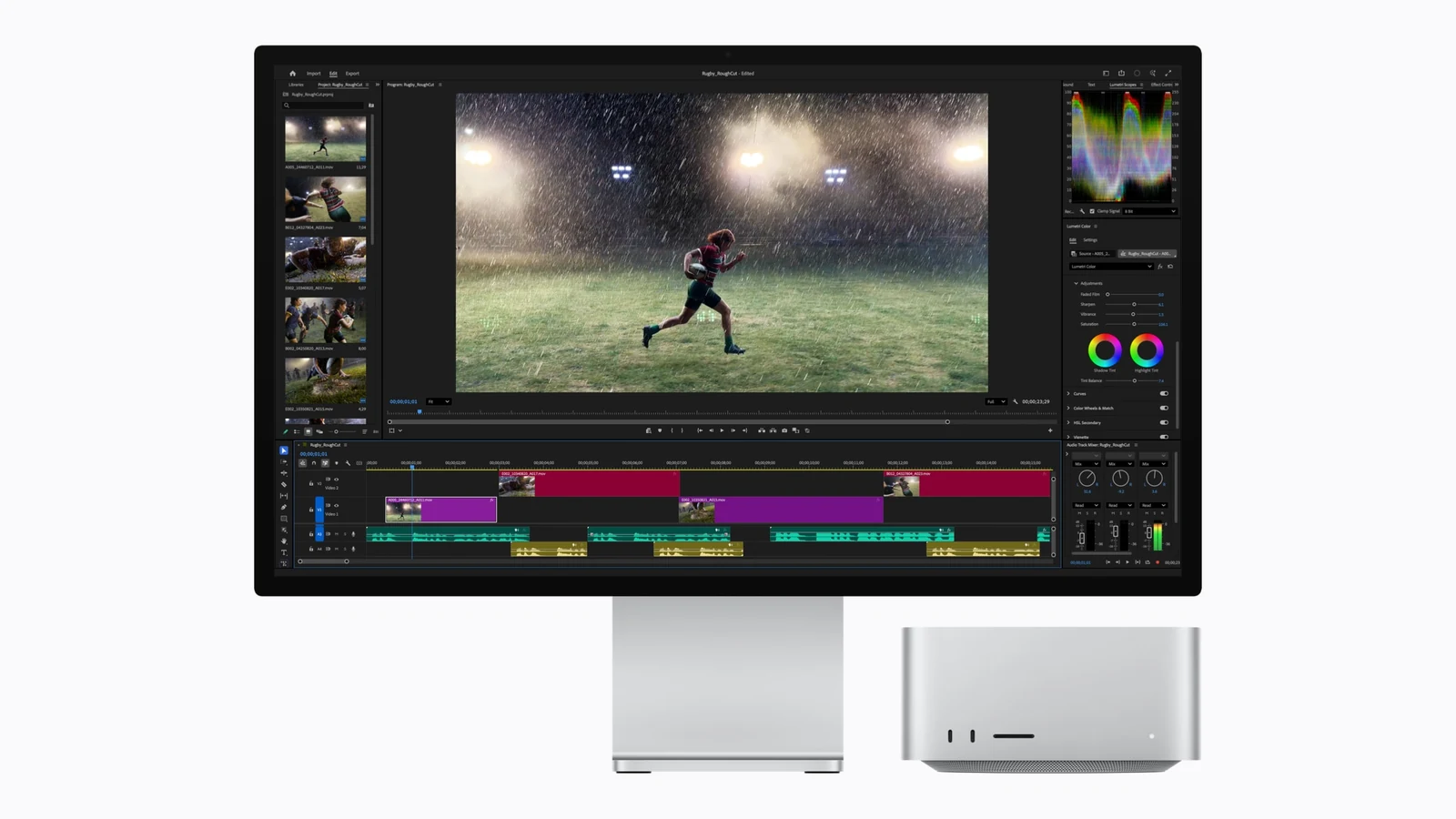
Anyone buying a machine for editing should compare the base M6 with more powerful M5 Pro/Max options, rather than comparing chip generations alone. If OLED means a substantial price premium, that extra cost needs to pay off in display quality and an input method used regularly. The accompanying photo shows the existing Mac Studio with M5 Ultra running Adobe Premiere, not any of the rumoured new machines.
Frequently asked questions
Will every new MacBook Pro have a touchscreen?
Not according to current reports. OLED touchscreens are expected in premium 14-inch and 16-inch MacBook Pros with M5 Pro and M5 Max, while the entry-level 14-inch M6 machine is expected to retain its current display.
Will touchscreen input replace the trackpad or keyboard?
No. Reports describe touch as an optional complementary input method. macOS is rumoured to adapt menus and controls based on how the user interacts with the machine.
Have OLED MacBook Pro prices been announced?
No official prices exist yet. One estimate suggests US starting prices could increase by up to $500, which is neither a confirmed final price nor a price for Greece.