Summary
- Rubin has released a striking view of the Seagull Nebula’s head.
- It was captured in 2024 with the 144-megapixel ComCam and published on October 22, 2026.
- The nebula lies roughly 3,700 light-years away.
- ComCam testing helped prepare the 3,200-megapixel LSST Camera.
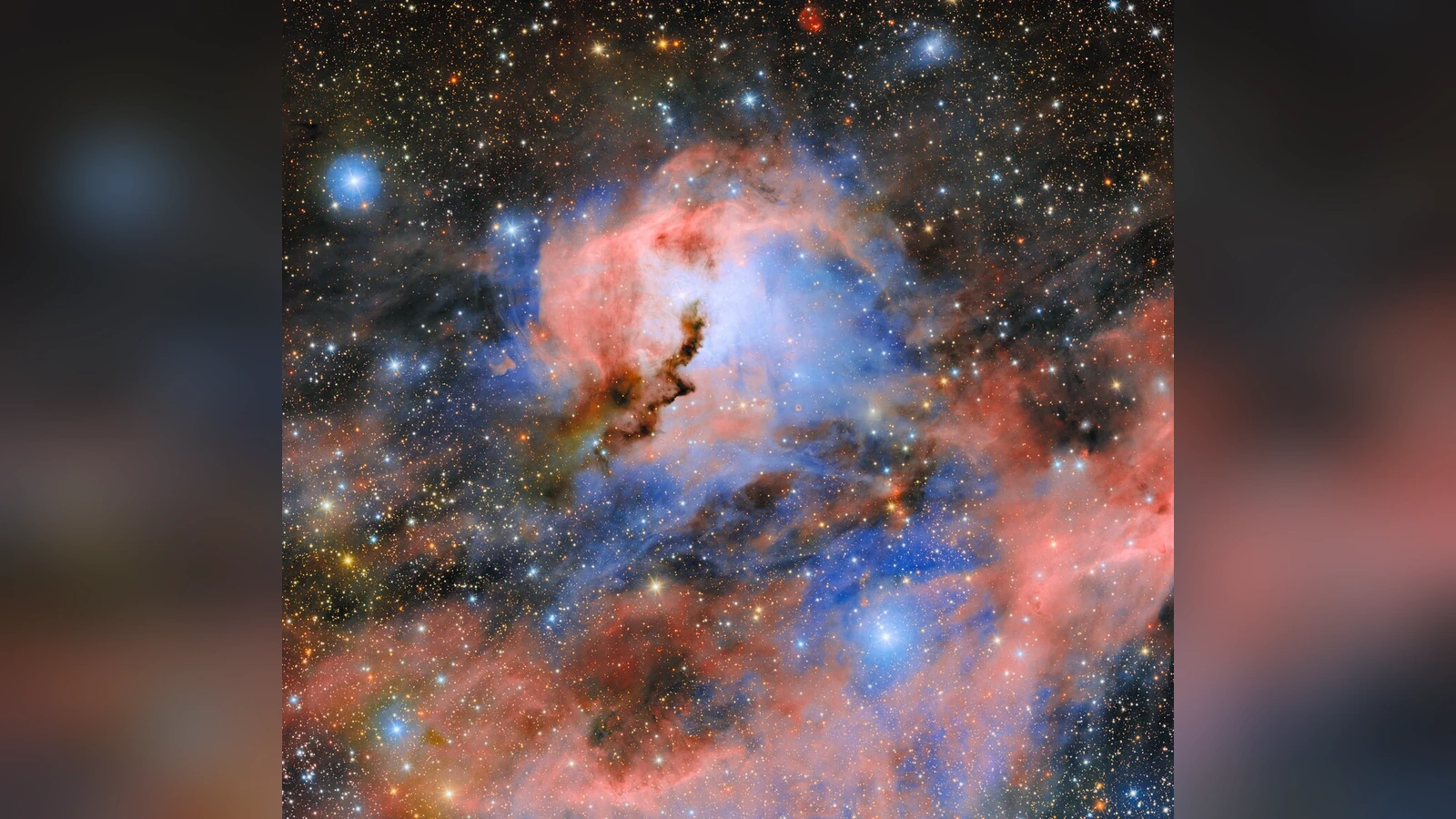
A striking new image of the Seagull Nebula reveals intricate details of an active star-forming region through the Vera C. Rubin Observatory’s 144-megapixel commissioning camera.
Captured in Chile in 2024, the photograph was released on October 22, 2026, marking two years since the observatory began its engineering camera tests.
The Seagull’s head, 3,700 light-years away
The wider Seagull Nebula is a vast complex of gas clouds stretching between the constellations Monoceros and Canis Major. This image focuses on Sharpless 2-292, the Seagull’s “head,” associated with IC 2177 and located approximately 3,700 light-years from Earth.
The pink areas are hydrogen gas excited and ionized by ultraviolet radiation from young stars. The blue haze is starlight reflected by interstellar dust. At the top of a jagged dark ridge sits HD 53367, a triple system of young massive stars that appears as the Seagull’s blue “eye.”
The 144-megapixel camera that prepared the LSST
The LSST Commissioning Camera, known as ComCam, used a nine-CCD mosaic totaling 144 megapixels. It covered a patch of sky roughly twice the size of the full Moon. Nearly 16,000 exposures were recorded during a seven-week engineering campaign running from October 24 to December 11, 2024.
These observations helped test the observatory’s optics and image-processing software. ComCam no longer takes astronomical exposures; it now serves as a laboratory test platform. The 3,200-megapixel LSST Camera has replaced it on the Simonyi Survey Telescope and offers a field of view 21 times larger.
The main camera is designed to repeatedly survey the southern sky every three to four nights. That imaging capability has also produced the deep COSMOS field image containing more than 500,000 galaxies.
The demanding processing behind the colors
The nebula’s complex structure made this image a useful processing exercise. The team had to preserve the fine structures of gas and dust along with the numerous stars in a crowded field. Lessons from this work helped prepare the team for the far larger datasets generated by the LSST Camera.
Rubin’s official gallery also includes a 1:25 zoom video and a scale comparison with the Trifid and Lagoon nebulae, showing the difference in sky coverage between the two cameras.
What we think
What makes this image compelling is more than its vivid pink and blue palette. The layers tell a physical story: where gas glows under stellar radiation, and where dust blocks or scatters the surrounding light.
For night-sky photographers, it is remarkable that an engineering test camera produced such a rich result. Good astrophotography relies on careful calibration, repeated measurements and thoughtful processing. Here the photographic appeal and scientific information reinforce one another.
The successor camera’s 21-times-wider field is also a reminder that capturing one beautiful frame is different from systematically mapping the sky. Both approaches can produce images worth studying closely.