

Summary
- NASA introduces six Johnson Space Center photographers documenting human space exploration.
- Robert Markowitz and David DeHoyos each have more than three decades of experience at Johnson.
- Artemis II features prominently in their recent work, from Mission Control to the crew’s return.
- NASA’s imaging infrastructure is also used for technical analysis and long-term archiving.
- NASA continues to preserve original Apollo mission film in a dedicated cold-storage vault.
- Robert Markowitz: More than three decades of human spaceflight
- Bill Stafford: Every photograph is also a technical problem
- James Blair: Photojournalism from Earth to the new lunar era
- Helen Arase Vargas: When an image must reach the world immediately
- Luna Posadas Nava: A new generation behind the lens
- David DeHoyos: From a Kodak Instamatic to NASA
- Artemis II shows how central imagery has become
- Much more than a few cameras and six photographers
- From Apollo to Artemis, photography becomes a historical record
- What we think
- Frequently Asked Questions
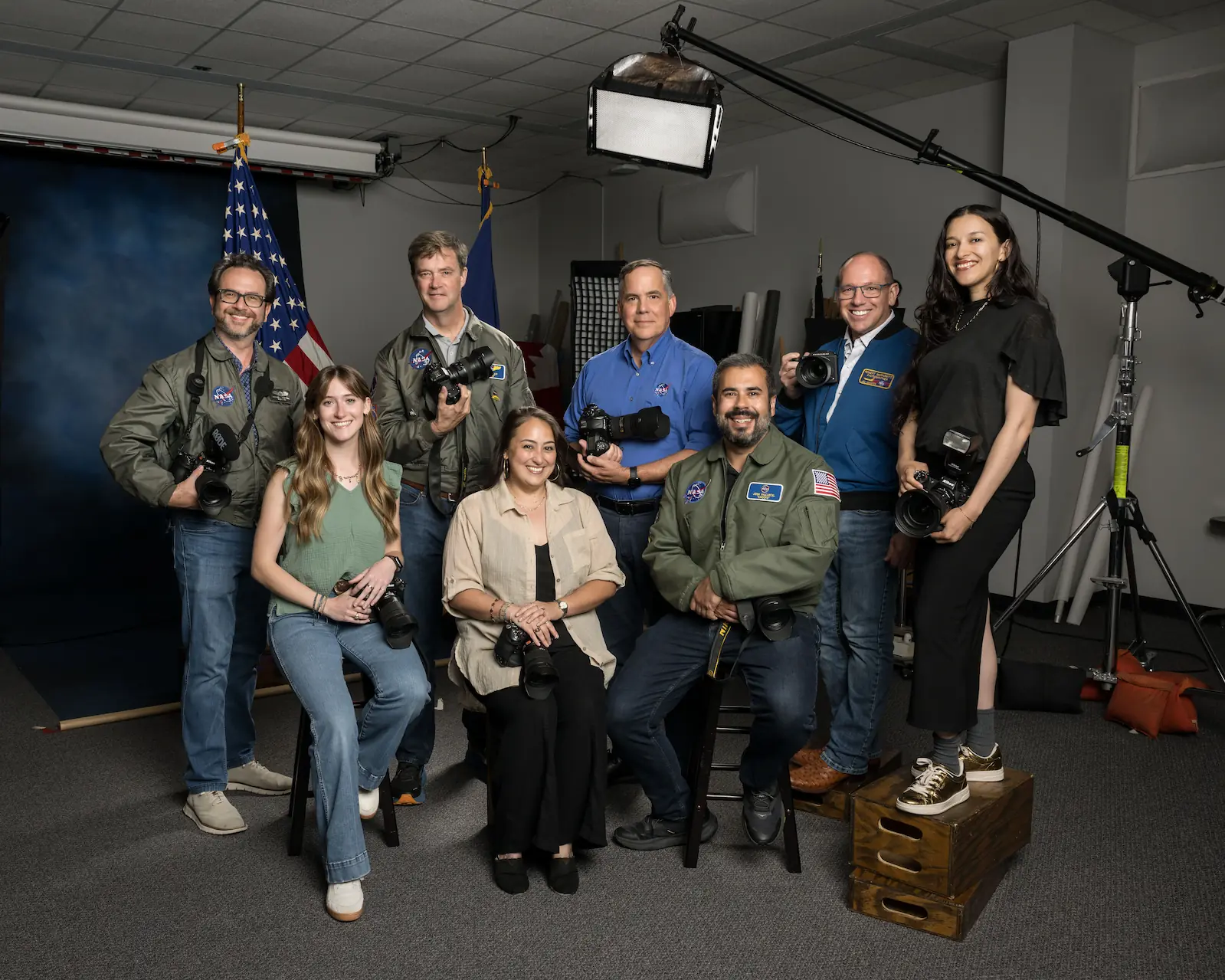
NASA is turning the camera on its own photographers, introducing six people at Johnson Space Center who document human space exploration from Mission Control and astronaut training to the Artemis missions.
The US space agency published Behind the Lens: Meet NASA Johnson’s Photographers on August 19, 2026, profiling Robert Markowitz, Bill Stafford, James Blair, Helen Arase Vargas, Luna Posadas Nava, and David DeHoyos. The Johnson photographers in Houston cover everything from astronaut training and engineering tests to Mission Control operations and historic moments in human spaceflight.
Their work matters because imagery at NASA is not simply communications material. It serves as a historical record of space exploration, while Johnson’s broader imaging infrastructure also supports scientific and technical analysis of spacecraft, hardware, and mission events.
Robert Markowitz: More than three decades of human spaceflight
Robert Markowitz has spent more than three decades documenting the people and milestones of NASA’s human spaceflight program. His career spans the Space Shuttle, the long-running human presence aboard the International Space Station, and Artemis II.
One of the most unusual experiences early in his career came during production of the film “Apollo 13.” As a behind-the-scenes still photographer, he participated in nearly every KC-135 zero-gravity flight used for filming, photographing Tom Hanks, Ron Howard, Bill Paxton, Kevin Bacon, Gary Sinise, and others.
His recent work includes the Artemis II flight control team inside Mission Control during the lunar flyby on April 6, 2026, as well as the mission’s training team in front of the Orion mockup.
Bill Stafford: Every photograph is also a technical problem
Bill Stafford arrived at Johnson after learning about an opportunity during his senior year of college. His interest in science and technology merged with photography in an environment where every assignment can involve different constraints involving light, timing, and access.
NASA showcases his photographs of an Artemis II entry simulation, a mock spacewalk for future lunar surface operations, astronaut photography training, and the Exploration Extravehicular Mobility Unit inside a thermal vacuum chamber.
Stafford’s work was also recognized at the NASA Imagery Experts Program Annual Awards. At the April 2026 ceremony, he earned third place in the portrait category behind David DeHoyos and Josh Valcarcel.
James Blair: Photojournalism from Earth to the new lunar era
James Blair began in photojournalism, working for newspapers across the United States as well as as a photographer and photo editor for a publication in Ecuador. At Johnson, the same journalistic approach is applied to assignments ranging from astronaut training to geology field exercises in Iceland.
Of particular interest to photographers is his work around preparations for the Moon. Blair documents new spacesuits, rovers, and potential future lunar infrastructure, and has photographed Christina Koch and Victor Glover during lunar imaging training using an Orion crew configuration.
NASA’s feature also includes one of his images from the Artemis II crew recovery, showing US Navy divers, the astronauts, and helicopters involved in the operation after the crew left Orion.
Helen Arase Vargas: When an image must reach the world immediately
Helen Arase Vargas began in journalism and photojournalism in Southern California before moving into scientific photography at Boeing in El Segundo and eventually Johnson. She connects her current work with journalistic ethics and the concept of imagery serving the public interest.
A clear example was the Artemis II crew’s return to Ellington Field in Houston on April 11, 2026. In an event like this, photographers not only have to capture the decisive moment, but also deliver their imagery quickly so it can be distributed to media around the world.
Her work also includes official portraits, geology training with NASA’s 2025 astronaut candidate class, and nighttime Lunar Terrain Vehicle tests at Johnson’s Rock Yard.
Luna Posadas Nava: A new generation behind the lens
Luna Posadas Nava came to Johnson with experience in emerging technology, optics, imaging systems, and photographing artists. She joined the team shortly before the launch of Artemis II.
One of her first major assignments was documenting the Science Evaluation Room during the Artemis II lunar flyby. Her photographs show scientists conducting real-time observations and reacting to descriptions of the Moon provided by the astronauts.
Those photographs are a reminder that the story of a space mission does not exist only inside the spacecraft. Much of it unfolds in rooms filled with scientists, engineers, and support teams who rarely become the central figures in the public-facing imagery.
David DeHoyos: From a Kodak Instamatic to NASA
David DeHoyos grew up in Houston during the Apollo era, and his interest in photography began with his mother’s Kodak Instamatic. After roughly a decade working in photo labs, he joined Johnson’s photo laboratory in 1991 and later moved behind the camera as a NASA photographer.
More than three decades later, he continues to document astronauts, hardware, and activities at Johnson. In April 2026, he won first place in the portrait category of the NASA Imagery Experts Program Annual Awards for an image of ESA astronaut Sophie Adenot.
His recent work includes Reid Wiseman’s Orion emergency cabin leak training, Victor Glover’s return from Artemis II, and technology testing inside Johnson’s Chamber A.
Artemis II shows how central imagery has become
NASA’s feature comes only a few months after the completion of Artemis II, the crewed mission that flew around the Moon with Reid Wiseman, Victor Glover, Christina Koch, and Jeremy Hansen. The mission ended with Orion’s splashdown on April 11, 2026, Greek time.
For PTTL’s complete photographic coverage of the mission, the equipment used, the crew, the timeline, and imagery released by NASA, the dedicated Artemis II Mission Hub brings the relevant material together in one place.
The connection with NASA’s new feature is direct. The six photographers are shown documenting different parts of the same mission: preflight training, flight controllers during the lunar flyby, scientists working on the ground, crew recovery, and the astronauts’ return to Houston.
Much more than a few cameras and six photographers
The new article focuses on six creators, but Johnson’s imaging operation is much larger. In an earlier official feature, NASA explained that its Imagery Acquisition Group operates eight different capture systems ranging from HD video and high-speed digital motion imaging to spherical 360-degree panoramas. Team members may also be certified for parabolic flights, T-38 aircraft, and helicopters.
After capture comes processing, color correction, and archiving. NASA even continues to preserve original Apollo mission films inside a purpose-built cold-storage vault for future generations.
There is another side to the operation as well. The Image Science and Analysis Group uses imagery to measure distances, dimensions, and motion, assess hardware condition, and analyze dynamic events or anomalies. At NASA, a photograph can therefore be both a visual document and a source of technical data.
From Apollo to Artemis, photography becomes a historical record
The value of these images changes over time. A photograph of an engineering test may seem almost routine today, yet decades later it can become a unique record of how a technology developed. The same applies to an astronaut portrait or a spontaneous reaction inside Mission Control.
PTTL previously covered the NASA Photographer of the Year winners, a program that brought greater visibility to the work of the agency’s photographers.
The other side of this photographic story exists inside spacecraft and the ISS itself. In an earlier feature, PTTL covered Don Pettit and Matt Dominick discussing the art of photography by astronauts in space, from reflections in spacecraft windows to fast lenses and the importance of visual storytelling.
What we think
The most interesting aspect of NASA’s new feature is not simply the striking photographs, but how complex the process behind them turns out to be. Johnson’s photographers operate as photojournalists, technical creators, and historical documentarians, often in situations where a moment cannot be repeated.
Artemis II made that relationship particularly visible: one photographer documented Mission Control, another the science team, another crew recovery, and another the astronauts’ return to Houston. The result is not merely a collection of attractive photographs, but the visual archive of a mission that will continue to be used for decades.
Frequently Asked Questions
Which photographers are featured in NASA’s article?
The six photographers are Robert Markowitz, Bill Stafford, James Blair, Helen Arase Vargas, Luna Posadas Nava, and David DeHoyos of Johnson Space Center in Houston.
What do Johnson Space Center photographers photograph?
Their assignments include astronauts, training, Mission Control, engineering hardware, science activities, tests, official portraits, and important events before, during, and after space missions.
What is their connection to Artemis II?
The photographers documented multiple stages of Artemis II, from training and Mission Control to the lunar science team, crew recovery, and the astronauts’ return to Houston.
Does NASA use imagery only for communications?
No. NASA has a specialized team that uses imagery for engineering analysis, including measurements of motion, distances and dimensions, hardware assessment, and evaluation of events or anomalies.
Does NASA still preserve original Apollo mission film?
Yes. NASA says original Apollo-era film is stored in a purpose-built cold-storage vault for long-term preservation.