Summary
- An Expedition 75 astronaut photographed the American Midwest at night with a Nikon Z9 at 14mm.
- Cities, highways and natural atmospheric airglow fill the frame.
- An older Nikon D5 photograph at 400mm shows the fine details of Chicago.
- Together, the images illustrate the value of monitoring artificial light from orbit.
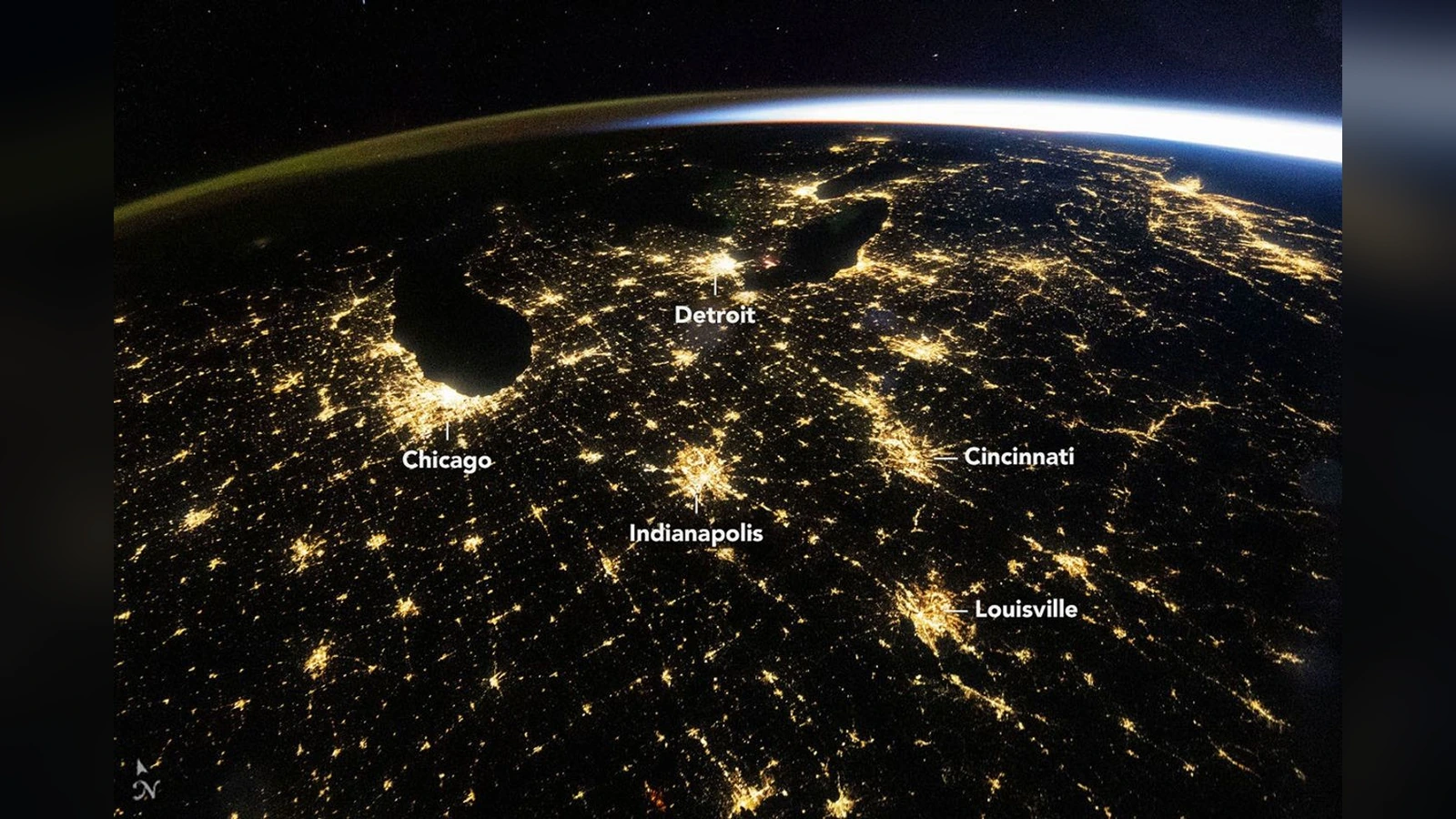
A Nikon Z9 at a 14mm focal length captured a vast network of illuminated cities and highways across the U.S. Midwest from the International Space Station shortly before sunrise.
NASA published the photograph on November 4, 2026. It was captured on October 18, 2026, at 09:54 UTC (4:54 a.m. CDT) by an Expedition 75 crew member under nearly cloud-free skies.
A network of lights from Chicago to Detroit
Chicago and Detroit stand out in the wide-angle view, alongside Indianapolis, Cincinnati and Louisville. State and interstate highways connect them in bright lines across the darker landscape.
The photograph captures densely illuminated metropolitan areas alongside much more scattered rural lights. Seen from orbit, human activity becomes visible at a geographic scale impossible to appreciate from the ground.
Nikon Z9 and 14mm: why the wide-angle view matters
NASA identifies the image as ISS075-E-226709 and specifies a Nikon Z9 at 14mm. The full-frame mirrorless camera has a 45.7-megapixel sensor, but the defining photographic choice here is the field of view: 14mm accommodates a huge geographic area, the glowing horizon and Earth’s curvature in a single frame.
The focal length does not establish the exact lens model, and NASA does not provide a full set of exposure settings in this story. There is therefore no basis to assign a particular aperture, ISO or shutter speed to the photograph.
More information about the Nikon Z9 here.
The second photograph shows the difference at 400mm
Alongside the wide-angle image, NASA includes an earlier photograph of Chicago, identified as ISS070-E-105097. It was captured on March 1, 2024 using a Nikon D5 at 400mm by the Expedition 70 crew.
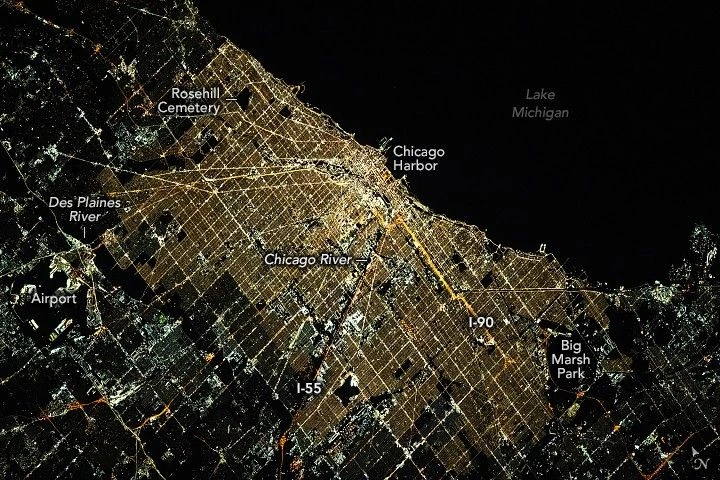
At 400mm, the city fills much of the frame, making the urban grid and variations in the colors of artificial lighting more apparent. The two photographs illustrate different scales of observation; they are not a controlled before-and-after comparison of lighting conditions.
NASA notes that the published photographs were cropped, contrast-enhanced and corrected for lens artifacts. That matters when reading them as scientifically useful visual records rather than untouched camera originals.
The green and orange glow does not come from the cities
A diffuse green-and-orange band appears along the left side of the horizon. This is airglow, a natural emission of light in the upper atmosphere. The brighter arc at right is sunlight approaching the horizon.
Airglow is distinct from light pollution, which is associated with artificial illumination and its spill into the night environment. The photograph captures both a natural atmospheric effect and the visible footprint of human nighttime activity.
Why NASA tracks Earth’s nighttime lights
NASA uses astronaut photographs and satellite observations to monitor urban development, infrastructure and changes in night lighting. Its Black Marble product suite provides daily, monthly and yearly observations used, among other things, to study power outages and restoration after major storms.
Color changes also matter: the shift from sodium-vapor streetlights to LEDs has visibly altered the appearance of cities after dark. Detailed photographs can help researchers distinguish lighting types by brightness, color and spatial extent.
What we think
What makes this image so engaging is that the spectacle draws you in before you start reading the information in it. A wide-angle lens turns whole cities and their roads into a connected network; a telephoto view begins to reveal individual neighborhoods and the colors of their lights.
For photographers, that comparison is much more revealing than simply saying the image was shot on a Nikon Z9. Focal length changes the story you can tell: one frame gives you the geography of a place, while the other reveals details about how it works.
There is another point worth keeping in mind. A city can look extraordinary from orbit without its lighting being well designed. This kind of photograph can start a useful conversation about excessive artificial lighting, but measuring its extent calls for comparable observations and data, not just a striking image.
Frequently asked questions
What is the difference between airglow and light pollution?
Airglow is natural light emitted by the upper atmosphere. Light pollution comes from artificial light sources that alter the nighttime environment.
Why do the 14mm and 400mm photographs look so different?
A 14mm focal length offers a very wide field of view, whereas 400mm isolates a smaller area with more visible detail. These particular photographs were also taken on different dates.