

Summary
- The 570-megapixel Dark Energy Camera captured the Corona Australis Molecular Cloud.
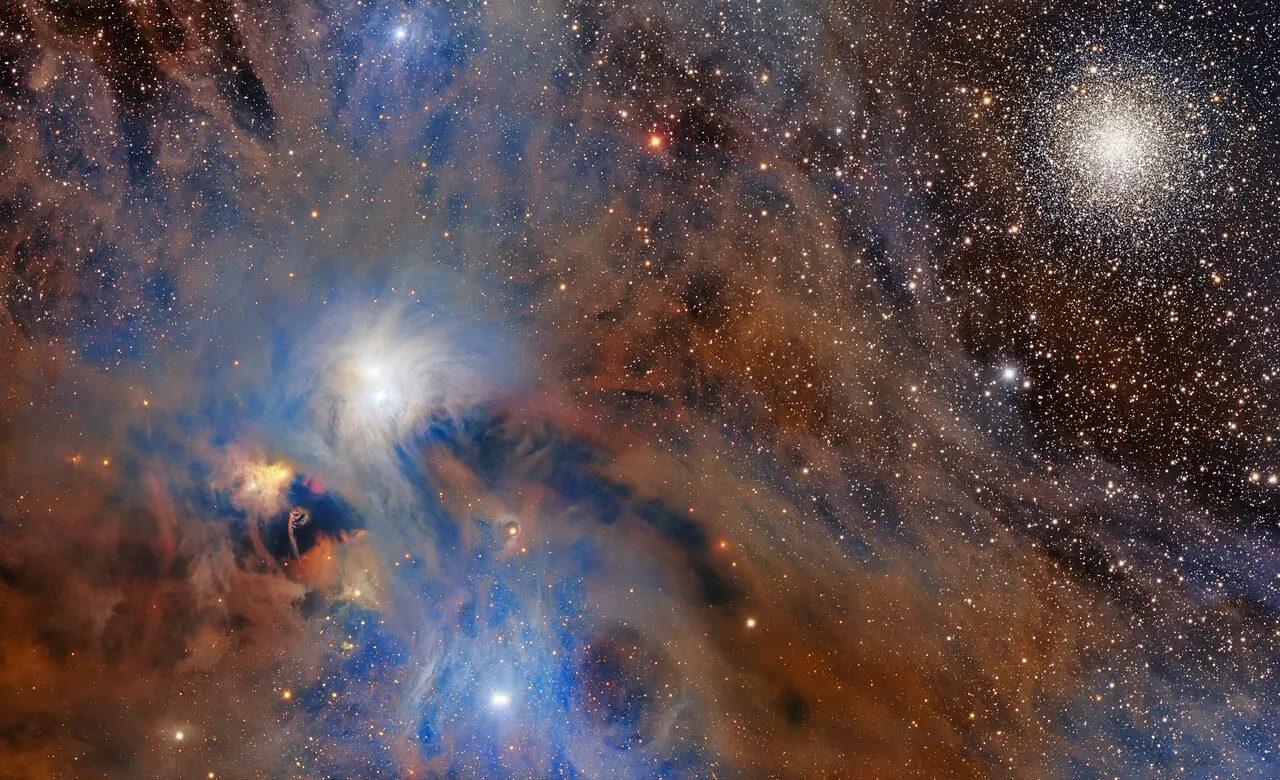
- The image includes nebulae, newborn stars and the globular cluster NGC 6723.
- Its swirling appearance evokes Van Gogh's Starry Night.
- The photograph combines scientific importance with remarkable visual beauty.
A new 570-megapixel image from the Dark Energy Camera reveals a region of space that strongly resembles Vincent van Gogh’s famous painting The Starry Night.
The image, released by NSF NOIRLab, was captured with the Dark Energy Camera (DECam) mounted on the Víctor M. Blanco 4-meter Telescope in Chile. It combines glowing nebulae, dark dust clouds, newborn stars, and a distant globular cluster in a spectacular cosmic landscape.
One of the nearest stellar nurseries
The Corona Australis Molecular Cloud lies about 430 light-years from Earth and is one of the closest regions where new stars are forming.
On the left side of the image, the reflection nebula NGC 6729 is illuminated by the young binary star system R Coronae Australis, creating dramatic patterns of light and dust.
A much more distant star cluster
The globular cluster NGC 6723 appears near the upper right of the image but actually lies around 29,000 light-years away, far behind the nearby molecular cloud.
It contains tens of thousands to millions of stars bound together by gravity.
The power of DECam
The 570-megapixel Dark Energy Camera was originally built for the Dark Energy Survey and remains one of the world’s most capable astronomical imaging systems.
Its enormous resolution enables astronomers to capture vast regions of the sky while preserving exceptional detail.
What we think
This image demonstrates that modern astronomy can produce not only valuable scientific observations but also breathtaking works of natural beauty.
Frequently Asked Questions
What is DECam?
It is a 570-megapixel astronomical camera designed for wide-field observations and dark energy research.
Where was the image taken?
It was captured with the Víctor M. Blanco 4-meter Telescope at Cerro Tololo, Chile.
What does it show?
The Corona Australis Molecular Cloud, NGC 6729, and the globular cluster NGC 6723.
Why is it compared to Starry Night?
Because the swirling clouds and bright stars closely resemble the visual style of Van Gogh’s famous masterpiece.