


Summary
- NASA combined IXPE and Chandra observations to directly measure magnetic fields around the Lighthouse Pulsar.
- The results confirm theories about particle escape along galactic magnetic field lines.
- Researchers also found a surprisingly ordered magnetic environment.
NASA has directly measured the magnetic fields surrounding the Lighthouse Pulsar for the first time, opening a new chapter in the study of extreme cosmic objects.
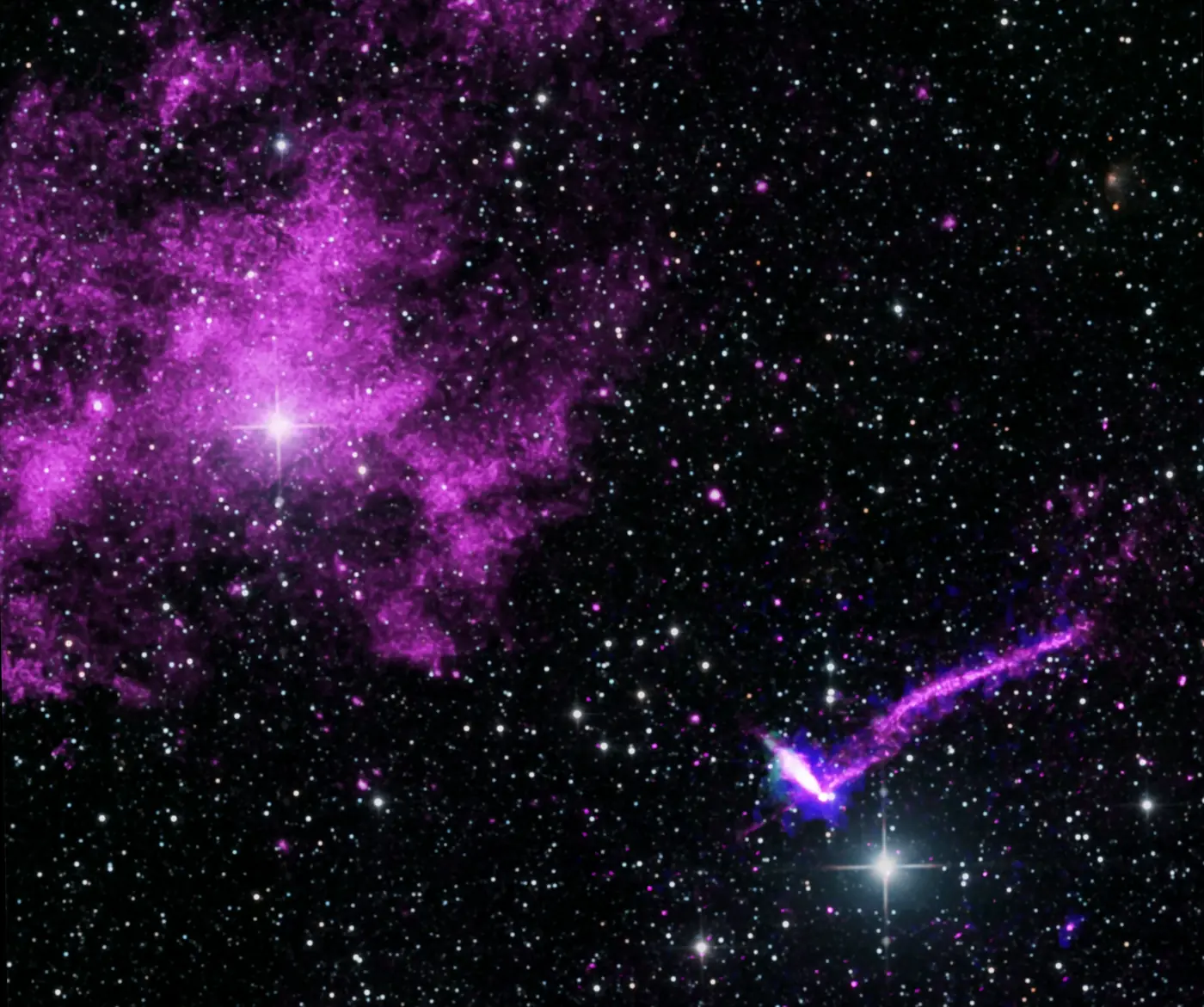
Scientists combined observations from NASA’s Imaging X-ray Polarimetry Explorer (IXPE) and the Chandra X-ray Observatory to study PSR J1101−6101, located inside the Lighthouse Nebula. The observations provide the first direct measurement of the pulsar’s magnetic field geometry and confirm long-standing theoretical predictions.
What is the Lighthouse Pulsar?
PSR J1101−6101 is a rapidly spinning neutron star created after a supernova explosion. It rotates about 16 times per second and moves through space at supersonic speed, leaving behind a bright X-ray tail and a narrow filament.
Mapping invisible magnetic fields
IXPE measures X-ray polarization, allowing astronomers to determine the orientation of magnetic fields. The observations confirmed that energetic particles escape along magnetic field lines extending through the Milky Way.
A surprisingly ordered environment
Researchers also discovered that the magnetic field is much more orderly and less turbulent than expected, suggesting multiple particle acceleration mechanisms within the system.
What we think
This discovery highlights the growing importance of X-ray polarimetry for understanding the most energetic objects in the universe and demonstrates the scientific power of combining IXPE with Chandra observations.
Frequently Asked Questions
What is a pulsar?
A rapidly rotating neutron star with an extremely strong magnetic field.
What is IXPE?
NASA’s Imaging X-ray Polarimetry Explorer, designed to study X-ray polarization.
Why is this discovery important?
It provides the first direct view of magnetic field structures around the Lighthouse Pulsar and improves our understanding of particle acceleration.