Summary
- Researchers examined how AI-altered visuals affected recollections among 200 participants.
- Videos generated from edited photographs had the strongest effect.
- That group reported 2.05 times as many false recollections as controls.
- The findings raise questions for personal archives and documentary photography.
Can an AI “enhancement” change not only what a photograph shows, but what we believe we remember? An experiment involving 200 people suggests that the risk is real.
The study, “Synthetic Human Memories: AI-Edited Images and Videos Can Implant False Memories and Distort Recollection,” published at CHI 2025, examines what happens when people revisit AI-altered depictions of an event. Its preprint appeared in September 2024; coverage in October 2026 has brought the findings back into focus.
How the experiment worked
Researchers associated with the MIT Media Lab, including Pat Pataranutaporn and memory expert Elizabeth Loftus, recruited 200 participants. Everyone initially viewed 24 images, completed an intervening task and then saw a second set of visual stimuli. They were randomly assigned to one of four groups of 50.
The conditions were original photographs, AI-edited photographs, AI-generated videos based on the originals, and AI-generated videos based on already edited photographs. Manipulations could add, remove or change people, objects and environmental details.
The result: more false recollections
The strongest effect came from videos generated from AI-edited images: participants reported 2.05 times as many false recollections as the control group. Confidence in these false memories was also 1.19 times higher. This does not mean every AI edit inevitably produces a false memory, nor that the 2.05 ratio applies equally to every editing technique.
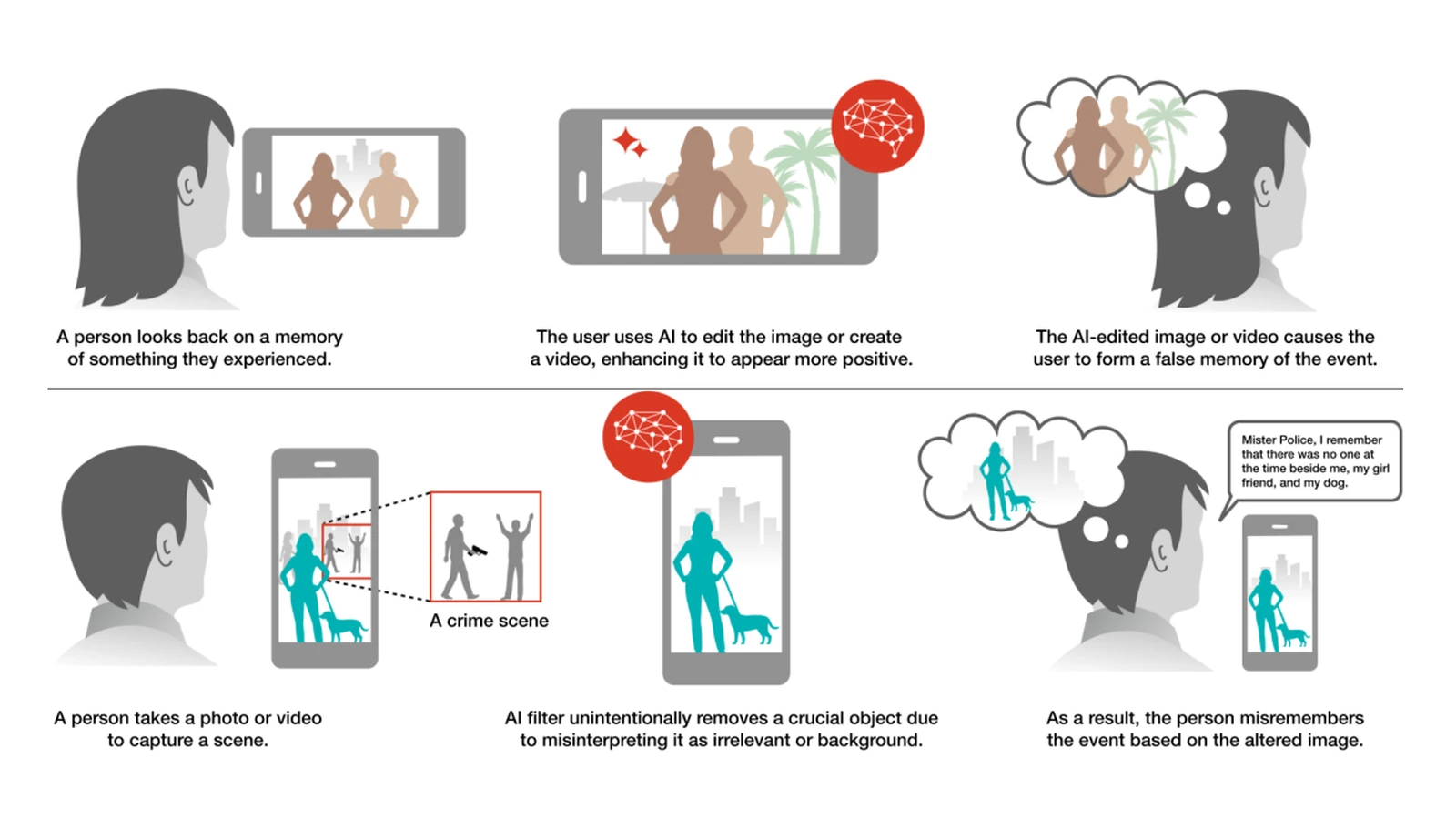
The crucial finding goes beyond mistaking a manipulated image for a genuine one. People can later describe its altered details as something they personally remember.
Why photographers should care
Modern photo applications can remove bystanders, replace backgrounds and combine different exposures or expressions. If the original disappears and only the edited image remains, a viewer may have no indication that an important part of the scene has gone missing.
Consider family pictures showing people together who never actually met. The discussion around Grandmaslop and invented family photographs demonstrates how readily a fabricated scene can enter a personal archive. The experiment did not study those specific families, but it helps explain the broader risk of confusing an image with a memory.
For photojournalism, evidence and historical archives, the distinction is even more consequential. Removing a person or object can change the context of an event and shape later accounts of what happened. Keeping originals, documenting edits and clearly identifying synthetic alterations are therefore essential safeguards.
What the research does — and does not — show
This was a controlled experiment using particular visual stimuli and recall measures, not an estimate of how often ordinary smartphone users are misled. It does not establish that all edits have the same effect or that the effect lasts indefinitely. It does show that manipulated images, especially when turned into persuasive moving footage, can measurably influence remembered details.
What we think
The greatest concern is not a spectacular fake that everyone can spot. It is the quiet change to an image we already trust: a removed person, a substituted object, a moment made to look slightly different from the one that occurred.
Photographers understand that no photograph tells a complete story. Every frame involves selection and interpretation. Generative AI adds the ability to replace elements of the recorded scene itself with convincing new content. When that version becomes the only record people revisit, it may influence not just their interpretation but their subsequent recollection.
The sensible response is not to reject all editing. It is to preserve originals and distinguish visual documentation from creative reconstruction. Where photographs serve as evidence, explaining what has been changed matters as much as presenting the finished image.
Frequently asked questions
Does every AI-edited photo create a false memory?
No. The researchers found increased false recollections in particular experimental conditions. The strongest effect involved AI-generated videos made from previously edited photos.
How many people participated, and what does 2.05 mean?
There were 200 participants, 50 in each condition. The 2.05 figure means 2.05 times as many false recollections in the video-of-edited-images condition as in the control, not that 205% of participants acquired false memories.