

Summary
- Jude Bellingham equalised for England in the 45th minute of stoppage time
- The ball appeared to change direction following Ørjan Nyland’s goal kick
- Norway claimed that it had struck an overhead camera cable
- FIFA said the Connected Ball sensor detected no evidence of contact
- England eventually won 2-1 after extra time
England’s equaliser against Norway was followed by strong protests after the ball appeared to change direction before the move that led to the goal.
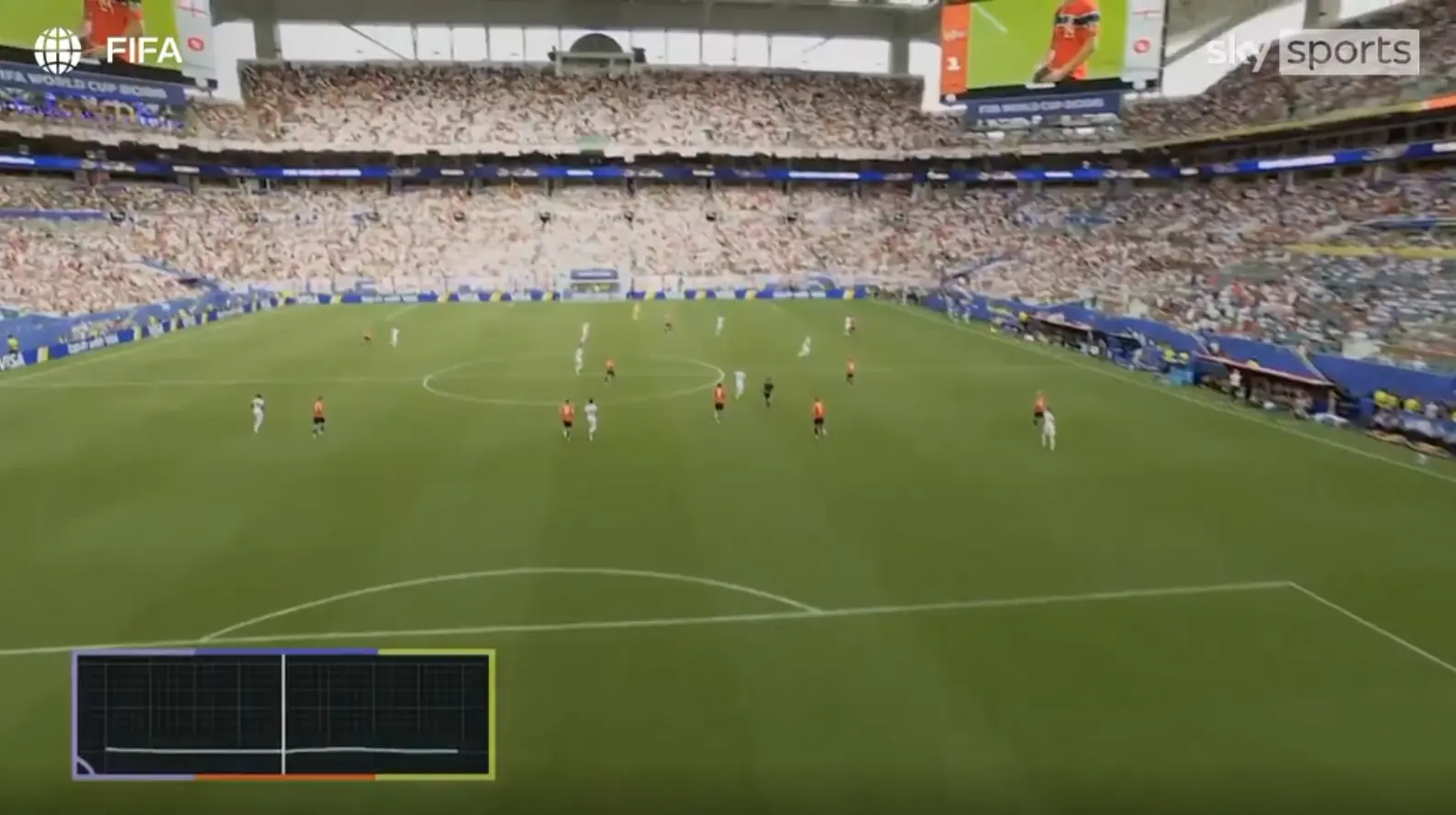
Jude Bellingham made it 1-1 during first-half stoppage time in the 2026 World Cup quarter-final. However, the move began with a long goal kick by Norway goalkeeper Ørjan Nyland, during which the ball appeared in some replays to make contact with a cable supporting the overhead camera system.
The incident is significant because, had contact with an external object been confirmed, play should have been stopped and restarted with a dropped ball. England’s attack would therefore not have been allowed to continue until the goal.
Embed from Getty Imageswindow.gie=window.gie||function(c){(gie.q=gie.q||[]).push(c)};gie(function(){gie.widgets.load({id:’iXLWdBaoQ_FGMsX_aXaTyw’,sig:’kB-5IV_4yhSEV0bTH2kESTPlMM92oL_ppm_QOJfgZrQ=’,w:’594px’,h:’396px’,items:’2285685540′,caption: true ,tld:’com’,is360: false })});
The sequence before the equaliser
The incident occurred in the 45th minute of stoppage time, when Nyland launched a long goal kick. As the ball descended, its trajectory appeared to change sharply, allowing England to regain possession.
The move continued until the ball reached Bellingham, who beat Nyland with a low finish to equalise.
Norway’s players reacted immediately, arguing that the ball’s sudden drop was unnatural. Head coach Ståle Solbakken complained to the officials at half-time, but the decision was not changed.
FIFA’s explanation
FIFA said there was no evidence that the ball had touched the overhead cable.
According to the governing body, the Connected Ball sensor did not record a peak in the ball’s so-called “heartbeat” while it was in the air. Based on that data, FIFA concluded that there was no indication that contact with the camera system had altered the ball’s movement.
England manager Thomas Tuchel said he had not seen the incident, although he noted that the chip inside the ball should be capable of detecting such contact.
What the rules say
If the ball touches a cable, camera or another external object above the pitch, the referee must stop play.
The match is then restarted with a dropped ball at the appropriate location. Therefore, if contact had been confirmed, England’s attacking move should have been stopped before the goal was created.
The central question is not Bellingham’s finish, but whether the ball actually struck the cable and whether VAR was able to identify the possible contact.
Embed from Getty Imageswindow.gie=window.gie||function(c){(gie.q=gie.q||[]).push(c)};gie(function(){gie.widgets.load({id:’PjLFKV5BT9h2akRuD5qpVw’,sig:’MmId6r2_CEPrnSqSnJws87aX86lCHNdcl2HaKVTSk5c=’,w:’594px’,h:’396px’,items:’2285686926′,caption: true ,tld:’com’,is360: false })});<script src=’//embed-cdn.gettyimages.com/wi
Norway’s reaction
Solbakken said he was convinced that the ball had touched something, pointing out that it dropped almost vertically and caused confusion among his players.
Despite his frustration, he stressed that he did not want the incident to overshadow Norway’s run to the quarter-finals in their first World Cup appearance since 1998.
England eventually won 2-1 after extra time, with Bellingham scoring both goals to send his team into the semi-finals.
What we think
Technology in refereeing is valuable only when it is supported by clear procedures and convincing explanations. Regardless of whether the ball actually touched the cable, the incident shows that overhead camera systems can create serious problems when they are positioned close to the ball’s potential path.
Frequently asked questions
Who scored England’s disputed goal?
Jude Bellingham scored the equaliser during first-half stoppage time.
Did the ball hit the camera cable?
Some television replays appear to show a change in trajectory, but FIFA said the ball’s sensor did not detect any contact.
What would have happened if contact had been confirmed?
The referee should have stopped play and restarted the match with a dropped ball.
Did VAR review the incident?
It was not made clear whether a full review of the possible contact took place, while Norway said there had been no intervention from VAR.
What was the final score?
England defeated Norway 2-1 after extra time and advanced to the semi-finals of the 2026 World Cup.