

Summary
- A drone struck and injured a child during a fireworks event in Norfolk, Nebraska.
- Authorities used specialized drone identification equipment to identify the aircraft.
- The process appears consistent with Remote ID technology, although this has not been officially confirmed.
- The operator voluntarily approached police and is cooperating with the investigation.
- The case will be reviewed by local authorities and the FAA.
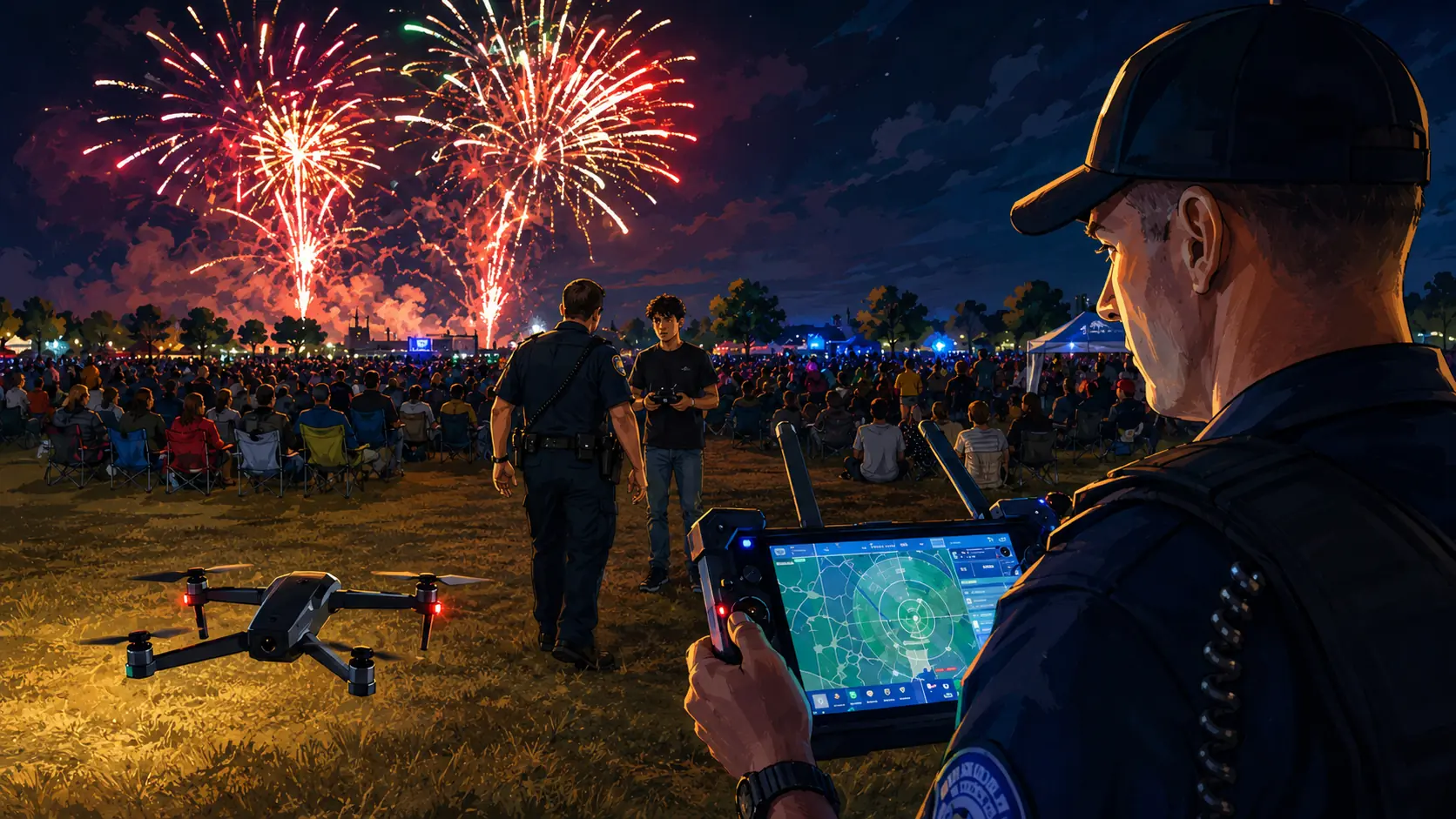
A drone flying during a major fireworks display in Nebraska struck a child, with authorities using specialized equipment to identify the aircraft and trace its operator.
The incident occurred during the Big Bang Boom event in Norfolk as part of the July 4 celebrations. According to the Madison County Sheriff’s Office, the child was injured after being struck by a drone, while the child’s age and the severity of the injuries have not been released.
The case is particularly significant because of the way event organizers and law enforcement agencies identified the drone before contacting its operator. The process demonstrates how modern electronic identification systems can reduce the anonymity of flights near large public gatherings.
The drone was identified before the operator appeared
The operation involved the Big Bang Boom organizers, the Madison County Sheriff’s Office and the Norfolk Police Department.
Authorities said specialized drone identification equipment was used to detect and identify the aircraft. This identification took place before officers made contact with the person controlling it.
The operator later voluntarily approached law enforcement and, according to the official statement, has fully cooperated with the investigation. Officials have not clarified whether they had already located the operator’s exact position or had only recorded the drone’s identity and location.
The possible role of Remote ID
Authorities did not disclose the type or name of the equipment used. However, the described process appears consistent with the operation of a Remote ID receiver.
Remote ID works as an electronic license plate for a drone. Compliant aircraft wirelessly broadcast information that may include a unique identification number, the drone’s position and altitude, its speed and, depending on the compliance method, the location of the control station or takeoff point.
A suitable receiver can display broadcasts from nearby drones on a map. Authorities can therefore distinguish a specific aircraft from other drones operating in the same area and obtain information that may help locate its operator.
It has not been officially confirmed that Remote ID was used in this case. It is the most likely technical explanation based on the sheriff’s statement, but the exact technology remains unknown.
What information authorities may have received
A Remote ID monitoring system does not necessarily display the operator’s name or personal details. It can, however, provide a real-time digital picture of the flight.
Officers may be able to monitor the drone’s location, its flight path and the point from which it appears to be controlled. Its unique identification number can also be used during an official investigation so that federal authorities can determine which registered aircraft or owner it is connected to.
In this case, the full registration-matching process may not have been necessary because the operator came forward voluntarily.
Controlled airspace and flights over people
Most of Norfolk is located near the city’s regional airport and within controlled airspace. A drone flight in the area may require prior authorization from the Federal Aviation Administration through the LAANC system.
Flights over assembled crowds are also subject to strict restrictions. Authorization to use controlled airspace does not automatically permit sustained flight above spectators.
Investigators are reviewing whether Nebraska law was violated, while the case will also be forwarded to the FAA for an assessment of possible federal aviation violations.
Why the incident matters for drone monitoring
The case shows that a drone can be electronically identified before officers are forced to visually search for its operator within a large crowd.
At an event attended by thousands of spectators, locating someone holding a small controller or using a mobile phone would be extremely difficult. Detecting the drone’s digital broadcast can significantly narrow the search area and preserve information that may later be used by investigators.
The system cannot prevent an accident on its own. It can, however, make it easier to establish responsibility following a dangerous or unauthorized flight.
What we think
The Nebraska case is a clear example of the practical value of electronic drone identification. Specialized equipment appears to have allowed authorities to recognize the aircraft quickly, without relying exclusively on eyewitness accounts or a difficult search through the crowd.
Remote ID and similar monitoring systems cannot replace responsible flying or protect a spectator from a drone that is already falling. They can, however, reduce the sense of anonymity and provide authorities with an important tool for investigating serious incidents.
Frequently asked questions
How was the drone operator located?
Authorities used specialized drone identification equipment and first identified the aircraft. The operator then voluntarily approached law enforcement.
Was Remote ID definitely used?
This has not been officially confirmed. The described process is consistent with Remote ID receivers, but the sheriff’s office did not identify the system used.
Can Remote ID reveal the operator’s location?
Depending on the drone’s compliance method, the broadcast may include the control station’s position or the takeoff location, helping authorities narrow the search area.
Does Remote ID display the operator’s name?
Not directly through a standard receiver. It broadcasts an identification number and flight data. Matching that number to a registered owner requires access by the relevant authorities.
Has the operator been charged?
No charges have been announced so far. The incident is being reviewed under Nebraska law and will also be referred to the FAA.