

Summary
- Researchers at ETH Zurich developed a new bidirectional pixel type
- Fourier pixels can both record and display light
- The technology is based on the interference of light waves
- The pixel can analyze intensity, phase, and polarization
- The research was published in Nature on June 24, 2026
Researchers at ETH Zurich have developed a new type of pixel that can both record and display light.
A research team led by David Norris, Professor at the Optical Materials Engineering Laboratory at ETH Zurich, presented the so-called Fourier pixels, a new approach to pixels that until now had separate roles: they either recorded light in camera sensors or displayed light on screens.
The development matters because it could lead to hybrid camera-display devices, where image capture and image display are combined within the same element, opening new possibilities in imaging, sensors, and optical systems.
A pixel with dual functionality
In today’s devices, the pixels of a screen are used to display light, while the pixels of a camera sensor record the light that reaches them.
The ETH Zurich team developed a pixel that can do both. According to the research approach, the new pixel can control and analyze not only the intensity of light, but also its oscillation phase and polarization.
This means that the pixel is not limited to a simple brightness function, but can actively participate in shaping and analyzing light.
How Fourier pixels work
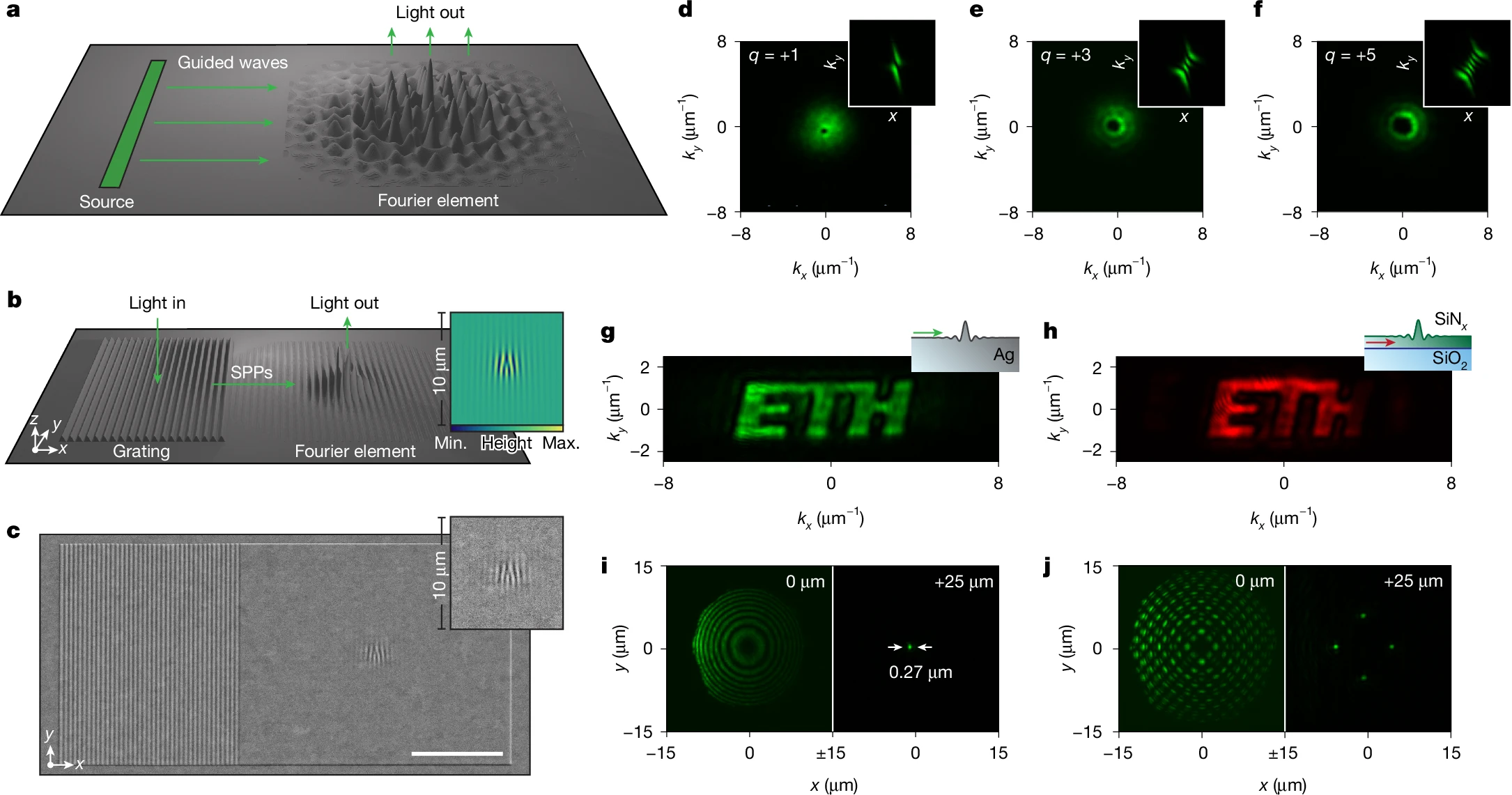
The technology is based on the interference of light waves. When light is scattered by a surface, the waves originating from different points of that surface interact with one another.
If the waves have the same phase, they reinforce each other. If they have opposite phases, they cancel each other out. The researchers used this effect by creating specially shaped, wave-like surfaces that guide light in a controlled way.
The pixel converts incoming light into a surface wave that travels across the chip. At another point within the same pixel, this wave is scattered back out as a light wave, allowing patterns and images to be created through interference.
From light analysis to image creation
Using Fourier analysis, the researchers can calculate how the surface must be shaped in order to produce a specific image.
In the experiment, the researchers created an image of the ETH logo, with the letter E measuring roughly one millimeter on the camera. The image was created using the new Fourier pixels, demonstrating that the technology can be used for controlled generation of light patterns.
The same pixel can also operate in reverse, analyzing incoming light waves in terms of intensity, phase, and polarization.
Potential applications
One of the most interesting prospects is the development of devices that combine a camera and a display into a single system.
In the future, such bidirectional pixels could lead to displays that also record images, new types of sensors, optical communication systems, or more compact imaging devices.
ETH Zurich also notes that the pixels could react to a captured image and produce corresponding light without the use of a computer. In the short term, the more practical goal is to create a matrix of Fourier pixels, which could form the basis for more complex camera-display devices.
The research and patent application
The study was published in Nature on June 24, 2026, under the title Fourier pixels for bidirectional light control.
The technology has already led to a patent application and is in the running for ETH Zurich’s Spark Award, which highlights research innovations with potential commercial or technological impact.
The idea of a pixel that can function both as a recording and display element is particularly important for the future of imaging. This is not a technology we expect to see immediately in commercial cameras, but it points to a possible path toward smarter, thinner, and more multifunctional imaging systems.
Read the research here.
Frequently asked questions
What are Fourier pixels?
They are a new type of pixel that can control and analyze light, allowing both the recording and display of light patterns.
Who developed the new technology?
The technology was developed by researchers at ETH Zurich, led by David Norris.
Can this technology be used in cameras?
In the future, it could be used in hybrid camera-display devices, but for now it remains at the research stage.
What can the new pixel analyze?
It can analyze the intensity, phase, and polarization of incoming light.
When was the research published?
The related study was published in Nature on June 24, 2026.