

Summary
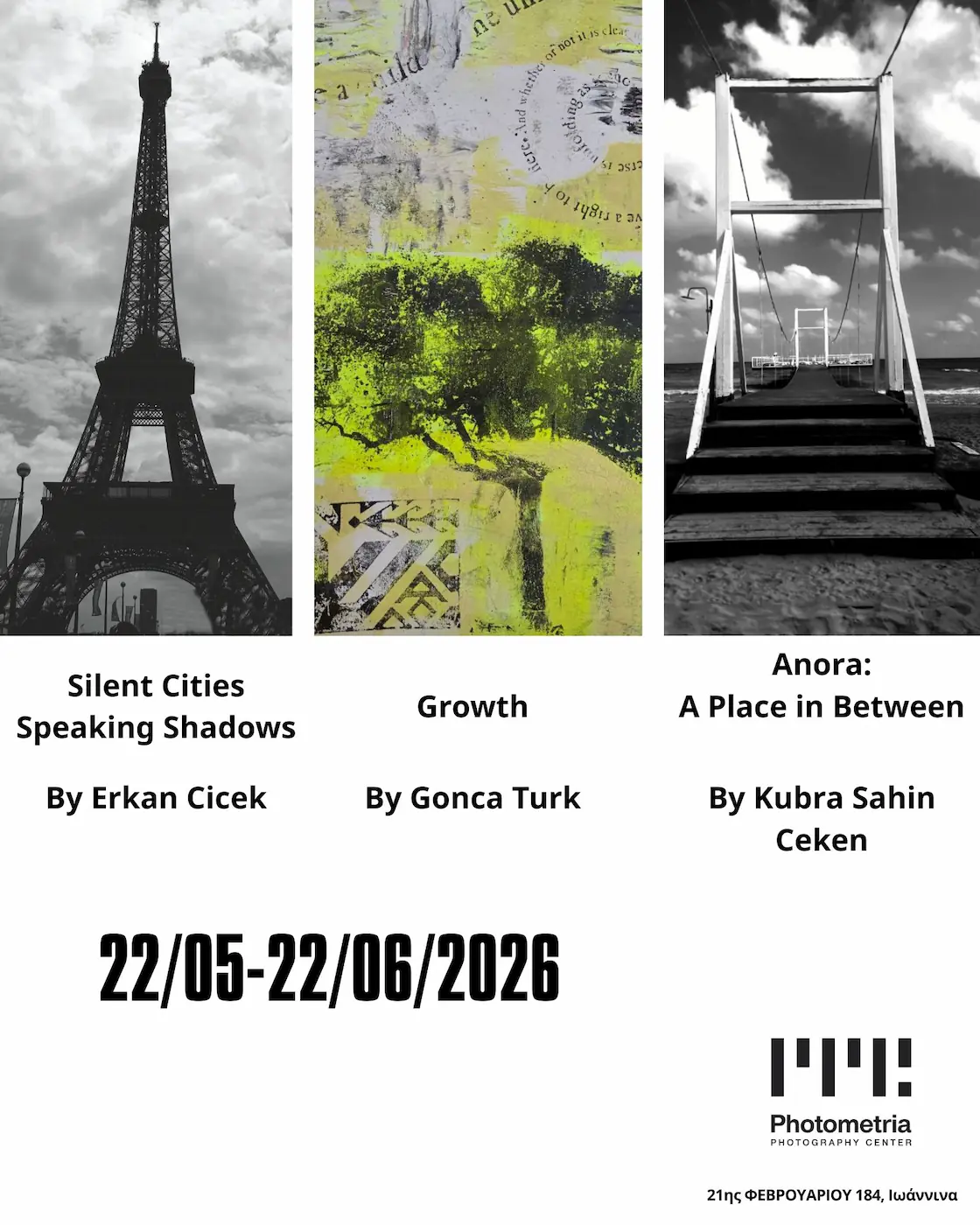
- The exhibition opens on Friday, May 22, 2026 at 20:00.
- It will run until June 22, 2026 at Photometria Photography Center in Ioannina.
- Opening hours are Thursday to Sunday, 17:00 to 21:00.
- Admission for the public is free.
- Erkan Çiçek presents the section Silent Cities, Speaking Shadows.
- Gonca Türk presents the section Growth with monotype works.
- Kübra Şahin Çeken presents the section Anora: A Place In Between with 16 black-and-white photographs.
Event Details
Photometria Photography Center presents a new group exhibition in Ioannina featuring works by Erkan Çiçek, Gonca Türk and Kübra Şahin Çeken.
The exhibition opens on Friday, May 22, 2026, at 20:00 and will run until June 22, 2026, with opening hours from Thursday to Sunday, 17:00 to 21:00. Admission is free. It is hosted at Photometria Photography Center, at 184 21is Fevrouariou Street, Ioannina.
It is an exhibition that brings into dialogue three different artistic approaches: the memory and silence of European cities, the relationship between nature and knowledge through monotype, and the concept of “in-between” space through the image of the staircase. The result is a shared journey around space, experience and human perception.
Silent Cities, Speaking Shadows
In Erkan Çiçek’s section, the city is not treated as a collection of buildings and tourist images, but as a living organism that carries memory, experiences and traces of life. According to the exhibition’s concept, spaces are not inert masses of brick, iron and concrete, but carriers of a language of their own, through which farewells, human passages and the accumulation of time survive.
From the towers of Paris to the Gothic domes of Amsterdam, every architectural structure is approached as part of collective memory. The artist invites the public to look beyond the easy recognizability of cities and to observe the deeper “conversations” that remain inscribed in these spaces. The camera functions not simply as a recording medium, but as a listening tool that attempts to make visible the silent cries and whispers of stone structures in the heart of Europe.
The monochromatic and dramatic tones of the photographs remove the noise of everyday life and chromatic excess, allowing the spaces themselves to gain a clearer voice. Light reveals the space, while shadow gives it depth and mystery. Whether in the lines of the Louvre or in the presence of Manneken Pis in Brussels, the images do not freeze time, but illuminate the ongoing dialogue between past and present. This section is presented as a renewed articulation of these “stone languages,” collected from different regions of Europe and brought back into a new exhibition setting.
Growth
Through the section Growth, Gonca Türk explores the development and expansion of knowledge and science. The central symbol of the works is the tree, which is presented as a form of knowledge that emerges and evolves through written forms. Here, texts do not appear only to be read, but also function as visual elements that actively contribute to shaping the image itself.
The combination of the tree form with textual layers reflects the relationship between nature and knowledge. The tree functions as a living structure, while the texts resemble layers of information accumulating over time. Through this process, the shaping of memory and the construction of meaning in the human mind are brought to the fore.
Particular significance also lies in the choice of printing with a Gelli plate, that is, monotype. This technique is presented as a conscious response to the digital age and the rise of artificial intelligence. In contrast to digital images that can be reproduced endlessly, every work in the series is unique and unrepeatable, the result of physical contact, pressure and the unpredictable interactions of materials.
At the same time, the works engage with a contemporary identity that moves between the natural world and the digital field. The organic forms, textual elements and layered textures reflect this dual condition, while the exhibition ultimately emphasizes the value of uniqueness, embodied experience and ongoing transformation in a world increasingly dependent on repetition and reproduction.
Anora: A Place In Between
Kübra Şahin Çeken presents the section Anora: A Place In Between, which begins with the word “Anora,” a word from the Erzurum dialect meaning “exactly here.” This concept does not describe a fully defined location, but rather a state of orientation, transition and existence at the threshold. Within this framework, the exhibition reexamines the ambiguous concept of space, using the staircase as its central image.
The staircase is presented not only as an architectural element, but as a condition of the “in-between.” It belongs neither to the beginning nor to the end, but functions as a continuation between two points. For this reason, it is not treated as a static space, but as a carrier of temporal and experiential flow.
The 16 black-and-white photographs of the exhibition intensify this experience of transition through a distinct visual language. The removal of color sharpens the tension between light and shadow and, rather than stabilizing orientation, disrupts it. The hierarchy between up and down becomes ambiguous, and the viewer is led not to a clear spatial resolution, but to an experience of perceptual indeterminacy.
In this logic, “Anora” is not proposed as a destination, but as a condition that cannot be fully defined, only experienced. The exhibition invites the viewer into a process of meaning-making that resists certainty and remains open, like a continuous suspension. In this way, space is presented not as a goal, but as a process, keeping the viewer exactly within the condition of “exactly here.”
What we think
The new group exhibition at Photometria Photography Center is not based on a single narrowly defined theme, but on three different approaches that meaningfully engage with one another. The interest lies precisely in the fact that photography and monotype are used here not only to describe spaces, forms and materials, but to open up a discussion about memory, knowledge, transition and the way people experience the world around them.