

Summary
- A new research team developed a system that recreates animal vision.
- The technology works with moving images as well as photos.
- It captures data in both visible and ultraviolet light.
- The setup relies largely on commercially available hardware.
- Potential applications include science and nature documentaries.
A new research technology brings humans closer to seeing the world the way different animal species perceive it.
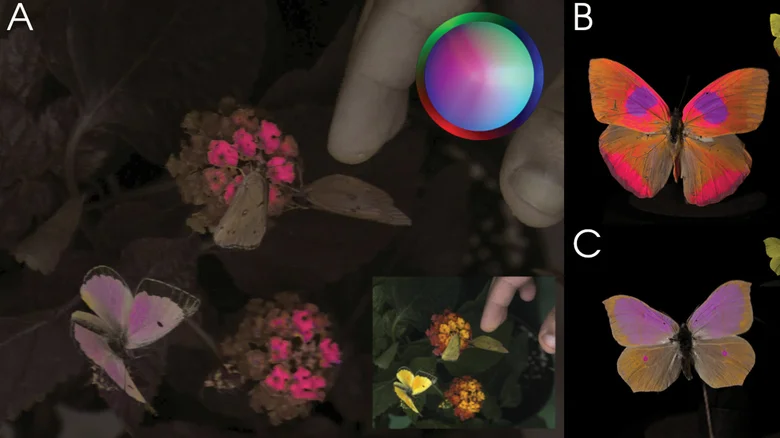
Researchers have developed a camera system capable of recreating the visual experience of animals with greater accuracy, producing videos that simulate how they perceive their surroundings.
The development is considered important because previous attempts to recreate animal vision were largely limited to still images and required highly controlled lighting conditions. The new approach opens the door to more realistic studies of animal behavior and perception.
Why animals see differently from humans
Human vision relies on specific photoreceptors, rods and cones, which allow us to perceive a limited portion of the electromagnetic spectrum known as visible light.
Many animals possess different combinations of photoreceptors. Some species have more than humans, while others have fewer. As a result, they perceive colors, contrasts and visual information in very different ways.
There are also animals that can see beyond the limits of human vision, including in the ultraviolet range of the spectrum, such as reindeer and certain spider species.
The researchers’ new approach
The research team, led by scientists from George Mason University in collaboration with universities and research institutions in the United States and the United Kingdom, developed a system capable of recording moving images and converting them according to the visual capabilities of different animals.
The method is not limited to colors alone. It also takes into account motion, lighting conditions, object reflectance and the photoreceptor sensitivity of each species.
This creates a result that more closely approximates the actual experience of an animal in its natural environment.
How the system works
Despite its advanced capabilities, the system relies on relatively simple equipment. Researchers used commercially available Sony a6400 cameras, a specialized EL-Nikkor lens and 3D-printed components.
An optical setup separates ultraviolet radiation from visible light and directs the information to different cameras. This allows data from the ultraviolet spectrum and the main visible color channels to be captured simultaneously.
The collected data is then matched against the known visual sensitivities of various species to create a simulation of how they are likely to perceive their environment.
Where it could be used
The ability to recreate the vision of different species could provide valuable new tools for biology, ecology and animal behavior research.
At the same time, the technology could find applications in filmmaking, nature documentaries and science education, enabling more accurate depictions of how animals experience the world.
What we think
The new method is an impressive example of how imaging technology and computational processing can help science approach questions that were once considered nearly impossible to answer. If the results continue to prove reliable, we may be closer than ever to understanding how other species truly perceive the world.