

Summary
- The series consists of the Laowa Aksen 45mm 1–5x and 17.5mm 5–10x
- The parfocal design maintains focus as magnification changes
- The lenses offer fixed working distances and an internal mechanism
- They are available in photo and cinema versions for multiple mounts
- Base pricing starts at $749 for the photo versions
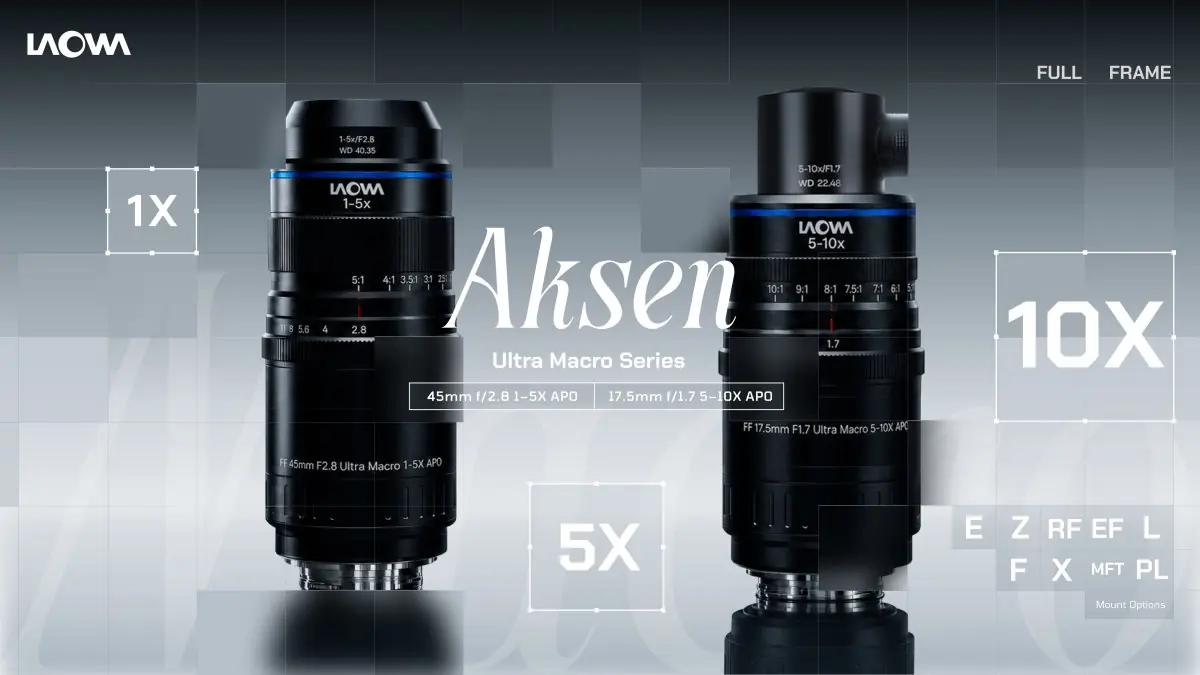
Venus Optics has introduced the Laowa Aksen Ultra Macro series, comprising two full-frame parfocal lenses with a combined magnification range from 1x to 10x.
The new series consists of the Laowa Aksen 45mm f/2.8 1–5x Ultra Macro APO and the Laowa Aksen 17.5mm f/1.7 5–10x Ultra Macro APO, with the latter described by the company as the first commercially available ultra macro lens to continuously cover the 5x to 10x range.
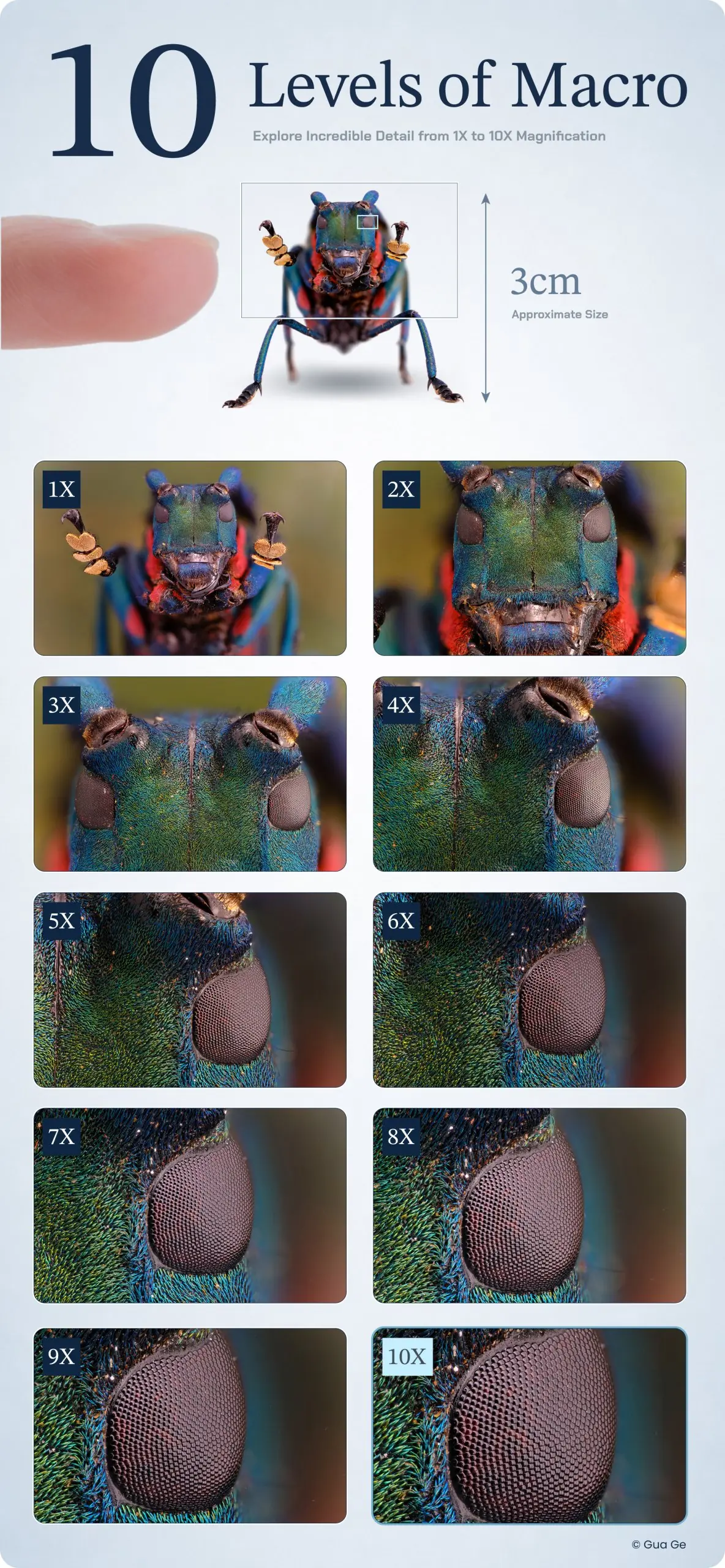
The significance of the announcement is not limited to the high magnification. Thanks to their parfocal design and internal magnification mechanism, creators can change the scale of their subject without having to constantly readjust focus, camera position, or lighting.
Two lenses covering 1x to 10x
The Aksen 45mm f/2.8 covers magnifications from 1x to 5x, while the Aksen 17.5mm f/1.7 handles the more extreme 5x to 10x range. Together, they form a system capable of moving from a conventional 1:1 macro reproduction ratio to details approaching microscopic imaging scales.
Both lenses are designed to cover full-frame sensors and use manual focusing, which is expected for such a specialised extreme-magnification system.
Why the parfocal design matters
With many high-magnification lenses, changing the reproduction ratio affects focus, subject distance, and often the entire shooting arrangement. The Aksen lenses are designed to maintain focus as magnification changes, reducing the need for repeated adjustments.
The 45mm maintains a working distance of 40.35 millimetres throughout its 1–5x range, while the 17.5mm operates at a fixed working distance of 22.48 millimetres between 5x and 10x. At the same time, the internal mechanism keeps the external length of the lens unchanged.
This is particularly useful in controlled setups, where even a small movement can affect the composition, light diffusion, or the safety of a fragile subject.
Optical construction of the Laowa Aksen 45mm f/2.8
The Laowa Aksen 45mm f/2.8 1–5x Ultra Macro APO uses 13 optical elements arranged in 9 groups. Its 11-blade diaphragm can be adjusted from f/2.8 to f/11.
The front filter diameter is 56 millimetres, while the PL-mount version also supports 37-millimetre rear filters. The lens measures 70.2 x 121 millimetres and weighs 599 grams.
Optical construction of the Laowa Aksen 17.5mm f/1.7
The Laowa Aksen 17.5mm f/1.7 5–10x Ultra Macro APO consists of 17 elements in 12 groups. It also features an 11-blade diaphragm, with an aperture range from f/1.7 to f/5.6.
The lens has a front diameter of 42 millimetres and does not accept rear filters. It measures 70.2 x 127.5 millimetres and weighs 570 grams.
The APO optical design of both models is intended to reduce chromatic aberration and coloured fringing, issues that become increasingly visible as magnification rises. Their actual optical performance will, however, need to be assessed through independent testing.
An integrated coaxial lighting solution
The Aksen 17.5mm 5–10x features an integrated coaxial optical system, a solution more commonly associated with machine-vision applications. It allows light to be directed towards the subject along the optical axis of the lens.
According to Laowa, this configuration can improve edge contrast and provide more even illumination with fewer shadows. An 8-millimetre coaxial light adapter is included with the 5–10x lens.
Support, mounts, and versions
Both lenses include a dedicated support collar compatible with Arca-Swiss tripod heads. They also come with 15-millimetre rods for mounting additional accessories and support systems.
The series is offered for Arri PL, Sony E, Nikon Z, Canon RF, Leica L, Canon EF, Fujifilm X, and Micro Four Thirds. Separate versions are available for photographic and cinema use.
The base price of each photo version is $749, while the cinema versions cost $1,499. Versions that include an additional coaxial lighting system may carry a higher price.
Find more here.
Frequently asked questions
What does 10x magnification mean?
At 10x magnification, the image projected onto the sensor is ten times larger than the subject’s real dimensions. This enables the recording of extremely small structures but requires great precision in focusing, lighting, and stabilisation.
What does parfocal mean?
A parfocal lens maintains its focus plane when magnification or zoom changes. With the Aksen lenses, creators can alter the macro reproduction ratio without having to refocus after every adjustment.
Can the two lenses cover the entire 1x to 10x range?
Yes. The 45mm covers 1–5x, while the 17.5mm covers 5–10x, providing continuous combined coverage from 1x to 10x.
Who are the Laowa Aksen lenses intended for?
They are specialised lenses for creators working in extreme macro photography and video, scientific documentation, small-product imaging, minerals, insects, electronic components, and other subjects with very small dimensions.
What we think
The fixed working distance and parfocal operation address two of the most important practical challenges in extreme macro imaging. The Laowa Aksen lenses remain highly specialised tools and are not intended for the average photographer, but their continuous coverage from 1x to 10x could considerably simplify demanding photographic, cinematic, and scientific applications.