


Summary
- Cameras were attached to whale sharks at Ningaloo Reef in Western Australia.
- Researchers analyzed 22 hours and 27 minutes of footage from five animals.
- The study documented 36 behaviors, including six previously unknown feeding behaviors.
- Whale sharks feed from the surface to the seabed and adjust their effort according to prey density.
- The findings could support future conservation and management measures for the species.
- Cameras attached to the dorsal fin
- The most comprehensive catalog of whale shark behavior
- Feeding from the surface to the seabed
- From continuous filtering to active pursuit
- How whale sharks clear their filtering structures
- Limitations of the recordings
- Why the findings matter for conservation
- What we think
- Frequently asked questions
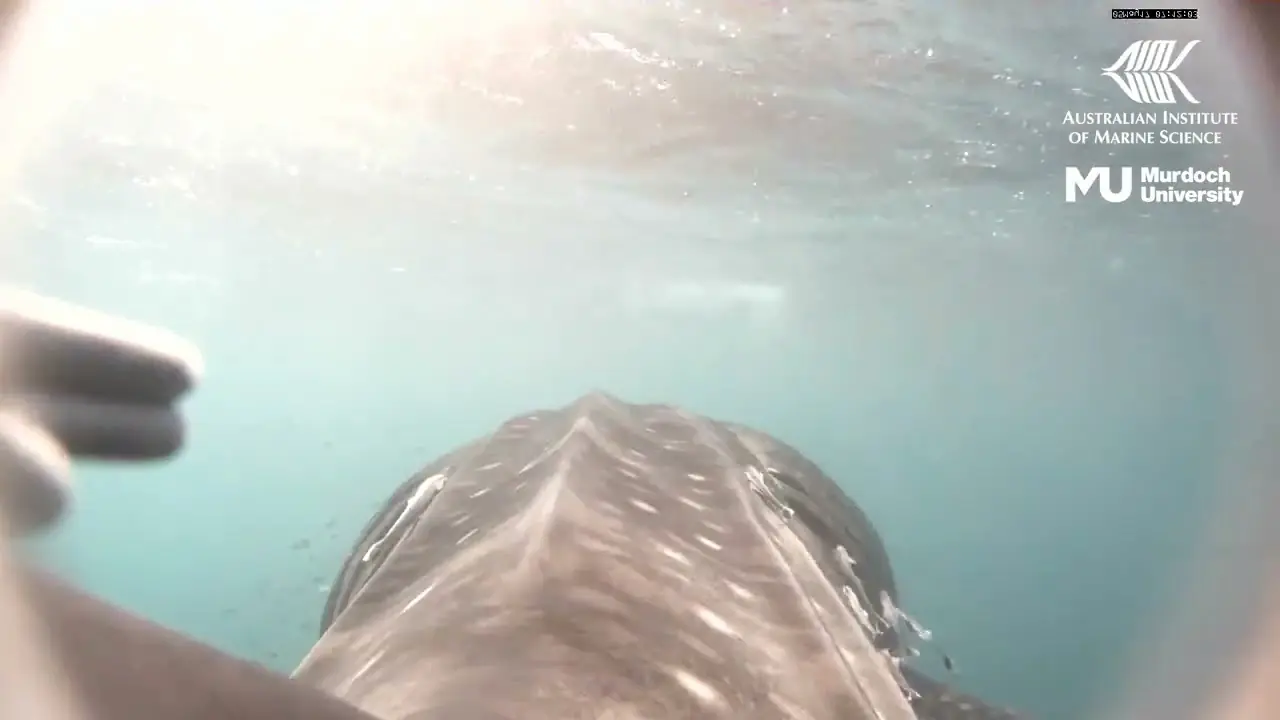
Cameras attached to whale sharks recorded the ocean from their perspective and revealed feeding behaviors that had never previously been documented.
Researchers fitted whale sharks at Ningaloo Reef in Western Australia with specialized cameras and sensors, recording their movements from the surface to the seabed. The footage provides a rare view into the daily life of the world’s largest known fish at times when no divers or research boats were directly beside it.
The research is particularly important because most previous knowledge about whale shark behavior came from observations made near the surface. The new recordings show that the species uses a much broader and more flexible range of feeding strategies than scientists could identify from boats, divers, or aerial surveys.
Cameras attached to the dorsal fin
The fieldwork was conducted in May 2017 and 2018. Researchers deployed CATS Cam systems on ten whale sharks using a minimally invasive clamp attached to the leading edge of the dorsal fin.
Each package included a high-definition camera, a VHF transmitter, GPS equipment, and sensors that recorded depth and movement. The devices were designed to detach after approximately 24 to 48 hours and float to the surface for recovery.
Technical problems, detached tags, and material accumulating in front of some camera lenses meant that data from five animals, two females and three males, were used in the final analysis. The usable footage totaled 22 hours and 27 minutes.
The most comprehensive catalog of whale shark behavior
The researchers combined the new footage with information from 106 scientific publications to create a detailed ethogram, a systematic catalog of whale shark behaviors.
The catalog contains 36 distinct behaviors. Twelve are associated with feeding, while six previously unknown feeding behaviors were documented through the animal-borne cameras. The footage also recorded different forms of locomotion, reactions to other whale sharks, and behaviors associated with the presence of humans or vessels.
Feeding from the surface to the seabed
The cameras recorded whale sharks at depths ranging from approximately one meter to 68.8 meters. The animals did not restrict their feeding to the surface but continued to forage while descending, within the water column, near the seabed, and while returning toward the surface.
The newly described behaviors include slow feeding while gliding into deeper water, feeding during ascent, slow feeding within the water column, and movement with the gills open near the seabed.
In some cases, whale sharks continued filtering water throughout an entire descent or ascent. Slow feeding was the most frequently observed strategy, requiring relatively little energy and potentially allowing the animals to collect food even when prey density is low.
From continuous filtering to active pursuit
The data indicate that whale sharks adjust their behavior according to the amount of available food. In areas with low prey density, they move slowly and filter water continuously, collecting small quantities of food at a relatively low energetic cost.
When they encounter denser concentrations, such as krill swarms or schools of small fish, they can switch to more active movements, sharper changes of direction, and faster feeding.
Their ability to alternate between ram filtration and suction allows the species to exploit both widely dispersed prey and brief periods of high food abundance. This flexibility may help explain how such a large animal survives in relatively nutrient-poor tropical waters.
How whale sharks clear their filtering structures
The footage also recorded events in which whale sharks briefly closed their gill slits, shook their heads and bodies vigorously, and then expelled a cloud of particles.
The researchers believe this movement may clear the filtering structures around the gills, where food or other material can accumulate. The process may create a reverse flow of water that dislodges trapped particles.
The composition of the expelled clouds could not be determined from the footage, so the exact function of the mechanism requires further study.
Limitations of the recordings
Although the cameras provided an unprecedented perspective, they could not directly record the animals’ mouths because they were positioned behind the head on the dorsal fin. The researchers mainly used the opening of the gill slits as an indication that water and prey were passing through the filtering system.
The prey itself was not always visible because of video quality, limited underwater visibility, and the swimming speed of the sharks. The data also came from only five animals at a coastal aggregation site and did not include possible behaviors in the open ocean.
The ethogram is therefore an important but not definitive framework and can be expanded through future recordings involving different locations and populations.
Why the findings matter for conservation
The systematic classification of these behaviors could allow scientists to compare data from different locations, age groups, and animal sizes. It may also help them assess how whale sharks respond to tourism, vessels, and other human activities.
Distinguishing between feeding near the surface and feeding at greater depths is particularly useful when estimating the risk of vessel collisions or disturbance caused by tourism operations.
What we think
Attaching cameras to the animals themselves is proving to be a powerful method for recording behaviors that remain invisible from the surface. The study provides a valuable foundation for whale shark research and conservation, although the small sample and the indirect identification of some feeding behaviors require caution before the findings are generalized.
Frequently asked questions
Is the whale shark a whale or a shark?
It is a shark and is considered the world’s largest known fish species. Its name comes from its large size and its filter-feeding method, both of which resemble characteristics associated with some whales.
How were the cameras attached to the animals?
The devices were fixed to the leading edge of the dorsal fin with a minimally invasive clamp. They were designed to detach automatically after 24 to 48 hours and float to the surface for recovery.
How many new behaviors were documented?
The study created a catalog of 36 behaviors, 12 of which are associated with feeding. Six previously unknown feeding behaviors were identified through the animal-borne cameras.
Why is slow feeding important?
It allows whale sharks to collect small amounts of food with a relatively low energetic cost, even in tropical waters where prey is widely dispersed.