

Summary
- Researchers documented two cases of American Black Vultures nesting only one to two metres from other raptors.
- In La Pampa, a vulture visited a Chaco Eagle nest and the egg was later missing, although the cause was not established.
- In Santa Fe, vultures and American Barn Owls successfully raised young in adjacent tanks inside a ruined house.
- The study shows how abandoned human structures can become crucial and complex nesting sites.
Two abandoned structures in Argentina became unexpected wildlife “apartment blocks,” with vultures nesting within metres of eagles and owls.
The study Uneasy Neighbors?, published on 27 July 2026 in the Journal of Raptor Research, describes the first documented cases of American Black Vultures (Coragyps atratus) nesting only one to two metres from other raptors: a Chaco Eagle (Buteogallus coronatus) and American Barn Owls (Tyto furcata). The observations came from different provinces and years, with trail cameras revealing part of the behaviour.
The finding matters because suitable nest sites may be limited and neighbouring species can simultaneously act as competitors, threats or merely tolerated neighbours. The two cases ended very differently: both nesting attempts failed in the first, while vultures and owls successfully raised young in the second.
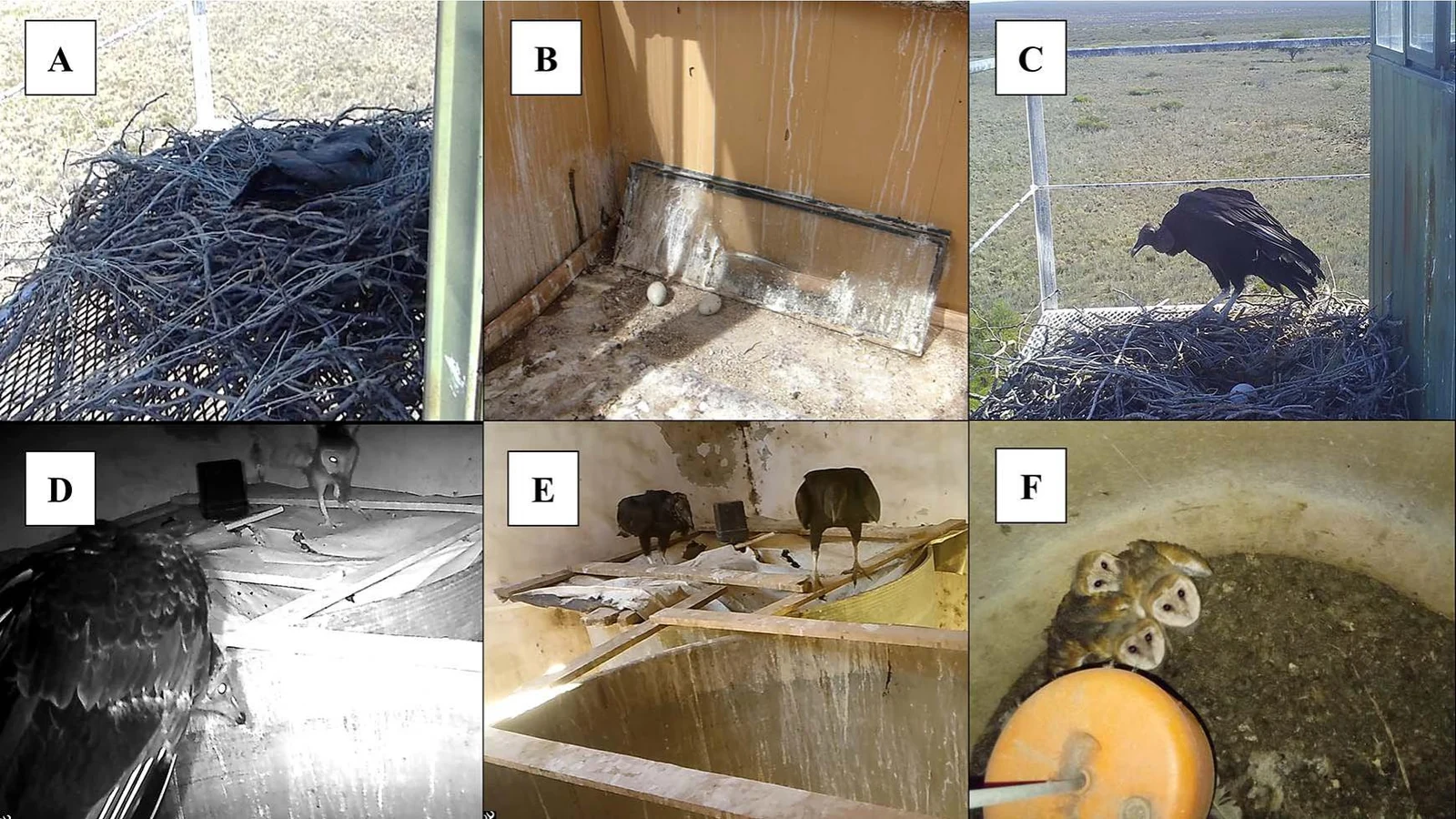
The two neighbouring-nest cases documented in Argentina. Photos: DGG, MC and JHS. Credit: Journal of Raptor Research, CC BY-NC-ND 4.0.
The first “apartment block” in a hunting tower
The first record came from La Pampa in October 2019. The structure was an abandoned hunting tower about 25 metres high with a small cabin and an outside terrace. One section held a Chaco Eagle pair with one egg, while a pair of Black Vultures had two eggs in a nearby spot.
On 22 October, a trail camera recorded a vulture at the eagle nest while the adult eagle was absent. At a later check, the eagle egg was no longer there. The sequence raises a reasonable suspicion, but the researchers stress that there is no image proving that the vulture removed or destroyed the egg.
The vulture nest also failed. Even so, Black Vultures continued using the same abandoned structure as a nesting site through 2023, showing that the tower remained a valuable resource after an unsuccessful breeding season.
Half a metre apart, with two successful families
The second case was found in late 2024 and early 2025 in northern Santa Fe. A ruined house contained two open water tanks about half a metre apart. Black Vultures occupied one and American Barn Owls the other.
Coexistence unfolded differently here. The vulture fledgling successfully left its nest on 6 January, while researchers recorded owl nestlings and adults delivering food. Despite the physical proximity and different ecology of the two species, no event leading to nesting failure was observed.
Why abandoned structures are so attractive
Black Vultures do not build the familiar large stick nest. They seek sheltered spaces in cavities, caves, hollow trees, ruins and artificial structures. Barn owls also use attics, sheds, towers and tanks, while Chaco Eagles may use high structures when they provide a secure site.
In landscapes where large trees and natural cavities are scarce, an abandoned human structure can concentrate several species in the same small area. That increases the chance of interaction but does not inevitably cause conflict. Food availability, breeding stage, direct lines of sight and the exact layout can all change the outcome.
What the cameras prove — and what they do not
The first camera shows a vulture present at the eagle nest, not what happened to the egg. That distinction is crucial: a sequence of events is not proof of predation. The egg could have disappeared for more than one reason, and the study avoids claiming certainty where the recording is absent.
Likewise, success in Santa Fe does not mean the two species cooperated or that such close coexistence is always safe. It does show that physical distance alone does not predict the result. Broader conclusions require more sites, longer monitoring and systematic records of interactions.
Who conducted the study
The paper is by Diego Gallego-García, Maximiliano Churruarin, Sergi Gómez-Espí, José Hernán Sarasola and Bracken M. Brown. It appears in volume 61, issue 1 of the Journal of Raptor Research, pages 1–4, under DOI 10.3356/jrr26066.
What we think
The most interesting aspect of the study is its resistance to a simple story of “conflict” or “friendship.” Similar distances produced different outcomes, and the cameras provided strong clues without solving every mystery. The researchers’ careful language is as important as the unusual sight of neighbouring nests.
Frequently asked questions
How close were the nests?
In the two cases, nests were roughly one to two metres apart, while the two Santa Fe tanks were separated by about half a metre.
Did the vultures destroy the eagle egg?
That has not been proven. A camera recorded a vulture at the nest while the eagle was absent and the egg was missing later, but its disappearance was not recorded.
Why do the birds use human structures?
Abandoned structures can offer height, shade, protection and cavities, especially where natural nesting sites are scarce.
Was coexistence successful?
Both nests failed in La Pampa. In Santa Fe, both vultures and barn owls successfully raised young.