

Summary
- National Geographic followed Kio from a tiny cub through adulthood
- The production lasted four years and nearly 1,400 filming days across 52 shoots
- Sophie Darlington served as Series Director of Photography
- Local Kenyan filmmakers played a major creative role in the production
- Anthony Njuguna used a DJI Inspire and low aerial movements to create more cinematic imagery
- Cameras were mounted low on vehicles to bring the visual perspective closer to the lion's eye level
- Hans Zimmer leads the score alongside Bleeding Fingers Music Group
- The series premieres today, August 19, on National Geographic
- Four years with the same lion
- The story could not be directed
- Sophie Darlington leads the cinematography
- Kenyan filmmakers were a creative part of the production
- Anthony Njuguna: a drone shot does not have to look like a drone shot
- Distance from the animals was part of the visual strategy
- Cameras at Kio’s eye level
- Keeping four years of footage visually consistent
- Hans Zimmer scores a real-life Lion King
- Jon Favreau and Mike Gunton
- A conservation dimension
- When to watch
- What we think
- Frequently Asked Questions
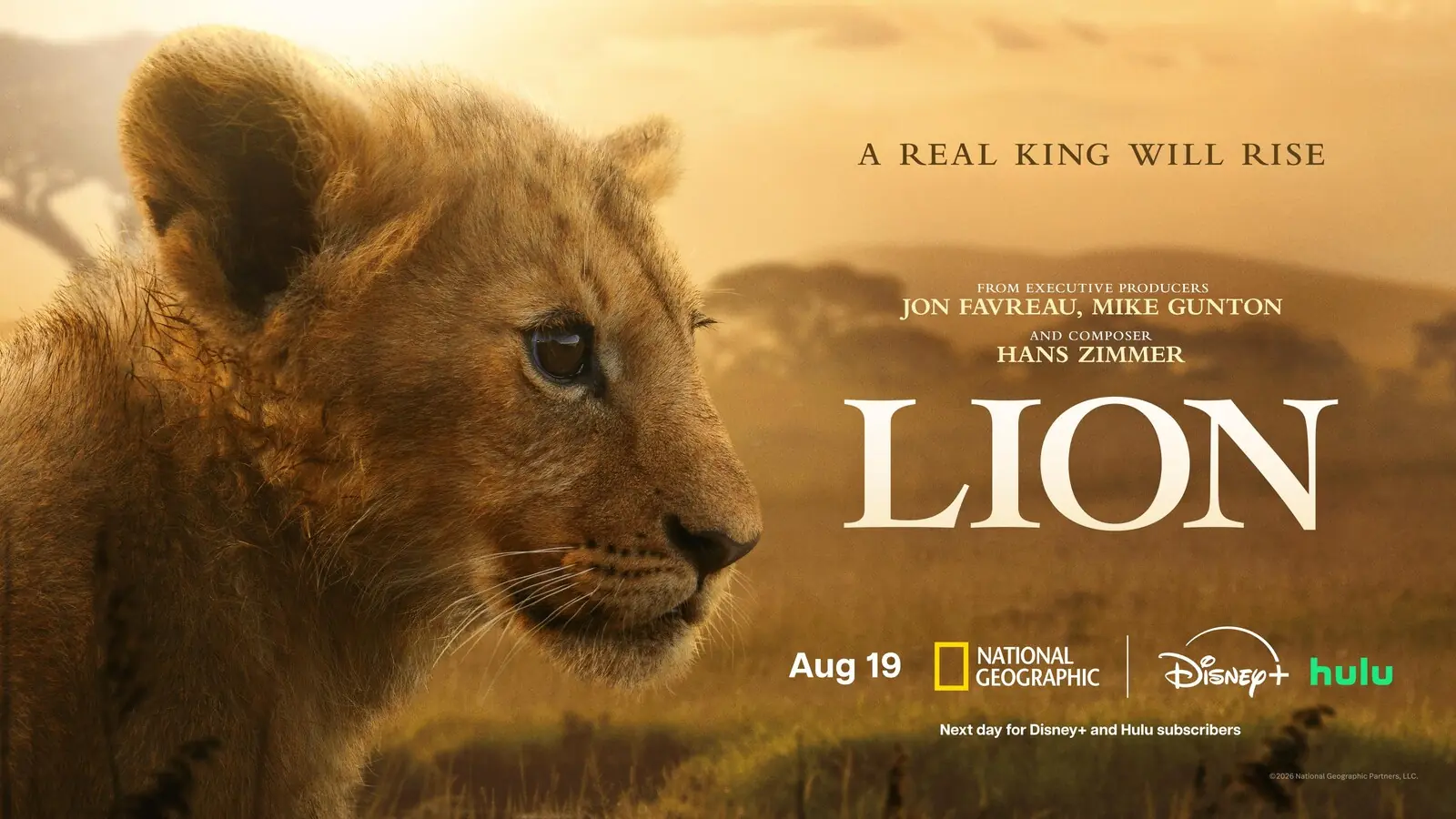
National Geographic followed Kio from a tiny lion cub into adulthood for four years, logging nearly 1,400 filming days across 52 shoots for its new series LION, which premieres today, August 19.
The four-part series premieres today on National Geographic and, according to the official announcement, is the first natural-history production to document a lion’s complete journey from vulnerable cub to adulthood and his attempt to become a leader.
For photographers and filmmakers, the most interesting element may be how that story was captured. The production combined long-lens cinematography, drones, cameras mounted extremely low on vehicles and a crew with significant Kenyan creative involvement to bring the viewpoint as close as possible to the animals’ own world.
Four years with the same lion
Kio became the centre of a story the filmmakers could not script in advance.
The crew began following him when he was still a tiny cub in Kenya’s Maasai Mara and continued over four consecutive years, recording pride relationships, loss, conflict, dry seasons and eventually his transition into adulthood.
The team completed 52 shoots and logged nearly 1,400 days in the field, which National Geographic describes as the most field time ever devoted exclusively to following a single lion pride in a production of this kind.
The story could not be directed
The filmmakers never knew what the lions would do next.
Kio’s story effectively developed in front of the cameras, leaving the team with the enormous task of shaping years of real events into four episodes without losing their natural chronology.
There are no second takes in wildlife filmmaking, and no animal can be asked to repeat an action.
The production even extended its filming period in the hope of capturing the final stage of Kio’s journey before new cubs eventually appeared and provided the story with the ending the team had hoped nature might deliver.
Sophie Darlington leads the cinematography
The series’ Director of Photography is veteran wildlife cinematographer Sophie Darlington.
Her official filmography lists LION as a four-part National Geographic/Disney+ and BBC Studios production with Darlington serving as Series Director of Photography.
Darlington has more than three decades of experience and has worked on productions including Planet Earth II, Dynasties, Our Planet and African Cats.
Website:
https://sophiedarlington.com/
Instagram:
https://www.instagram.com/sophiedarlingtondop/
Kenyan filmmakers were a creative part of the production
The production placed significant emphasis on Kenyan filmmakers working as part of the creative team rather than simply supporting an outside unit.
Producer and director Faith Musembi is among the Kenyan talent involved.
Her own portfolio also lists LION among her 2026 credits.
Website:
https://www.faithmusembi.com/
Anthony Njuguna: a drone shot does not have to look like a drone shot
Aerial cinematographer Anthony Njuguna took a particularly interesting approach to the series.
He used a DJI Inspire not only for conventional aerial perspectives but also very low to the ground, producing shots viewers may not immediately recognise as drone footage.
He frequently used a 50mm lens on a Super35 sensor, giving him enough working distance to avoid unnecessarily approaching the lions while still creating compressed, cinematic imagery.
Distance from the animals was part of the visual strategy
The longer working distance was not only an aesthetic decision.
It helped the crew avoid disturbing the lions’ natural behaviour.
The production’s goal was to allow the animals to largely ignore the filmmakers. If the crew changes an animal’s behaviour, it is no longer documenting the life it came to record.
Cameras at Kio’s eye level
The production also used cameras mounted low on the sides of vehicles.
This allowed the visual perspective to move closer to Kio’s world instead of constantly observing him from the elevated position of a safari vehicle.
That changes the scale of the landscape, the height of the grass and the relationship between Kio and the other animals around him.
The technology therefore becomes a storytelling tool rather than simply a source of unusual angles.
Keeping four years of footage visually consistent
A production lasting this long also creates a major continuity problem.
Multiple cinematographers need to deliver images that can eventually coexist inside one coherent series.
The filmmakers shared footage and worked together to maintain consistency rather than operating as isolated camera units.
Hans Zimmer scores a real-life Lion King
The connection to The Lion King extends beyond Jon Favreau.
Hans Zimmer leads the score alongside Bleeding Fingers Music Group composers Niccolò Pacella and George Hutson Warren.
The soundtrack incorporates recordings made in the Maasai Mara, local singers and instruments, actual lion roars and the Nairobi Chamber Chorus.
Jon Favreau and Mike Gunton
LION is executive produced by Jon Favreau and Mike Gunton of BBC Studios Natural History Unit.
Favreau directed the 2019 version of The Lion King, while Gunton is associated with major modern natural-history productions.
A conservation dimension
The series is accompanied by Disney’s continuing Protect the Pride campaign.
Disney says it has invested more than $5 million in the Lion Recovery Fund since 2019, whose network has supported more than 400 conservation projects across 26 countries.
When to watch
LION consists of four episodes.
It premieres today, August 19, 2026, on National Geographic and becomes available tomorrow, August 20, on Disney+ and Hulu.
What we think
Nearly 1,400 days of filming is an extraordinary statistic, but the number alone is not what makes LION interesting.
What matters is what such sustained observation makes possible.
The production did not need to construct a story from unrelated spectacular wildlife moments. It had time to wait for genuine relationships, changes, failures and shifts within the pride to emerge.
The cinematography also offers an important lesson for wildlife creators: some of the most advanced technology was used not to get closer to the animals, but to create stronger images while remaining farther away and reducing interference.
The most powerful wildlife image often appears when the filmmaker succeeds in disappearing from the scene.
Frequently Asked Questions
How long did LION take to film?
The crew followed Kio and his pride for four years, completing 52 shoots and nearly 1,400 filming days.
Who is the Director of Photography?
Sophie Darlington served as Series Director of Photography.
Which drone was used?
Aerial cinematographer Anthony Njuguna used a DJI Inspire, including a 50mm lens on a Super35 sensor for more distant and cinematic perspectives.
Who composed the score?
Hans Zimmer leads the score with Niccolò Pacella and George Hutson Warren of Bleeding Fingers Music Group.
When does LION premiere?
LION premieres today, August 19, 2026, on National Geographic and streams tomorrow, August 20, on Disney+ and Hulu.